Two young delegates from Africa visit a photovoltaic power generation park in the Talatan Gobi Desert, Northwest China's Qinghai Province, on September 12, 2025. Photo: IC
Editor's Note:As 2026 marks the Year of China-Africa People-to-People Exchanges, friendship between the people forms the vital cornerstone of China-Africa ties, and the cultural and people-to-people exchanges serve as the enduring engine of intergenerational friendship between China and Africa.
The Global Times, in collaboration with South Africa's Independent Media, has launched a series titled "Global South Dialogue." We have invited Chinese and African experts and scholars to engage in in-depth discussions on a wide range of topics related to China-Africa relations and their international context. The sixth installment of the series features discussions on the theme of "jointly promoting youth development and building a future-oriented China-Africa talent ecosystem."
Africa's youth surge: a strategic asset yet to be unleashed
Augustin F. C. Holl (distinguished professor emeritus at Xiamen University): Relying on UN data, in January this year, the African population is nearing 15.7 billion. There are, however, significant regional variations in population distribution and growth rate. Central Africa has the fastest-growing population. East Africa is the largest population block. It is the age composition that sets the current African population in a special category, with 60 percent of the population in Africa being under 25 and the population of young people aged 15-24 in Africa projected to reach 500 million in 2080.
Mammo Muchie (professor at South Africa's Tshwane University of Technology): Africa is witnessing a demographic momentum which presents a once-in-a-generation opportunity to harness a demographic dividend. A demographic dividend is the potential for faster economic growth when a country's working-age population grows larger relative to its dependent population of children and elderly people. It enables the country to take advantage of the opportunities and respond to the new challenges that demographic transition brings.
The problem is that Africa's demographic dividend faces many obstacles: slow fertility decline, inadequate job creation, especially in manufacturing, poor education and skills mismatch and so on. Without addressing these challenges, Africa's youth bulge risks becoming a demographic burden rather than a dividend.
Paul Frimpong (executive director of Ghana-based think tank Africa-China Centre for Policy and Advisory): Today, Africa is the world's youngest continent, home to a rapidly expanding population of young people whose energy, creativity and ambition will shape the global development in the decades ahead. This demographic reality presents both opportunity and urgency.
Many young Africans work, often intensely, but in low-productivity and informal activities. This reflects that the economies are still transitioning toward higher value-added production, rather than a lack of effort or aspiration.
The real question, therefore, is not how many young people Africa has, but whether the right systems exist to translate youth potential into productivity, innovation and leadership. Demography alone does not create development, but strategy does. This is where China-Africa cooperation becomes especially relevant. With its experience in large-scale skills development, industrial transformation and long-term planning, China is uniquely positioned to partner with Africa in turning a youthful population into a powerful engine of shared growth and modernization.
Africa can draw valuable lessons from China in youth development
Mammo Muchie: Africa can draw lessons from the development, modernization and demographic dividend strategies for youth development followed by China. The China youth development strategy is guided by the Middle- and Long-term Youth Development Plan (2016-25). The focus of the plan is on comprehensive and inclusive growth in education, health, job creation, employment, and social integration and solidarity by addressing youth unemployment and urban-rural disparities.
Africa can learn from China's experience to link economic development with demographic shifts, focusing on massive investments in Africa to proactively design policies that align economic development with education, health, promoting family planning, fostering labor-intensive industrialization, diversifying economies and building infrastructure to transform its youth bulge from a potential burden into a significant demographic dividend for sustainable growth.
Wang Jinjie (research assistant professor at the National School of Development and the Institute of South-South Cooperation and Development at Peking University): China's experience is often summarized as turning demographic changes into productivity growth through a synchronized package: demography plus reform plus employment absorption.
A declining dependency ratio created a favorable age structure, but dividend capture depended on reforms that enables labor reallocation and mass job creation. The World Bank notes that China "succeeded in capturing the demographic dividend," with estimates attributing a meaningful share of growth to demographic structure changes. Large-scale basic education expansion, skills formation and public health improvements were paired with infrastructure and industrial capacity building, so workers could actually be absorbed into productive sectors.
Augustin F. C. Holl: Job creation and entrepreneurship in all activity sectors are an absolute necessity. The whole continent provides a large and open market and substantial space to maneuver. Africa needs infrastructure, roads, railways, ports, a power grid and local transformation of raw materials to export value-added goods. Regulation will have to be simplified, and people's well-being must be at the core of the new economic policy for Africa.
If we really want the youth to contribute to the future prosperity of a continent, they have to be given space.
Why is China-Africa cooperation important?
Paul Frimpong: China-Africa cooperation is particularly relevant at this stage of Africa's demographic transition because it sits at the intersection of youth, industrialization and long-term development planning. Unlike partnerships focused narrowly on aid or short-term interventions, China-Africa cooperation has consistently engaged with productive sectors.
Chinese-supported industrial parks and special economic zones have created environments where skills training is linked directly to production. In countries such as Ethiopia and Egypt, light manufacturing in textiles, apparel and building materials has generated entry-level industrial jobs, enabling young workers to transition from vocational training into factory employment. Cooperation is also expanding beyond traditional manufacturing.
China-Africa cooperation can reinforce these pathways by linking youth programs to industrial corridors, logistics hubs and cross-border infrastructure. When youth are embedded in these systems, cooperation becomes not a social add-on, but a core pillar of economic transformation.
Wang Jinjie: My research on industrial parks and firms highlights a practical entry point: linking enterprises with local education/training institutions to relieve skilled-labor bottlenecks and convert investment into local capability.
For example: Co-developed technical and vocational education and training plus apprenticeship systems embedded in industrial parks and anchor firms (curricula, instructor training, jointly run training centers, portable certification). Job-quality upgrading, not only job counts (progression ladders from entry jobs to skilled technician/supervisor roles). Entrepreneurship plus supplier upgrading (youth-led SMEs plugged into procurement and maintenance contracts).
The most durable complementarity between China and Africa comes not only from trade and infrastructure, but also from investment in capability and productivity so as to increase resilience, with skills ecosystems as the transmission mechanism.
Mammo Muchie: The youth, both in China and Africa, are the change-makers and game-changers. All the stakeholders from both China and Africa must collaborate to make sure that all future generations can lead a life with adequate work, health, security and peace.
Faire progresser le développement de la jeunesse Chine-Afrique
Par Global Times
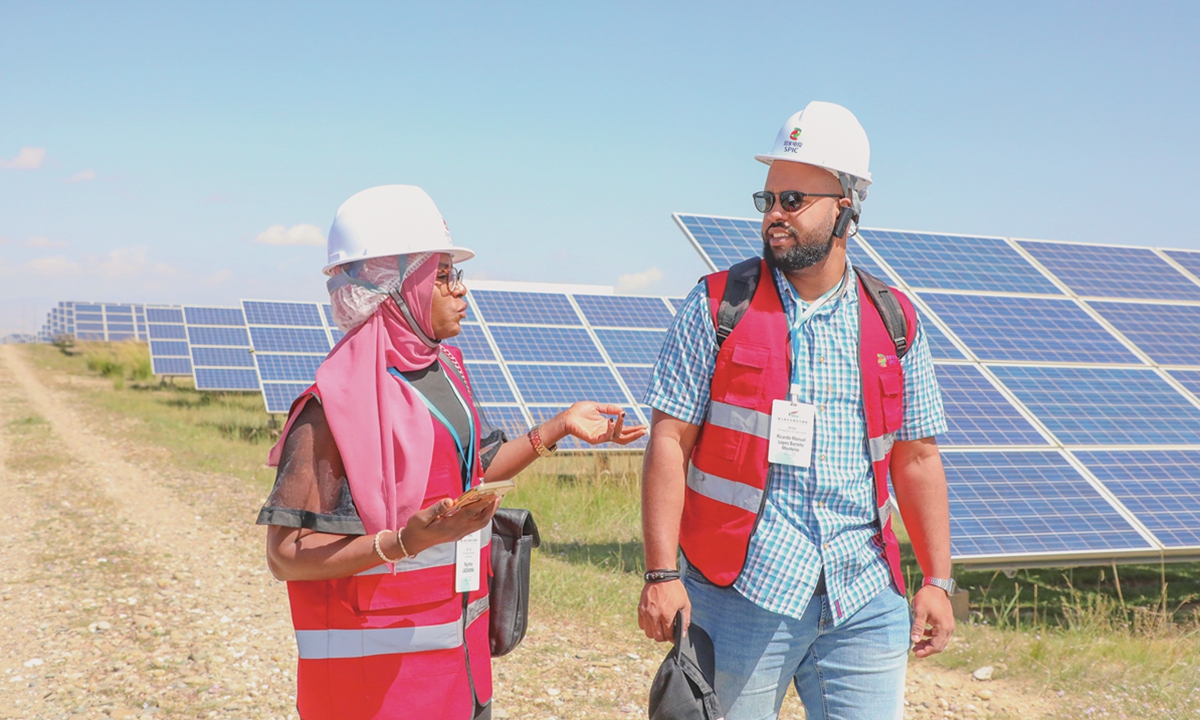
Deux jeunes délégués africains visitent un parc de production d'énergie photovoltaïque dans le désert de Talatan Gobi, province du Qinghai, nord-ouest de la Chine, le 12 septembre 2025. Photo : IC
Note de la rédaction :
En cette année 2026, proclamée Année des échanges humains entre la Chine et l'Afrique, l'amitié entre les peuples constitue la pierre angulaire essentielle des relations sino-africaines, et les échanges culturels et interpersonnels servent de moteur durable pour l'amitié transgénérationnelle entre la Chine et l'Afrique.
Le Global Times, en coopération avec Independent Media d'Afrique du Sud, a lancé une série intitulée « Dialogue du Sud Mondial. » (Global South Dialogue) Nous avons invité des experts et universitaires chinois et africains à engager des discussions approfondies sur un large éventail de sujets liés aux relations sino-africaines et à leur contexte international. Le sixième volet de cette série propose des échanges autour du thème suivant : « la promotion conjointe du développement de la jeunesse et la construction d'un écosystème de talents Chine-Afrique tourné vers l'avenir. »
L'essor de la jeunesse africaine : un atout stratégique encore à libérer
Augustin F. C. Holl (professeur émérite distingué à l'Université de Xiamen) : En nous appuyant sur les données de l'ONU, en janvier de cette année, la population africaine approche 15,7 milliards d'habitants. Cependant, il existe des variations régionales significatives dans la distribution et dans le taux de croissance de la population. L'Afrique centrale connaît la croissance démographique la plus rapide. L'Afrique orientale abrite le plus grand bloc de population. C'est la composition par âge qui place la population africaine actuelle dans une catégorie spéciale, avec 60% de la population en Afrique ayant moins de 25 ans et la population de jeunes âgés de 15 à 24 ans en Afrique devrait atteindre 500 millions en 2080.
Mammo Muchie (professeur à l'Université de Technologie de Tshwane en Afrique du Sud) : L'Afrique connaît une dynamique démographique qui présente une opportunité sans précédent de tirer parti d'un dividende démographique. Un dividende démographique est le potentiel d'une croissance économique plus rapide lorsque la population en âge de travailler d'un pays devient plus importante par rapport à sa population dépendante d'enfants et de personnes âgées. Il permet au pays de profiter des opportunités et de répondre aux nouveaux défis qu'apporte la transition démographique.
Le problème est que le dividende démographique de l'Afrique fait face à de nombreux obstacles : un déclin lent de la fécondité, une création d'emplois inadéquate, en particulier dans le secteur manufacturier, une éducation médiocre et une inadéquation des compétences, etc. Sans relever ces défis, la nombreuse jeunesse en Afrique risque de devenir un fardeau démographique plutôt qu'un dividende.
Paul Frimpong (directeur exécutif du groupe de réflexion basé au Ghana, Centre de politique et de conseil Afrique-Chine) : Aujourd'hui, l'Afrique est le continent le plus jeune du monde, abritant une population de jeunes en expansion rapide dont l'énergie, la créativité et l'ambition façonneront le développement mondial dans les décennies à venir. Cette réalité démographique présente à la fois une opportunité et une urgence.
De nombreux jeunes Africains travaillent, souvent intensément, mais dans des activités informelles et à faible productivité. Cela reflète le fait que les économies sont encore en transition vers une production à plus forte valeur ajoutée, plutôt qu'un manque d'efforts ou d'aspiration.
La vraie question, donc, n'est pas de savoir combien de jeunes compte l'Afrique, mais si les systèmes adéquats existent pour transformer leur potentiel en productivité, en innovation et en leadership. La démographie seule ne crée pas le développement, alors, c'est la stratégie qui le fait. C'est là que la coopération Chine-Afrique devient particulièrement pertinente. Grâce à son expérience en matière de développement des compétences à grande échelle, de transformation industrielle et de planification à long terme, la Chine est particulièrement bien placée pour s'associer à l'Afrique afin de transformer une population jeune en un puissant moteur de croissance partagée et de modernisation.
L'Afrique peut tirer des leçons précieuses de la Chine en matière de développement de la jeunesse
Mammo Muchie : L'Afrique peut tirer des leçons relatives aux stratégies chinoises de développement, de modernisation et de dividende démographique pour le développement de la jeunesse. La stratégie chinoise de développement de la jeunesse est orientée par le Plan de développement à moyen et long terme de la jeunesse (2016-25). L'accent du plan est mis sur une croissance globale et inclusive dans l'éducation, la santé, la création d'emplois, l'emploi, et l'intégration et la solidarité sociales en s'attaquant au chômage des jeunes et aux disparités urbaines et rurales.
L'Afrique peut s'inspirer de l'expérience chinoise pour lier le développement économique à l'évolution démographique, en se concentrant sur des investissements massifs en Afrique pour concevoir de façon proactive des politiques qui alignent le développement économique sur l'éducation, la santé, la promotion de la planification familiale, la promotion d'une industrialisation à forte intensité de main-d'œuvre, la diversification des économies et la construction d'infrastructures pour transformer sa nombreuse jeunesse d'un fardeau potentiel en un dividende démographique significatif afin de réaliser une croissance durable.
Wang Jinjie (professeur assistant de recherche à l'École nationale de développement et à l'Institut de coopération et de développement Sud-Sud de l'Université de Pékin) : L'expérience chinoise est souvent résumée comme la transformation des changements démographiques en croissance de la productivité grâce à un ensemble synchronisé : la démographie plus la réformes plus l'absorption de l'emploi.
Un taux de dépendance en déclin a créé une structure d'âge favorable, mais la capture du dividende dépendait de réformes permettant la réallocation de la main-d'œuvre et une création massive d'emplois. La Banque mondiale note que la Chine « a réussi à capter le dividende démographique », des estimations attribuant une part significative de la croissance aux changements de structure démographique. L'expansion à grande échelle de l'éducation de base, la formation des compétences et les améliorations de la santé publique ont été associées à la construction d'infrastructures et de capacités industrielles, afin que les travailleurs puissent effectivement être absorbés dans les secteurs productifs.
Augustin F. C. Holl : La création d'emplois et l'esprit d'entreprise dans tous les secteurs d'activité font une nécessité absolue . L'ensemble du continent offre un vaste marché ouvert et un espace de manœuvre substantiel. L'Afrique a besoin d'infrastructures, de routes, de chemins de fer, de ports, d'un réseau électrique et d'une transformation locale des matières premières pour exporter des biens à valeur ajoutée. La réglementation devra être simplifiée, et le bien-être des populations doit constituer le centre de la nouvelle politique économique pour l'Afrique.
Si nous voulons vraiment que la jeunesse contribue à la prospérité future du continent, il faut lui donner de l'espace.
Pourquoi la coopération Chine-Afrique est-elle importante ?
Paul Frimpong : La coopération Chine-Afrique est particulièrement pertinente à ce stade de la transition démographique de l'Afrique car elle se situe à l'intersection de la jeunesse, de l'industrialisation et de la planification du développement à long terme. Contrairement aux partenariats axés uniquement sur l'aide ou sur les interventions à court terme, la coopération Chine-Afrique s'est constamment engagée auprès des secteurs productifs.
Les parcs industriels et les zones économiques spéciales soutenus par la Chine ont créé des environnements où la formation aux compétences est directement liée à la production. Dans les pays tels que l'Éthiopie et l'Égypte, la fabrication légère dans les textiles, l'habillement et les matériaux de construction a créé des emplois industriels de premier échelon, permettant aux jeunes travailleurs de passer de la formation professionnelle à l'emploi en usine. La coopération s'étend également au-delà de la fabrication traditionnelle.
La coopération Chine-Afrique peut renforcer ces voies en reliant les programmes pour la jeunesse aux corridors industriels, aux plateformes logistiques et aux infrastructures transfrontalières. Lorsque les jeunes sont intégrés dans ces systèmes, la coopération ne sera plus d'une composante sociale supplémentaire, mais elle constitue un pilier central de la transformation économique.
Wang Jinjie : Mes recherches sur les parcs industriels et les entreprises mettent en lumière un point d'entrée pratique : relier les entreprises aux institutions locales d'éducation/formation pour lever les goulets d'étranglement liés à la main-d'œuvre qualifiée et transformer les investissements en capacités locales.
Par exemple : Des systèmes d'enseignement et de formation techniques et professionnels conjointement développés (EFTP) plus d'apprentissage intégrés dans les parcs industriels et les entreprises pivots (programmes, formation des instructeurs, centres de formation à gestion conjointe, certification portable). L'amélioration de la qualité de l'emploi, en plus de son nombre (échelles de progression des emplois d'entrée vers les rôles de technicien qualifié/superviseur). L'esprit d'entreprise plus l'amélioration des fournisseurs (PME dirigées par des jeunes intégrées dans les contrats d'approvisionnement et de maintenance).
La complémentarité la plus durable entre la Chine et l'Afrique vient non seulement du commerce et des infrastructures, mais aussi de l'investissement dans les capacités et la productivité afin d'accroître la résilience, les écosystèmes de compétences servant de mécanisme de transmission.
Mammo Muchie : Les jeunes, tant en Chine qu'en Afrique, sont les artisans du changement et ceux qui transforment la donne. Toutes les parties prenantes de la Chine et de l'Afrique doivent coopérer pour garantir que toutes les générations futures puissent mener une vie avec un travail adéquat, la santé, la sécurité et la paix.
RELATED ARTICLES