Tourism market sees golden window for off-peak travel before Spring Festival holidays
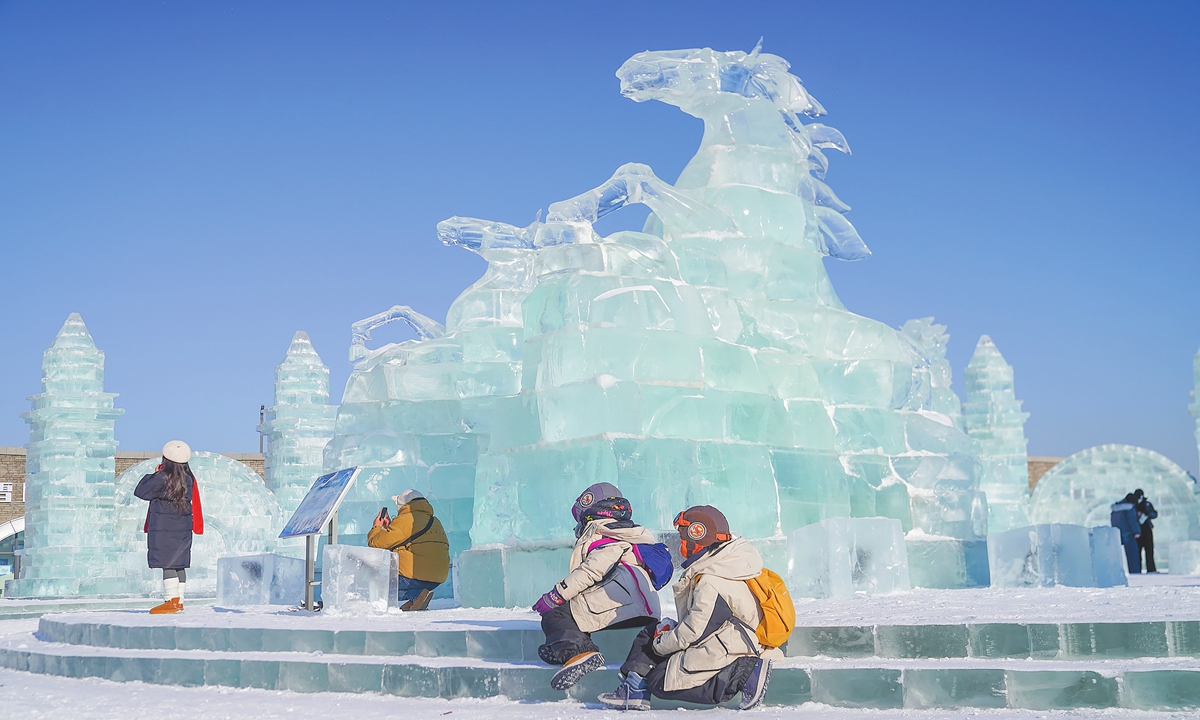
Tourists take photos with an ice sculpture of a horse at Harbin Ice and Snow World, seeking good fortune ahead of the upcoming Year of the Horse in Harbin, Northeast China's Heilongjiang Province, on January 5, 2026. Photo: VCG
China's tourism market sees a golden window for off-peak travel before the winter vacation and the Spring Festival holidays, with tourism prices generally down by 10-30 percent compared with the peak season levels, attracting experience-focused tourists, according to travel agencies.
"With policy support for vacations, the willingness of tourists to travel during off-peak periods has increased. In recent years, we have observed that the distinction between peak and off-peak seasons has become less obvious, whether for outbound or domestic travel," Xu Xiaolei, marketing manager at CYTS Tours Holding Co, told the Global Times on Monday.
He said that compared with traditional holidays such as the Spring Festival and National Day, current off-peak travel prices can be 10-30 percent lower.
According to domestic travel platform Tongcheng Travel, compared with the upcoming Spring Festival travel rush and holidays, current airfare and hotel prices are more cost-effective, with the costs of domestic air tickets before January 28 expected to be 40 percent lower. The reduction in jet fuel surcharges on domestic routes has further reduced fares, it noted.
In January, long-distance travel sees a significant upstick in China's domestic tourism markets, characterized by two major trends - heading north for ice-and-snow trips going south to escape warmer climates. Short-distance travel is led by hot spring vacations and theme parks, according to travel platform Tuniu, domestic news site ThePaper reported.
Tuniu's data reveals that off-peak tourists prefer more relaxed itineraries. This is reflected in recent small group tours of six to nine people and tours lasting eight- to 10-days.
Along with tourists' increasingly mature mindset for travel, more and more young people and senior citizens are starting to utilize the time difference for highly cost-effective consumption. This will drive the tourism market to evolve from concentrated bursts to year-round normalization and balanced development, contributing to the resilient growth of the tourism market, according to Xu.
Contrary to the assumption that off-peak means dull, we are observing quite vibrant activity in current market, Jiang Yiyi, a tourism and sports expert at Beijing Sport University, told the Global Times on Monday.
"Ice-and-snow tourism in regions such as Northeast China's Jilin and Heilongjiang provinces as well as Northwest China's Xinjiang Uygur Autonomous Region is booming," Jiang said, noting that she took a trip to Xinjiang recently and noticed the bustling scene of local ice-and-snow tourism.
According to a report released by the China Tourism Academy on Monday, the season from December 2025 to February 2026 is expected to see 360 million winter tourism trips, generating about 450 billion yuan ($64 billion) in revenue.
China's cultural and tourism consumption is vibrant with enormous potential, Xu said. He said that tourism will be further integrated into the daily lives of urban and rural residents, becoming a source of rigid demand for cultural experiences and spiritual enjoyment in 2026, and the tourism economy will usher in a new pattern of high-quality development.
A total of 142 million domestic trips were made during the three-day New Year holiday period that ended on Saturday, with total tourism spending reaching nearly 84.8 billion yuan, according to official data.
The Ministry of Culture and Tourism noted that winter-themed tours, sun-seeking getaways and short-distance excursions gained significant traction during this holiday, as consumption vitality remained robust and fluid.
RELATED ARTICLES