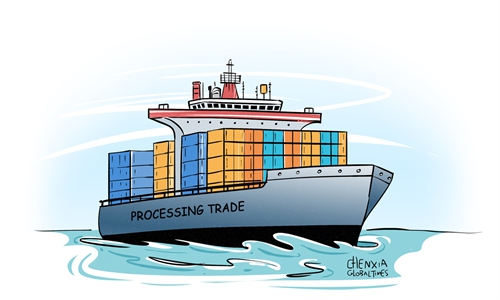
Illustration: Liu Xiangya/GT
In 2025, the SCO (Lianyungang) International Logistics Park handled 84.36 million tons of cargo, up 13.52 percent year-on-year, CCTV News reported. Even amid heightened uncertainty in global trade, certain Chinese logistics hubs have remained consistently active. Beyond cargo volumes alone, this activity points to the pragmatic, demand-driven connections between China and other Shanghai Cooperation Organization (SCO) economies, suggesting resilience in regional trade networks despite broader uncertainty.Uncertainty in global trade has been rising, and in this context, enhancing logistical connectivity and reducing operational unpredictability can be understood as a form of incremental support for cross-border trade - adding routes, options, and flexibility. The SCO (Lianyungang) International Logistics Park provides a concrete example of this process, showing how targeted improvements in logistics infrastructure and services can help sustain trade flows.
Located in East China's Jiangsu Province, the SCO (Lianyungang) International Logistics Park has established a multimodal transportation network linking roads, railways, rivers, and seas. According to the Lianyungang Daily, it has also set up six overseas warehouses in Central Asia, Southeast Asia, and other countries and regions, enhancing its international logistics service capabilities. Collectively, these developments demonstrate how targeted investments in infrastructure and service integration can incrementally broaden trade options and support more resilient cross-border operations.
In 2022, Jiangsu launched its first rail-road intermodal freight train along the China-Kyrgyzstan-Uzbekistan transport corridor from the SCO (Lianyungang) International Logistics Park, carrying 42 containers. Media reports indicate that the route cuts transit times by three to five days compared with traditional lines, delivering goods to Uzbekistan in about 20 days. These efforts illustrate how incremental improvements in transport connectivity can shorten supply chains and enhance predictability, providing tangible benefits for regional trade without large-scale restructuring.
The SCO (Lianyungang) International Logistics Park demonstrates how practical, incremental improvements can strengthen trade links between China and other SCO economies. Shorter transit times, integrated logistics services, and overseas warehouses gradually enhance the reliability and efficiency of cross-border trade. Across multiple nodes and corridors, these enhancements collectively support the broader movement of goods, illustrating one way in which trade between China and other SCO economies can be facilitated.
Trade between China and other SCO economies has continued to expand, supported by steady growth in volume, improvements in trade structure, and faster progress in cross-border logistics and industrial coordination. In recent years, China's trade with other SCO economies successively crossed the marks of $300 billion, $400 billion and $500 billion, reaching a record high of $512.4 billion in 2024, up 2.7 percent year-on-year.
Goods trade between China and other SCO economies totaled $293.18 billion in the first seven months of 2025, another record high for the same period, according to data from China's General Administration of Customs.
Complementary industrial structures and comparative advantages among SCO economies are translating into concrete trade opportunities. Logistics parks in Lianyungang and other hubs provide a clear illustration, facilitating the entry of Central Asian specialty agricultural products into China while expanding overseas channels for Chinese exports, including agricultural machinery.
In the first seven months of 2025, China's exports of agricultural machinery to other SCO members rose by 47.8 percent, while imports of agricultural products from these economies increased by 6.2 percent. Imports of rapeseed oil grew by 33.6 percent, while rice imports surged by as much as 412.1 percent, according to the Xinhua News Agency.
This deepening trade cooperation has also benefited from steadily improving interconnectivity under the Belt and Road Initiative. In recent years, China-Europe freight trains, international road transport and air cargo services have expanded, further strengthening cross-border logistics networks.
In Northwest China, the Xinjiang Uygur Autonomous Region is accelerating its role as a key logistics hub linking China with other SCO economies. The Horgos port, in particular, has become an increasingly important node for exports of cold-chain products such as fruit and vegetables.
Amid rising global trade uncertainty and the emergence of protectionist measures in some economies, China's logistics hubs continue to facilitate the flow of goods and support trade with other SCO economies. Through practical steps - improving connectivity, streamlining operations, and enhancing reliability - these incremental efforts strengthen supply chains and contribute to more stable and predictable cross-border trade.
The author is a reporter with the Global Times. bizopinion@globaltimes.com.cn
RELATED ARTICLES