China and Canada Photo: VCG
As Canadian Prime Minister Mark Carney prepares to visit China this week, several positive signals have emerged from both sides.Chinese Vice Minister of Finance Liao Min recently met with former Canadian prime minister Jean Chrétien in Beijing, with the two sides exchanging views on China-Canada relations, economic and trade cooperation, and two-way investment, according to a statement from the Ministry of Finance on Monday. China is willing to work with Canada to implement the important consensus reached by the leaders of the two countries, resume and restart dialogues and cooperation in the economic, financial and other fields, and promote the healthy, stable and sustainable development of bilateral relations, Liao stated.
Meanwhile, Canadian Member of Parliament Kody Blois told reporters on Sunday that Carney would like to "recalibrate" Canada's once-frosty relationship with the Chinese government and look at economic opportunities for the two nations, CBC News reported.
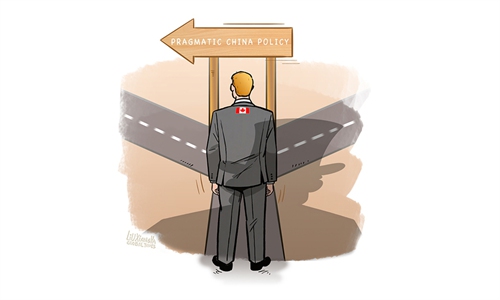
These positive gestures from both sides have undoubtedly raised optimism ahead of Carney's visit to China and injected imagination into the future of China-Canada economic and trade relations. While the visit itself represents a valuable opportunity, meaningful breakthroughs in bilateral cooperation still hinge on whether Canada can adopt a more pragmatic and stable policy approach toward China.
In recent years, relations between China and Canada have been strained, largely due to Ottawa's alignment with Washington's policy toward China. This approach, however, has failed to deliver any economic benefits for Canada. Instead, it has exposed several key Canadian industries to greater turbulence and uncertainty.
Compounding the situation, Canada-US frictions over issues such as steel and aluminum tariffs and electric vehicle supply chains have further placed Ottawa in a disadvantageous position.
It is noteworthy that even during the most challenging periods in bilateral relations, China has remained Canada's second-largest trading partner. This fact demonstrates that market principles and economic complementarity have always provided a solid foundation for China-Canada relations.
China possesses a vast consumer market, a comprehensive industrial system, and strong manufacturing capabilities, while Canada holds distinct advantages in natural resources, agricultural technology, and high-end manufacturing. The complementary nature of their economic structures provides ground for cooperation, with broad potential spanning agriculture, energy, manufacturing, and technological innovation.
According to the Office of the Canadian Prime Minister, Carney will discuss economic issues such as trade, energy, and agriculture with the Chinese side, areas that align closely with the most promising fields for bilateral cooperation. Taking agriculture as an example, Canada has long been an exporter of agricultural products to China. In the energy sector, Canada is not only one of the world's major liquefied natural gas producers, but also has accumulated extensive experience in clean energy development. Meanwhile, China is steadily advancing its dual-carbon goals and has growing demand for low-carbon technologies and green energy solutions.
For Canada, building a stable and predictable relationship with China is in line with the practical needs of its economic prosperity and industrial development. Today, amid growing protectionism and global economic uncertainty, China is not only an important export market but also a key participant in technological innovation, industrial collaboration and value chain cooperation. Stable bilateral economic relations will open a more certain door for Canadian businesses to develop, and support their long-term cooperation in agriculture, energy, science and technology, and other fields.
Nevertheless, despite the Carney government's willingness to "recalibrate" relations with China and the important opportunities presented by the upcoming visit, the long-term development of China-Canada economic and trade relations ultimately hinges on how to transform political statements into pragmatic, stable, and predictable cooperation mechanisms based on shared interests and mutual understanding.
If Canada can take a constructive approach to both sides' reasonable concerns and work to meet China halfway, the two countries will be better positioned to fully unlock the enormous potential of their economic complementarity. In that case, bilateral relations could indeed emerge from their recent trough and move toward a more stable and sustainable trajectory.
RELATED ARTICLES