Latest episode of anti-corruption documentary exposes a former national legislator’s bribes
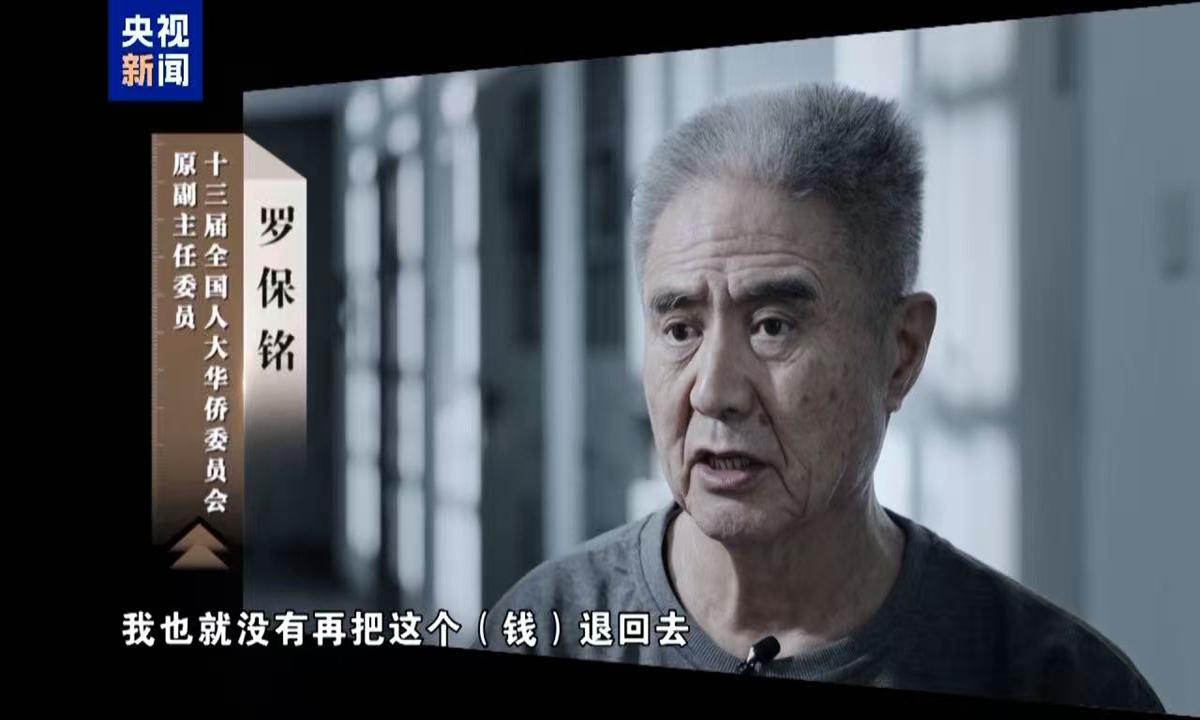
Luo Baoming, former vice chairman of the Overseas Chinese Affairs Committee of the 13th National People's Congress Photo: CCTV News
When the annual anti-corruption documentary series aired its latest episode on Monday, it centered on disciplinary inspection authorities' efforts to tackle corruption cases.The four-episode documentary series, titled "Never pause a single step, never yield an inch," is being aired from Sunday to Wednesday. It is jointly produced by the publicity department of the Communist Party of China Central Commission for Discipline Inspection (CCDI) and the National Commission of Supervision, and CCTV.
Its second episode, which premiered on Monday, spotlights how authorities target corruption cases where political and economic interests are intertwined, per CCTV. It details the rigorous crackdown on misconduct including corrupting officials through business interests, shielding business activities by virtue of official power, and the blurring of lines between some officials and businessmen.
Among the cases featured is that of Luo Baoming, former vice chairman of the Overseas Chinese Affairs Committee of the 13th National People's Congress. He confessed that his corruption crimes had caused significant damage to Hainan's business environment and severely undermined Hainan's political ecosystem.
Luo was previously found to have committed a series of violations including maintaining long-term improper connection with a certain "political swindler," and causing severe losses to fiscal funds, according to a report by the Xinhua News Agency in 2025. He was also found to have taken advantage of his positions to accept huge sums of money and valuables.
Luo worked in South China's Hainan Province for a long time. Investigations found that an intricate network of collusion between government and business had formed around him, involving many business owners, leading cadres and his relatives, according to the documentary.
Luo's political career started in North China's Tianjin Municipality. As early as the 1990s, when he served as director of the Tianjin municipal commission of commerce, he crossed the red line of discipline and law for the first time by accepting a cash bribe of 500,000 yuan from a businessperson in one single payment.
From then on, Luo became entangled in financial interests with a number of businesspeople from Tianjin. When he was transferred to work in Hainan Province in 2001, the ties with those business owners did not end, instead, they followed him and extended to Hainan, according to the episode.
Luo colluded with businessmen even at the expense of the long-term interests of social and economic development, a staff member of CCDI said in the episode.
After taking office in Hainan, he also made quite a few "new friends." It was an open secret in Hainan that Luo had an unusually close relationship with several senior executives of the airline enterprise in South China's Hainan Province. Under the high-sounding pretext of supporting the development of private enterprises, Luo provided the airline with various favors. Privately, however, he had long been accepting comprehensive high-end services provided by the enterprise for himself and his family.
Luo and his family took multiple trips to Guangdong, Shanxi, Gansu, Shaanxi and other places on the business jets of the airline. Arranged by the enterprise, Luo's family also traveled to Australia, New Zealand, Brazil, Switzerland, Spain and other countries on several occasions, with all relevant expenses borne by the airline.
The airline also provided a villa of over 300 square meters in Haikou exclusively for Luo's mother, allowing her to live there rent-free for four years, and arranged a full-time nanny to attend to her. All relevant expenses of this arrangement were covered by the airline, according to the documentary.
In December 2025, the court sentenced Luo to 15 years in prison for bribery. A number of involved individuals in his clique, including business owners and officials, also received severe punishment in accordance with Party discipline and the law of the country.
The documentary noted that Xu Xianping, a former deputy head of the National Development and Reform Commission, has long been engaged in economic management work and enjoys considerable popularity and influence in the economic and financial fields.
After stepping down from the position and moving to a "second-line" role in 2015, he was invited to serve as a specially appointed professor at universities. He often participates in forums, lectures, research projects and planning compilation activities in Party and government organs, large enterprises and social organizations, and frequently interacts with figures from both the political and business circles.
These should have been platforms for him to continue contributing his expertise, but Xu Xianping instead treated them as a means to maintain his influence and seek personal gains.
Anti-graft work tackling corruption cases requires both symptomatic and root-cause solutions, Su Wei, a professor from the Party School of the CPC Chongqing Municipal Committee, told the Global Times on Monday.
As China enters 2026 with strong development momentum, anti-corruption remains a key priority as the Communist Party of China (CPC) steers the country forward, according to Xinhua.
During the entire year in 2025, 65 centrally administered officials, mostly at the ministerial level or above, were placed under investigation for corruption, with nine of the cases initiated in December alone, according to information released on the website of China's top anti-corruption authorities.
Over the past year, China's rigorous anti-corruption campaign pressed ahead relentlessly, with authorities vowing "no pause or retreat" as they maintained efforts to root out graft and misconduct.
RELATED ARTICLES