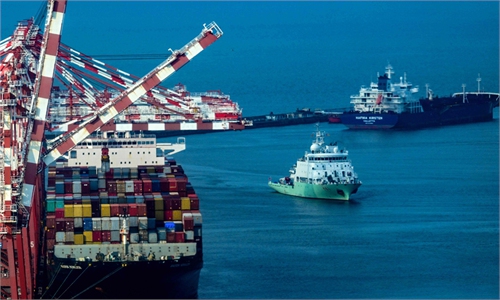
Hyping the ‘China threat in the Arctic’ an attempt to mislead the public: Global Times editorial
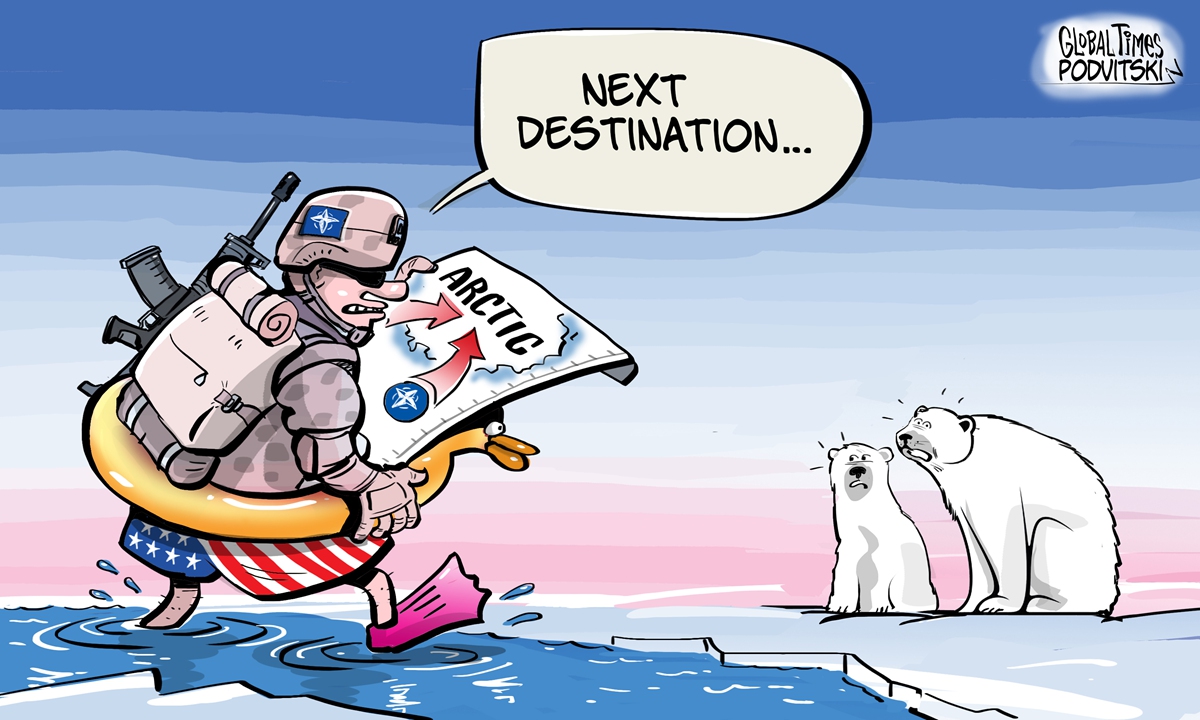
Cartoon: Vitaly Podvitski
Recently, some Western media outlets have repeatedly hyped China's Arctic scientific research and shipping activities as having military intentions, while turning a blind eye to the basic fact that China never has any military deployments in the Arctic and sensationalizing claims of a "China and Russia's Arctic military push." Even as the US and Europe spar over Greenland, the discussion is frequently derailed by assertions that NATO should "counter threats from Russia and China" in the Arctic. We firmly oppose attempts by the US and Europe to label China with terms such as "military threat," "resource grabber" or "rule breaker" in Arctic affairs. These claims seriously distort the facts and are steeped in Cold War thinking and hegemonic logic.First, such erroneous narratives are entirely detached from reality and ignore China's consistent role as a guardian of the Arctic's ecology and climate. Over the past more than 30 years, temperatures in the Arctic have continued to rise and summer sea ice has kept shrinking. Protecting and governing the Arctic is not only an urgent issue for Arctic states, but also concerns the common interests of the international community.
In conducting Arctic scientific research, China acts in accordance with international treaties, proactively discloses research data and cooperative outcomes, and uses transparency to dispel Western narrative traps. China's research activities are fully consistent with international law, and by deepening scientific, environmental and conservation cooperation with Arctic countries and international organizations, it provides data support and public goods for Arctic research, demonstrating the role of a responsible major country.
Second, these claims are marked by obvious Cold War mentality and ignore China's position as a supporter of multilateral governance in the Arctic. In addition to the territories and lawfully administered maritime areas of the eight Arctic states - including Canada and Denmark - the Arctic also encompasses the high seas and the international seabed area. States that do not enjoy territorial sovereignty in the Arctic nonetheless lawfully possess rights in the Arctic Ocean's high seas, including scientific research, navigation, overflight, fishing and the laying of submarine cables and pipelines, as well as rights to resource exploration and development in the international seabed area.
In its participation in multilateral mechanisms such as the Arctic Council and the International Arctic Science Committee, China has consistently worked to improve cooperative frameworks, opposed geopolitical security confrontation, and advocated global governance. As one of the countries closest to the Arctic Circle on land, China's rights and freedoms to carry out activities in the Arctic in accordance with law should be fully respected.
During the Cold War, the Arctic Ocean was a "forward frontline" of strategic confrontation between the two major countries - the US and the Soviet Union. Nuclear submarines from both sides lay hidden beneath the Arctic ice cap, making the region one of the key theaters for sea-based strategic nuclear deterrence. Since entering the 21st century, the Arctic has once again become a focal point of geopolitical security competition. Some countries have extended their jurisdiction northward toward the North Pole through so-called "blue grabbing" actions, accelerated military deployments, and stoked bloc confrontation, all in a bid to compete for regulatory authority and discursive power in Arctic affairs. Such moves are bound to cause concern in the international community. In 2024, the US released a new Arctic strategy that frames China-Russia cooperation in the Arctic as a "threat," which in essence serves as a pretext for its own expansion in the Arctic region. This is extremely detrimental to security and development in the Arctic region. It not only hinders climate and ecological protection, but also obstructs humanity's collective efforts to develop and utilize Arctic resources and shipping routes.
The US' hype about a so-called "China's Arctic threat" is, in essence, an attempt to confuse the public and conceal its own military expansion, unilateral resource extraction, and pursuit of hegemony in the Arctic. By invoking the "China threat" narrative, the US seeks to create excuses and shift attention for its ambition toward Greenland, with the real aim of turning Greenland into a strategic forward base against China and Russia, serving the strategic interests of "America First." There is no evidence whatsoever to support claims of "Chinese economic plunder" or a "military presence." On the contrary, China's capital, technology, markets, knowledge and experience in recent years have played a constructive role in Arctic development.
China is an important stakeholder in Arctic affairs. For many years, it has not only been a participant in Arctic multilateral governance but also a contributor to the region's sustainable development, a role widely recognized by the vast majority of Arctic states as well as non-Arctic countries. China's activities in the Arctic adhere to international treaties and general international law, including the UN Charter, the United Nations Convention on the Law of the Sea and the Treaty concerning the Archipelago of Spitsbergen. These activities follow the principle of "neither overstepping nor being absent" in its engagement in Arctic affairs. The "Polar Silk Road," which China advocates building jointly with all parties, is becoming a widely welcomed international public good.
China's Arctic policy is clear and consistent: to understand, protect, develop and participate in the governance of the Arctic, in accordance with the basic principles of "respect, cooperation, win-win result and sustainability." This clarity and resolve stem not only from China's deep understanding of the nature of Arctic affairs, but also from its sense of responsibility as a major country. The Arctic is not anyone's private garden. Its future concerns the well-being of Arctic and non-Arctic countries alike, and of all humanity, and should be safeguarded jointly by all stakeholders.
RELATED ARTICLES