Chang'e-6 study reveals early massive impact heated deep materials on lunar far side: report
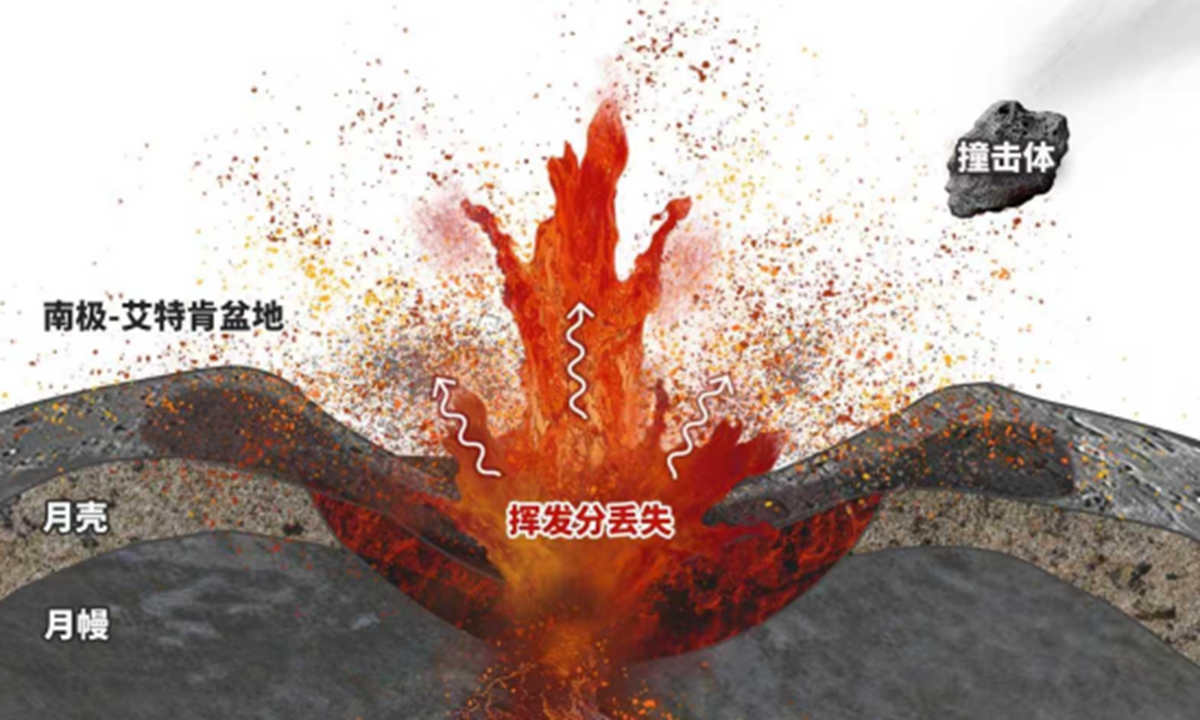
Illustration: Massive impact event occurs approximately 4.25 billion years ago on the lunar far side. Photo: Institute of Geology and Geophysics (IGG) of the Chinese Academy of Sciences
Analysis of basalt samples retrieved by China's Chang'e-6 lunar probe from the far side of moon continue to renew humanity's understanding of the lunar past. Chinese scientists revealed in their latest finding that the massive impact event approximately 4.25 billion years ago, which created satellite's South Pole-Aitken (SPA) basin, not only excavated this enormous crater but also intensely heated the deep materials on the lunar far side. It caused the loss of certain volatile elements, Science and Technology Daily reported Tuesday.
The discovery was made by scientists from the Institute of Geology and Geophysics (IGG) of the Chinese Academy of Sciences, who sought to address the mystery in lunar science on whether and how the large impacts that occurred during moon's early history affected the deep interior of the satellite, given that such impacts have been considered the dominant external force reshaping lunar landscapes on the surface.
Using high-precision isotope analysis, researchers detected minute variations in isotope ratios and precisely capture traces left by the impact, according to Tian Hengci, the author of the paper who is also a research fellow at the IGG.
Science and Technology Daily reported that the isotope systems of moderately volatile elements such as potassium, zinc and gallium hold unique research value. In the high-temperature environment generated by impacts, these elements are prone to volatilization and isotopic fractionation, and their isotopic compositions can sensitively reflect the temperatures, pressure and material sources during the impact. Therefore, they act as distinctive "isotope fingerprints," providing crucial clues for studying how impacts have transformed lunar crust and mantle materials.
In this study, the research team conducted high-precision potassium isotope analysis on the basalt samples returned by Chang'e-6. Analysi results show that, compared with Apollo samples from the lunar near side, the Chang'e-6 basalts exhibit a significantly higher proportion of the heavier potassium isotope, potassium-41.
To determine the cause of this difference, researchers systematically ruled out various possible factors, including cosmic ray irradiation, magmatic activity and contributions from impactors. They eventually confirmed that it was an early large-scale impact event that altered the potassium isotope composition of the deep lunar mantle.
The extreme high-temperature and high-pressure conditions at the moment of the impact caused more of the lighter potassium-39 isotope to volatilize and escape, resulting in relative enrichment of the heavier potassium-41 in the residual material.
This loss of volatile elements likely further suppressed later volcanic activity on moon's far side. This discovery provides key scientific clues for understanding the influence of large impacts on lunar evolution and explaining why the geological evolution of the lunar near side and far side differs so significantly, Tian explained.
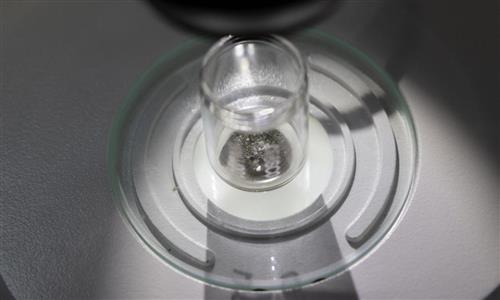
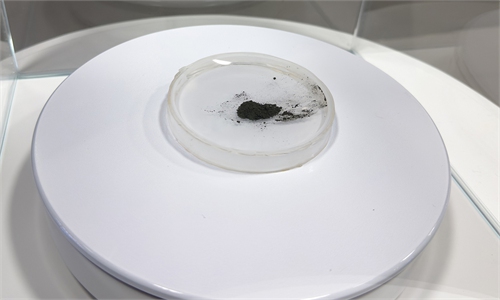
In 2024, Chang'e-6 made history by bringing 1,935.3 grams of lunar far-side samples back to Earth. These samples were collected from the SPA Basin, the largest, deepest and oldest basin on moon, which provided a rare opportunity to clarify the compositional differences between the near and far sides and to unravel the long-standing mystery of their asymmetry. Chinese scientists have achieved multiple pioneering breakthroughs through the study of the Chang'e-6 samples, including unveiling the volcanic activity, ancient magnetic field, water content and geochemical characteristics of lunar mantle, shedding the first light on the evolutionary history of its dark side, according to the Xinhua News Agency.
Global Times
RELATED ARTICLES