China’s first kilowatt‑scale underwater pump storage system ‘Dongchu‑1’ completes successful trials
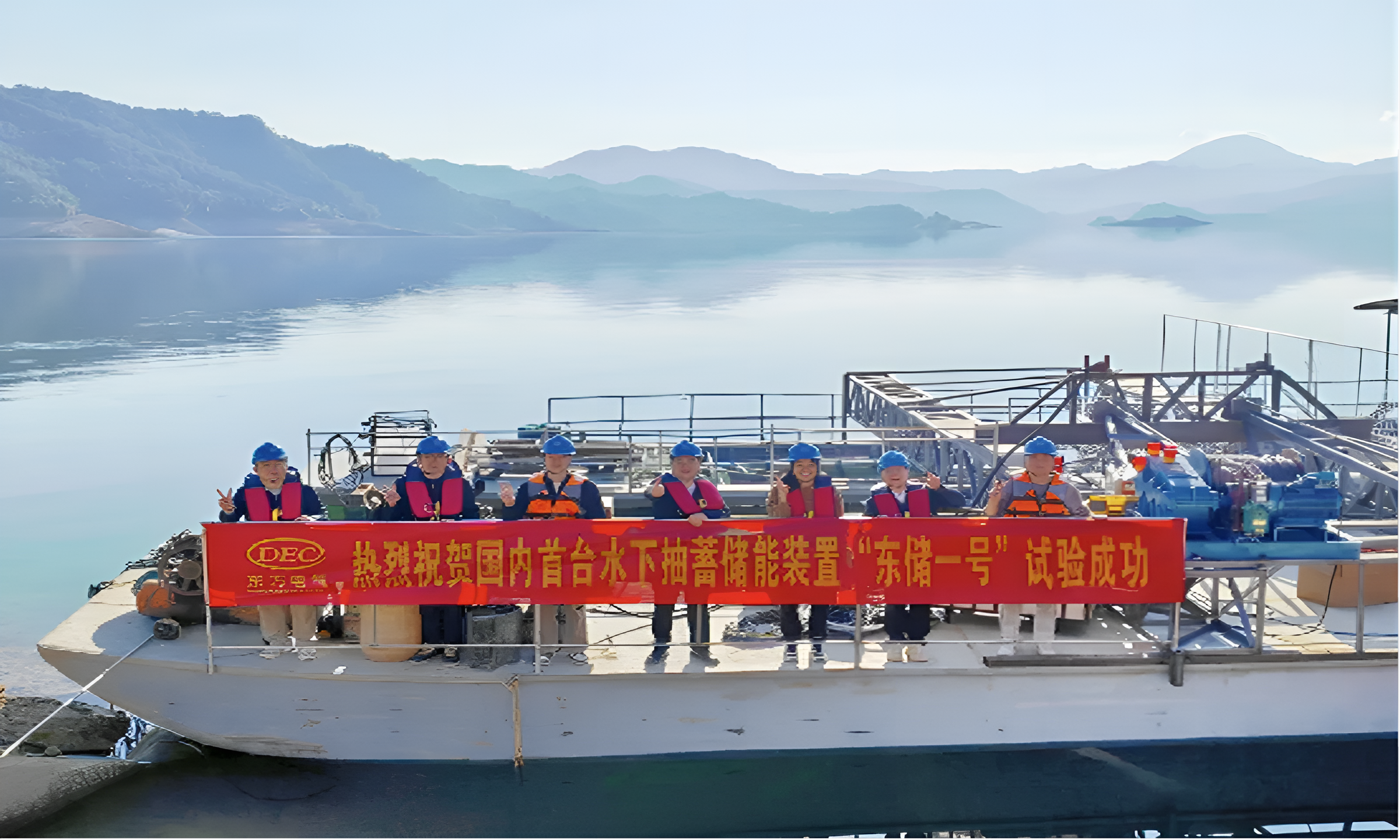
China's first kilowatt-scale underwater pump storage energy system successfully completes trials in East China's Fujian Province on January 11, 2026. Photo: Dongfang Electric Corporation
China has successfully completed a 10‑day underwater comprehensive trial of its first kilowatt‑scale underwater pump storage energy system, dubbed "Dongchu‑1," at Minhu Lake, East China's Fujian Province, according to a statement sent to the Global Times on Tuesday.
The platform was independently developed by Dongfang Research Institute, a state-owned enterprise under Dongfang Electric Corporation (DEC). The successful trials mark a key step forward from theory to engineering practice for submerged pump storage systems in China.
The trials, conducted at a depth of 65 meters, included more than 100 full charge-discharge cycles and demonstrated that the prototype met its design targets for sealing, operational stability and energy conversion efficiency, the DEC statement said, adding that the trials provide crucial empirical data and technical experience to support follow‑on development of higher‑power units and engineering scale‑up.
Unlike conventional pump storage plants that require both upper and lower land reservoirs, Dongchu-1 adopts a "self-contained lower reservoir + natural upper reservoir" concept. The system's core is a hollow spherical chamber that functions as the built in lower reservoir; the surrounding body of water serves as the natural upper reservoir.
During grid low‑load periods, surplus electricity drives pumps to evacuate water from inside the sphere, creating a sealed negative‑pressure storage volume. When demand peaks, an inlet valve opens and the pressure differential forces water rapidly back into the sphere, driving a turbine to generate electricity that is fed back to the grid — enabling time‑shifted storage and peak power delivery, according to the statement.
DEC said the technology is highly adaptable to conventional reservoirs at varying depths across China, offering a way to add storage capacity where building conventional pump storage plants is constrained by geography or land use.
As China's offshore wind development moves toward larger and more remote installations, complementary storage solutions such as Dongchu-1 could play an important role in system flexibility and grid stability.
According to the company, prior to Dongchu-1, domestic efforts in this field were largely theoretical, meaning these trials fill a notable technological gap. Moving forward, the company intends to continue collaborating with domestic research institutes and industry partners to optimize system performance, reduce costs associated with scaled deployment, and drive the development of technical standards. The company said these efforts will accelerate the practical adoption of underwater pump storage technology and support China's transition to a cleaner, more flexible energy system.
Global Times
RELATED ARTICLES