Chinese Embassy refutes Philippine National Maritime Council’s latest South China Sea claims, says some are pushing two neighbors capable of peaceful coexistence toward the brink of conflict
By Published: Jan 13, 2026 05:59 PM

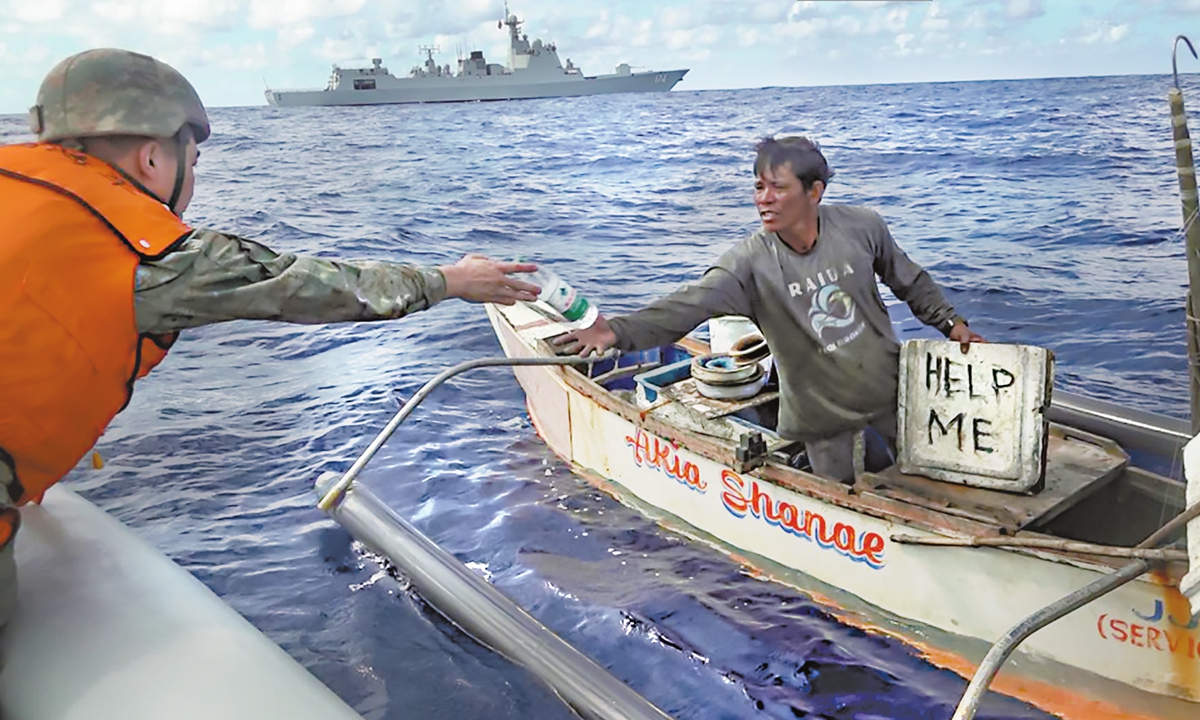
A Chinese PLA navy sailor provides humanitarian assistance to a Philippine fisherman in distress in the South China Sea on December 26, 2025. Photo: source
China has firmly rejected unfounded and misleading claims by the Philippine National Maritime Council, saying the Philippines has long distorted international maritime law by conflating territorial seas with exclusive economic zones (EEZs) and mischaracterizing China's lawful activities in overlapping waters as "illegal patrols," according to a statement from the Chinese Embassy in the Philippines on Tuesday.
The Chinese Embassy's statement is the latest in a series of exchanges between the Chinese Embassy and Philippine Coast Guard (PCG) spokesperson Jay Tarriela. A Chinese expert said some Philippine groups with hardline anti-China stance are exploiting maritime issues to keep disputes in focus and damage bilateral ties, a tactic that warrants firm rebuttal.
There is no such concept as "maritime zone" in the United Nations Convention on the Law of the Sea (UNCLOS). UNCLOS only provides for legal regimes such as the territorial sea and the exclusive economic zone (EEZ). For a long time, the Philippines has deliberately blurred the distinction between the territorial sea and the EEZ, and has distorted China's normal activities in waters claimed as EEZ by both China and the Philippines as "illegal patrols". The Philippines has been misleading the general public all these years by conflating the concepts of the territorial sea and the EEZ, the deputy spokesperson of the Chinese Embassy said in a statement.
In a statement released on Monday, the Philippine National Maritime Council claimed that tensions in the South China Sea are "direct result" of China's activities within the "maritime zones of the Philippines provided by the UNCLOS." It also claimed China's claim that the Philippines "stages provocations" by deploying government vessels or allowing Filipino fisherfolk to operate in these waters is "completely false."
In response, the deputy spokesperson of the Chinese Embassy said that "Since the second half of 2023, the Philippines has sent multiple Coast Guard vessels, official vessels and so-called fishing vessels to intrude into the territorial waters of Huangyan Dao, forcing China to take necessary measures to safeguard its rights."
"Among all the incidents mentioned above, which one was provoked by China? It has always been the Philippines that has time and again provoked trouble in an attempt to change the status quo… China has also been exercising maximum restraint and patience. Had this not been the case, the situation on the ground might have been entirely different," read the statement.
The Embassy also noted that "A lie repeated a thousand times will never become reality. China stands ready to engage in candid dialogue with the Philippines on the basis of mutual respect to manage differences properly. However, China firmly opposes people like Jay Tarriela, who does nothing but spreading false, twisted, manipulative, misleading and provocative narratives."
Some people provoke confrontation and tension under the pretext of "safeguarding rights". They push the Philippines to the forefront of geopolitical competition and push two neighbors capable of peaceful coexistence toward the brink of conflict. This will only seriously damage the fundamental and long-term interests of the Philippines, according to the Chinese statement of the Embassy.
The Chinese Embassy's latest statement came after a series of response targeting PCG spokesperson Jay Tarriela.
On January 9, Tarriela claimed that during their operation of searching for a missing fisherman, they found "illegal" presence of a PLA Navy vessel, which was patrolling "within the Philippine Exclusive Economic Zone (EEZ)."
In response, Deputy Spokesperson of the Chinese Embassy Guo Wei said in a statement released by the Embassy on X on January 9 that "China and the Philippines have overlapping EEZ claims in the waters concerned. That makes it entirely legitimate for Chinese naval and coast guard vessels to operate there." "Tarriela, as PCG, your priority should be search and rescue for the missing fisherman, not social media theatrics. Your tricks of rambling, confusing right and wrong, inciting confrontation, and misleading public opinion are useless," said the spokesperson.
On January 10, Terriela reposted the Embassy's statement and continued to quibble on so-called EEZ of the Philippines and questioned whether Guo a career diplomat. The deputy spokesperson of Chinese Embassy also refuted Terriela's post that "I'm a professional diplomat. My job is to promote friendship, build stable relations, keep the peace, and prevent conflict." "Wake up. You're the one fueling tensions, misleading the public, and wrecking the dialogue. Look at your statements over the past few years—are you trying to start a conflict, a war, or pretending to care about stability?" said the spokesperson.
Also on January 11, the Chinese Embassy also released several posts to refute Terriela and stressed Chinese naval activities in the relevant waters are lawful, legitimate and beyond reproach.
The latest statement of the Chinese Embassy is not an isolated case but part of a series of maritime flashpoints, including China's earlier rescue of Philippine fishermen. It reveals how certain Philippine institutions and individuals that hold extreme anti-China positions are amplifying one another's narratives on hyping topics around the South China Sea, Ding Duo, director of the Research Center for International and Regional Studies at the National Institute for South China Sea Studies, told the Global Times.
The Philippines has exhausted most of its options at sea, while China's response mechanisms are already well-established and effective. As a result, some Philippine activists have shifted their focus to political and rhetorical channels, including making irresponsible remarks on social media in an attempt to blur domestic public understanding, Ding said,
The expert also noted that for such individuals and rhetoric, firm and sustained rebuttals are necessary to expose their positions and intentions, and they must not be allowed to become obstacles to the normalization of China-Philippines relations.
RELATED ARTICLES