US House newly passed bill to extend AI chip curbs to cloud-based access mainly targeting China exposes zero-sum mentality, distorts market: experts

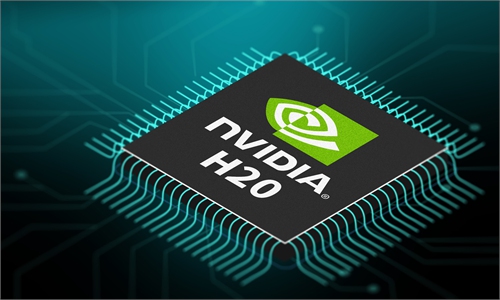
chip Photo:VCG
The US House of Representatives passed the Remote Access Security Act on Monday local time, a bipartisan bill intended to close what lawmakers claimed as a "cloud loophole" to limit foreign adversaries gaining remote access to US technologies including AI chips. The committee particularly singled out China as a concern in its statement on the passage of bill. Chinese experts said the move, which is largely symbolic and hard to enforce, reflects US zero-sum mentality and its anxiety over China's technological progress, and risks distorting market rules and undermining normal China-US economic and technological cooperation.The committee claimed that the bill modernizes the Export Control Reform Act by expanding federal authority to restrict foreign adversaries' ability to access technologies, including AI chips, remotely through cloud computing services, according to the website of the US House select committee on strategic competition with China.
China's AI ambitions are being fueled by its access to American chips housed in data centers located outside of China, said Select Committee on China Chairman John Moolenaar, a cosponsor of the legislation, according to the official website. "This bill brings our laws into the digital age and makes it clear that cloud compute is subject to US export control law, just like physical chips. Closing these loopholes will strengthen US national security and protect American innovation."
The Select Committee claimed it has repeatedly warned that Chinese entities use cloud services and remote computing to evade US restrictions on advanced semiconductors, artificial intelligence, and other sensitive technologies.
Chen Jing, vice-president of the Technology and Strategy Research Institute, told the Global Times that AI is a key battleground for the future of technology and the IT software industry, which is why the US government, some politicians and certain US companies do not want Chinese firms to advance too quickly. Moves to restrict the computing power available to Chinese companies, he added, are driven by zero-sum mindset and do not reflect fair competition.
Gao Lingyun, a researcher at the Chinese Academy of Social Sciences, told the Global Times that the bill passed by the US House of Representatives should be viewed in context, noting that the China-focused committee introduces numerous hardline China-related bills each year, many of which do not translate into substantive policy.
From a technical perspective, Gao questioned the feasibility of enforcing a ban on remote access to AI chips. He noted that tracing whether a remote computing request ultimately comes from a Chinese company is highly complex, given layered architectures and multiple intermediaries. "After several technical 'hops,' it is difficult to identify the origin of capital or users, let alone label a remote signal as 'Chinese,'" he said.
The bill's passage came after the US government allowed Nvidia's H200 processors, widely regarded as its second-most advanced AI chips, to be exported to China on the condition that Washington receives a 25 percent cut, Reuters reported on December 9, 2025.
Ma Jihua, a veteran industry analyst told the Global Times that while the US has partially loosened restrictions on chip sales, it is simultaneously seeking to block cloud-based remote access, in an attempt to force Chinese firms toward purchasing high-priced US chips. Under the pretext of "closing loopholes," the legislation aims to limit China's short-term AI computing capacity while squeezing the space for China's domestic chip industry and allowing US suppliers to reap huge profits.
Ma argued that such measures are misguided and ultimately futile. By politicizing markets and extending domestic laws beyond its borders, the US is undermining the global semiconductor industry and harming global AI development. He added that recent years have shown China continuing to make steady breakthroughs despite repeated US restrictions, highlighting that market forces and technological progress cannot be blocked.
Gao said the move reflects continued US efforts to expand restrictions from physical chip exports to remote usage. Such measures, he argued, undermine normal China-US economic and trade cooperation and also run counter to the interests of US companies that profit from providing cloud and computing services.
Even if the bill were eventually passed by the Senate and signed into law, Gao said it would likely be "more symbolic than substantive," given enforcement difficulties and conflicting commercial interests.
The latest move also came after in December, the US administration announced its intended imposition of tariffs on China's semiconductor industry, which will take effect in 2027.
Ma said the US approach now amounts to a "two-pronged squeeze," with Washington continuing to curb China's progress in high-end chips while also seeking to restrict exports of China's mature-node chips through measures such as tariffs, ultimately aiming at slowing the overall development of China's semiconductor industry.
Wei Shaojun, vice chairman of China Semiconductor Industry Association, told the Global Times that the US strategy of weaponizing trade is heightening the risk of global supply-chain fragmentation while also backfiring on its own industries through clear cost pass-through effects. Such moves not only further fracture the global semiconductor supply chain but also raise costs for downstream US industries, proving counterproductive.
History has repeatedly shown that isolation does not deliver lasting leadership; only openness and cooperation can foster sustained innovation and achieve genuine win-win outcomes, Wei said.
Global Times
RELATED ARTICLES