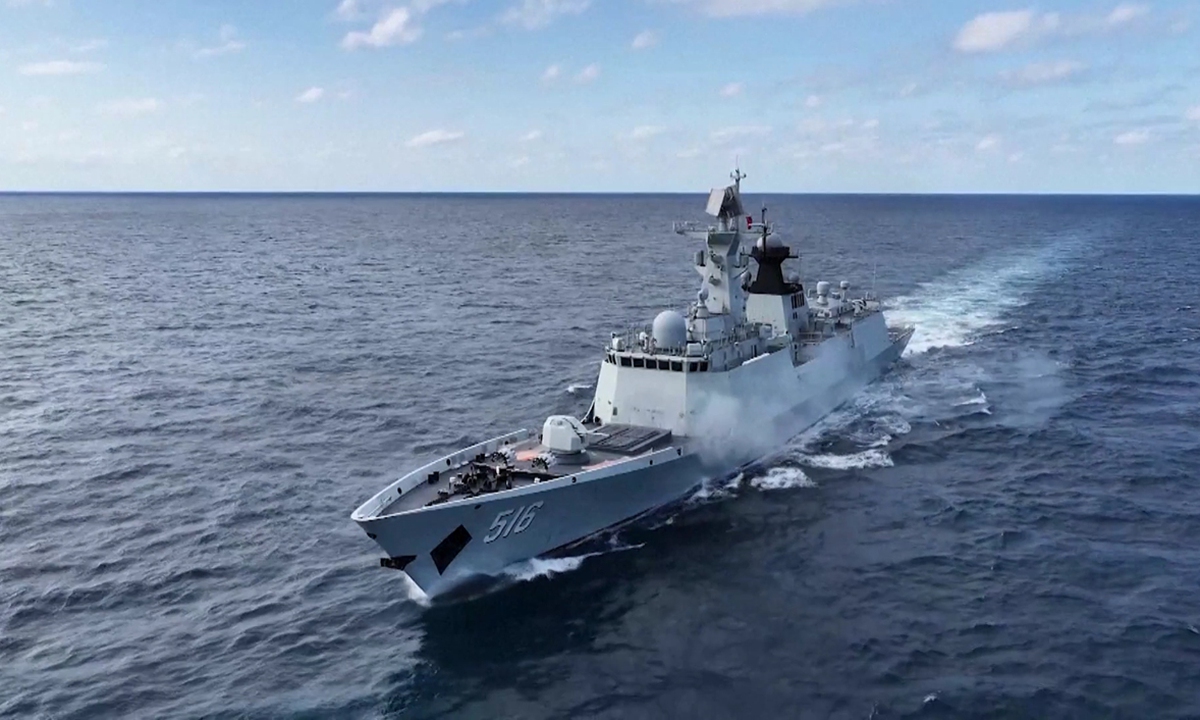
The Type 054A guided missile frigate Huaibei participates in the "Justice Mission 2025" joint military drills organized by the PLA Eastern Theater Command in waters around the island of Taiwan on December 29, 2025. Photo: VCG
The year 2025 marked the 20th anniversary of the enforcement of China's Anti-Secession Law and the 80th anniversary of Taiwan's restoration. Despite severe challenges in cross-Straits ties, the Chinese mainland's ability to shape and control the situation has continued to grow. Strategic initiative remains firmly in the hands of the Chinese mainland, while its strategic confidence and determination to resolve the Taiwan question and achieve complete national reunification have only deepened.First, the Chinese mainland's policy articulation on the Taiwan question has become more comprehensive and precise. During a symposium in 2025, China's top legislator Zhao Leji said that China has further enriched the legal framework for punishing separatist activities, resolutely fought against separatism and countered interference, while improving systems and policies that contribute to the well-being of Taiwan compatriots over the past 20 years, especially since the 18th CPC National Congress. This represents a systematic articulation of the established Taiwan policy framework, demonstrating a firm resolve to continuously deepen the struggle against secession and external interference within the framework of the rule of law. Meanwhile, since October last year, the regular press conferences held by the Taiwan Affairs Office of the State Council have increased to once a week, enhancing the frequency and transparency of policy communication and establishing a mechanism to ensure that the mainstream narrative of opposing separatism and promoting reunification is delivered with greater clarity.
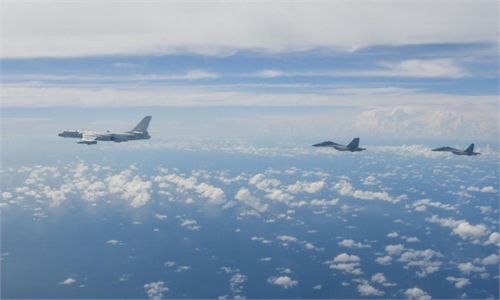
Second, the Chinese mainland has maintained intense and sustained pressure on separatist forces, decisively punishing all separatist provocations. The Lai Ching-te authorities' actions have pushed the island of Taiwan toward the brink of disaster. The Chinese People's Liberation Army's "Justice Mission 2025" drills around Taiwan in December were a stern warning to the Lai authorities' provocations of "pursuing independence through military buildup" and "relying on foreign forces to seek independence."
Third, the Chinese mainland has adopted powerful countermeasures to further refine and institutionalize the system of punishing secession by legal means. In 2025, notorious Shen Pao-yang, a Taiwan separatist, was put on the list of obstinate "Taiwan independence" separatists by the Taiwan Affairs Office of the State Council last year. In late October, police in Chongqing Municipality announced that a criminal investigation had been launched against Shen on suspicion of secession. Holding separatists accountable under the law is becoming a standard practice, making it impossible for separatist forces to evade justice.
Fourth, the Chinese mainland has held a series of events to commemorate the 80th anniversary of the victory of the Chinese People's War of Resistance Against Japanese Aggression. China's legislature established October 25 as the Commemoration Day of Taiwan's Restoration on October 24, 2025, marking the end of Japanese rule in 1945 and its return to China, to uphold the outcome of the war.
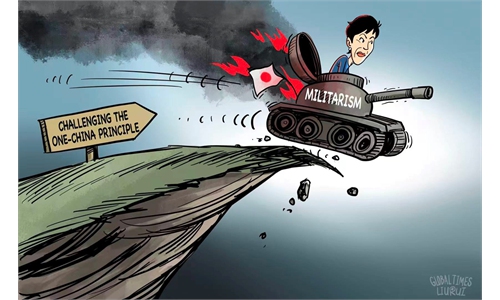
Fifth, the Chinese mainland has made proactive and strong responses, achieving remarkable results in countering external interference. In late 2025, Japanese Prime Minister Sanae Takaichi brazenly linked the Taiwan question to "a survival-threatening situation" for Japan. This was the most serious and malicious provocation on the Taiwan question by a Japanese leader since the normalization of China-Japan diplomatic relations. The Chinese mainland strikes back decisively against external interference, and has signaled clearly that it is fully prepared to deal with any provocations.
Taiwan will hold local elections this year. Judging from Lai Ching-te's recent behavior, he is clearly steering toward an even more confrontational cross-Straits policy, making his authorities the greatest source of poison for cross-Straits peace and stability.
The Chinese mainland's series of actions in 2025 has demonstrated an unprecedented determination and a clear strategic roadmap to crush separatists. They outlined a clear strategic trajectory in 2025 for the mainland's Taiwan-related strategy, marking the beginning of a new phase in which the mainland actively combats external interference and takes firm action against separatism.
The author is a research fellow at the Institute for Taiwan, Hong Kong and Macao Studies of the Shanghai Institutes for International Studies. opinion@globaltimes.com.cn
RELATED ARTICLES