The ‘soft landing’ of the China-EU EV case demonstrates value of dialogue: Global Times editorial
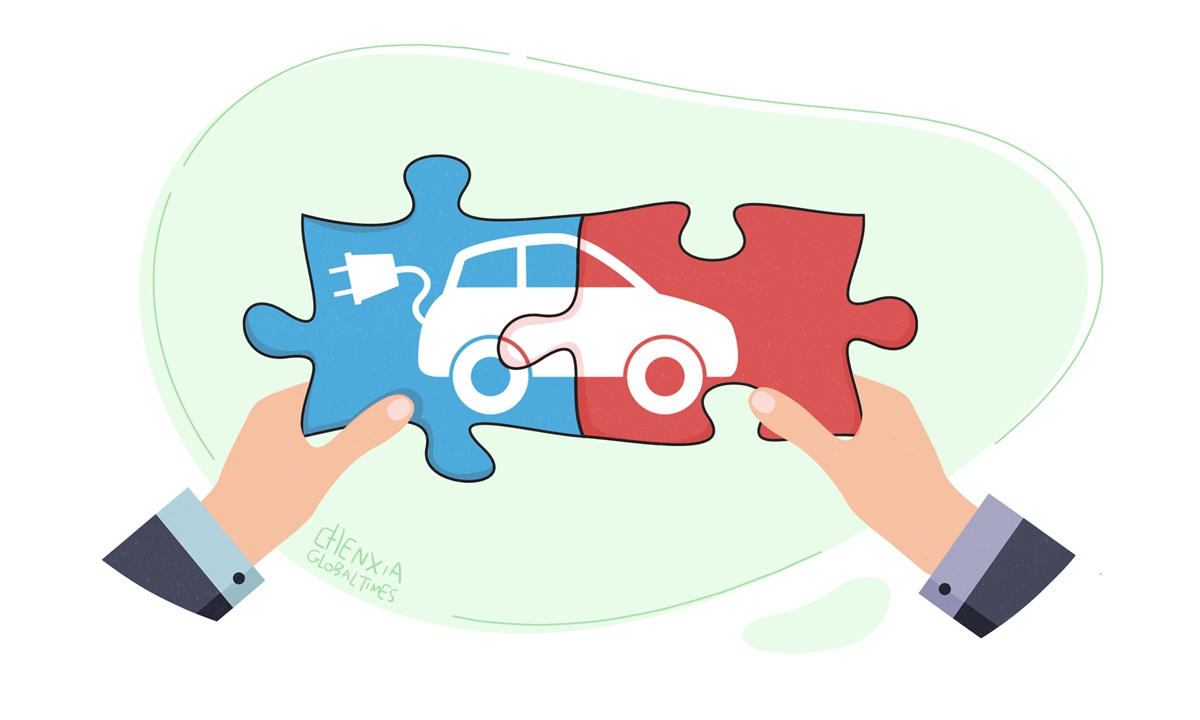
Illustration: Chen Xia/Global Times
Against the backdrop of escalating global geopolitical competition and a resurgence of protectionism, China-EU relations have once again demonstrated resilience. On Monday, China's Ministry of Commerce and the European Commission simultaneously announced an important consensus reached by both sides. The EU officially released the Guidance Document on Submission of Price Undertaking Offers, allowing Chinese electric vehicle (EV) companies to submit price undertaking offers in accordance with the document's content. This achievement is the result of multiple rounds of consultations conducted under the strategic guidance of the leaders of China and the EU based on mutual respect.
This was a powerful correction of zero-sum game thinking by a rational and pragmatic spirit. Since the EU launched its investigation and announced tariffs, bilateral trade relations have faced a severe test. However, China and the EU did not allow the friction to slide into a vicious cycle. Instead, they firmly implemented the consensus reached by their leaders and, within the framework of WTO rules, successfully found developed an alternative solution through arduous but sincere professional consultations. The newly released Guidance Document not only preserves a compliant operating path for Chinese companies through the institutional arrangement innovation of "price undertaking," but also sends a clear signal to the world: In an era of intertwined interests and competition, as long as we adhere to mutual respect and rules-based principles, dialogue and consultation remain the fundamental way to break the "zero-sum game" dilemma and maintain the stability of the global industrial and supply chains.
Rules-based approaches are the cornerstone of resolving frictions. The biggest highlight of this consultation outcome lies in the fact that both sides consistently adhered to the framework of WTO rules. The EU explicitly reaffirms in its Guidance Document its commitment to the principle of non-discrimination, applying the same legal standards to all applications in accordance with WTO regulations and ensuring that all assessments are conducted in an objective and impartial manner. The China Chamber of Commerce for Import and Export of Machinery and Electronic Products issued a statement indicating that this important outcome is a shared expectation among industry players across the EV value chain, in both China and the EU. The China Chamber of Commerce to the European Union noted that this will boost market confidence and creates a more stable and predictable environment for Chinese electric car manufacturers and their supply chains in Europe. The market's positive response is the most authentic indicator. The uncertainties of the past few years have troubled both Chinese and European industries. The price undertaking mechanism provides a predictable alternative, avoiding sudden spikes in trade costs and abrupt disruptions to market channels, thus ensuring the normal business planning and operation of companies across the supply chain.
Deep interlinking across industrial chains is the ballast that stabilizes cooperation. The progress achieved in this round of consultations is, at its core, determined by the mutually beneficial, win-win nature of China-EU economic and trade relations, and it constitutes the most powerful rebuttal to so-called "de-risking." The China-EU electric vehicle industrial chain has long formed a deeply integrated pattern in which "you are part of me, and I am part of you." China's competitiveness in the EV sector stems from sustained technological innovation and the scale and cost advantages forged through intense market competition. Forcing "de-risking" would instead sever Europe's own complete chain from technological innovation and consumer choice to energy transition, harming the tangible interests of European companies and the public. The Guidance Document specifically notes that any commitment to invest in the BEV-related industries within the EU will be considered and assessed as part of the UT offer. This telling detail in effect acknowledges the positive role of Chinese investment and technology in Europe's green transition. Rather than building high walls through tariffs, it would be better to guide Chinese investment in Europe through price commitment mechanisms. This would both ease Europe's anxiety over "overcapacity" and bring jobs and technology spillovers to Europe, a textbook example of a "positive-sum game."
Taking a longer-term view, the timing of the China-EU consensus reached this time is particularly meaningful. In the face of a possible resurgence of unilateralism and "America First" policies from across the Atlantic, as well as the growing spread of trade protectionism worldwide, China and the EU, as two major forces, two major markets, and two major civilizations, have a responsibility to provide greater certainty to the global economy. That the two sides were able to find a balance through consultation precisely shows that recognizing differences, managing disputes, and deepening cooperation is the true path to effective "risk management."
Looking ahead, China-EU economic and trade relations may enter a new phase in which "normalized competition" coexists with a solid cooperative foundation. Within the EU, policy inertia around "de-risking" still persists, and various investigations targeting Chinese companies have not completely ceased. The proper resolution of the China-EU EV case still requires both sides to meet each other halfway. For the great ship of China-EU economic and trade ties, the "soft landing" of the EV case should serve as a course correction amid rough seas. It once again confirms a simple truth: decoupling and supply-chain severance lead nowhere, while openness and cooperation are the right way forward. It is hoped that the European side will meet China halfway, turn the consensus reached through consultations with the Chinese side and the commitments in the Guidance Document into concrete actions as soon as possible, jointly safeguard the stability of the global automotive industrial and supply chains, and inject fresh momentum into the steady and long-term development of the China-EU comprehensive strategic partnership.
RELATED ARTICLES

