China’s trade in AI-related products rises 20%, displaying strong growing momentum: customs
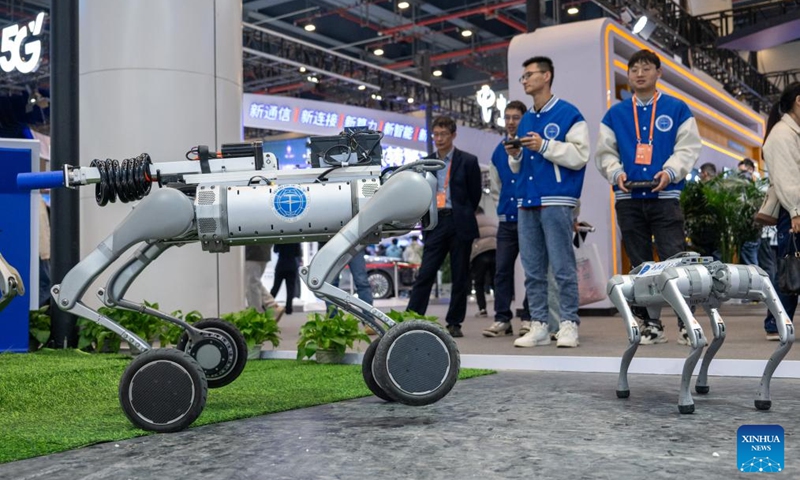
A robotic dog for on-site survey is seen during the 2025 China 5G + Industrial Internet Conference in Wuhan, central China's Hubei Province, Nov. 21, 2025. Photo: Xinhua
China's trade in artificial intelligence (AI)-related products has followed trends broadly in line with global developments in 2025 as detailed in a WTO report, demonstrating a vigorous and rapidly growing momentum, Wang Jun, deputy administrator of the General Administration of Customs (GAC), said at a press conference held in Beijing on Wednesday, in response to a question on China's AI exports and main highlights.
The WTO report showed that in the first half of 2025, global trade in AI-related products grew by about 20 percent, and accounting roughly one-sixth of total trade volume, they contributed more than 40 percent of the increase in global trade.
In terms of user-end products, China's intelligent robots not only can dance, run marathons, and practice Taichi, but are also synonymous with efficient production.
Material-handling robots are equipped with vision systems and algorithms that enable them to avoid obstacles, and welding robots can automatically scan and model work pieces and calculate optimal welding solutions.
"These two types of robots have demonstrated strong capabilities in overseas infrastructure, transportation, and other large-scale construction projects, with export growth rates in 2025 reaching roughly over 60 percent," Wang said at a press briefing sponsored by the State Council Information Office.
"In daily lives, our smart wearable devices are integrated with large AI models, enabling them to provide real-time health advice. Intelligent toys are equipped with features such as touch sensing and contextual dialogue, offering novel, user-friendly, and warm emotional consumption experiences, Wang said. In 2025, China's smart watches and intelligent toys were sold well in more than 170 countries and regions, according to him.
With regards to the field of intermediate goods, a wide range of application scenarios has provided ample space for the practical deployment of China's AI technologies, thereby driving imports of related products, Wang said.
For example, China's intelligent driving technologies have developed rapidly, with imports of LiDAR increasing by more than 20 percent. Demand for AI computing power remains strong, leading to a 20 percent rise in imports of computer components.
At the same time, Chinese enterprises are actively participating in the global division of labor in AI industry, with exports of optical transceiver modules that are used in high-end graphics card applications growing by nearly 60 percent. China has also effectively met the strong global power demand of data centers, with exports of electrical equipment such as large transformers and energy storage batteries increasing by 18.8 percent, according to Wang.
"At present, a new wave of scientific and technological innovation has entered a phase of intensive and dynamic development. The Central Economic Work Conference has made arrangements to further advance the "AI+" initiative. We expect China's AI sector will gain strong momentum in the near future, and the intelligence content of foreign trade will continue to rise steadily," Wang said.
Global Times
RELATED ARTICLES