NASA reaffirms 2030 lunar nuclear reactor goal; steep budget cuts, safety challenges loom large, observer say
By Published: Jan 14, 2026 03:37 PM

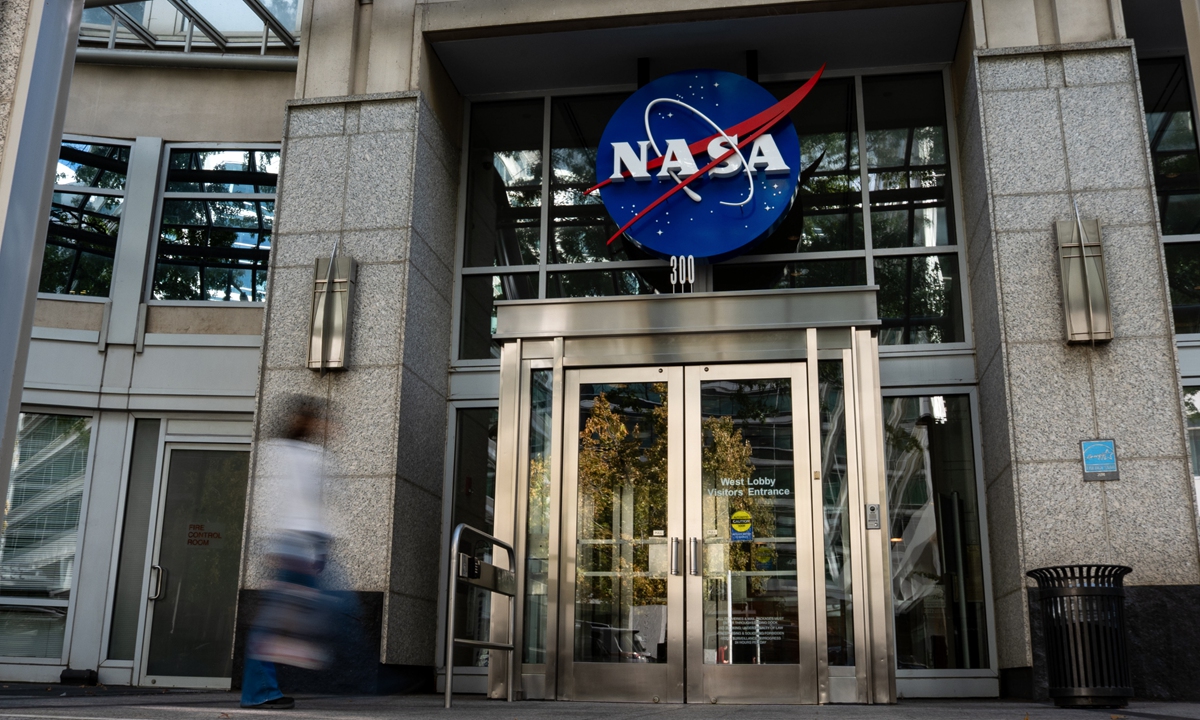
The Mary W. Jackson NASA headquarters in Washington DC, US, on October 2, 2025. Photo: VCG
NASA on Wednesday announced in an X post that it is partnering with the US Department of Energy "to get a lunar nuclear reactor ready by 2030," claiming it would enable the agency to stay and build infrastructure on the Moon, and eventually push toward Mars. However, it is not the first time the US space agency has openly stated plans to fast-track such ambitious goal, and space observers have listed factors such as budget reductions, inconsistencies in US crewed moon programs and safety concerns as major obstacles for implementing the mission.
Without providing details on the lunar nuclear reactor deployment, NASA claimed in the post that it is following through on a presidential directive outlined in national space policy.
Space observer reached by the Global Times on Wednesday also argued that the rushed 2030 timeline, possibly driven by geopolitical competition rather than proven readiness - overlooks critical challenges such as untested heavy-landing systems, vacuum heat dissipation issues, extreme temperature swings, and potential reactor faults in the harsh lunar environment.
As the Moon is designated humanity's common heritage under the Outer Space Treaty, which prohibits national appropriation and harmful contamination, any irreversible pollution would undermine global cooperation and equitable access.
It is not the first time NASA has outlined such an ambitious goal. In August 2025, US media NPR reported that then acting NASA Administrator Sean Duffy had signed a directive and sent it to NASA officials, indicating that the reactor would be launched to Moon by 2030.
Calling it an ambitious target, the NPR report highlighted concerns within the scientific community about high costs and potentially unrealistic schedule.
According to NPR, developing such a reactor would cost around $3 billion over five years, citing estimates by NASA experts.
Although an executive order in December 2025 set a 2028 target for returning US astronauts to the Moon and developing space defense technologies, NASA still faces the reality of significant budget cuts.
According to Xinhua News Agency, as part of a government efficiency initiative, the White House proposed an approximately 25 percent budget cut for NASA's 2026 fiscal year in May 2025, marking one of the largest single-year budget cuts in the agency's history.
Even NASA's Mars Sample Return (MSR) program, which was supposed to ferry Martian material collected by the Perseverance rover to Earth, looks set to be cancelled. According to the Science magazine on January 6, the US Congress released a compromise spending bill for the present financial year that backs the White House's effort to kill the Mars Sample Return (MSR) program. Although the bill must be passed by both congressional chambers and signed into law, it effectively signals the end of MSR.
The US space agency is also vulnerable to government shutdown threats. During the 43-day government shutdown in 2025, NASA halted the most of its work, with about 15,000 employees furloughed. Intensifying partisan divisions have increased the risk of government shutdowns, adding another layer of uncertainty to NASA's operations, Xinhua reported.
The BBC also noted in its August 2025 coverage that questions remain about the realism of the goal and timeline, given recent and steep NASA budget cuts, and some scientists remain concerned that the plans are being driven by geopolitical considerations.
There are questions concerning safety. "Launching radioactive material through the Earth's atmosphere brings safety concerns. You have to have a special license to do that, but it is not insurmountable," Simeon Barber, planetary science specialist at the Open University was quoted as saying in the BBC report.
Barber said there are significant hurdles to overcome before placing a nuclear reactor on the Moon for humans use. NASA's Artemis 3 mission aims to send humans to the lunar surface in 2027, but it has faced a series of setbacks and funding uncertainty, the BBC reported.
"If you've got nuclear power for a base, but you've got no way of getting people and equipment there, then it's not much use," he added. "The plans don't appear very joined up at the moment," he said.
TV commentator Song Zhongping, who has long followed the development of US Artemis program, also holds a cautious view of NASA's renewed ambitious goal, particularly over the safety issues.
Deploying a nuclear reactor on the Moon raises major safety concerns due to the harsh environment, including vacuum heat dissipation issues, extreme temperatures, moonquakes, and micrometeorites. Launch hazards are also a major concern, as spacecraft failure could disperse radioactive material into Earth's atmosphere, Song told the Global Times on Wednesday.
Logically, nuclear deployment should follow successful crewed landings and the establishment of a base to allow on-site fixes and ensure greater safety, Song noted.
Officially launched during Trump's first term, the Artemis Program aims to establish a long-term presence on the Moon and prepare for further exploration of Mars. In 2022, NASA's Orion spacecraft completed the uncrewed Artemis I mission after flying around the Moon, paving the way for a crewed flight test and future human lunar exploration. However, subsequent missions were delayed multiple times, putting the timetable at risk, Xinhua reported.
RELATED ARTICLES