IN-DEPTH / IN-DEPTH
GT investigates: Who’s next? Tracing US’ bloody trail of foreign military intervention
By and Published: Jan 14, 2026 07:12 PM



The Greenland flag is raised in a park in Copenhagen, Denmark, on January 8, 2026. Photo: IC
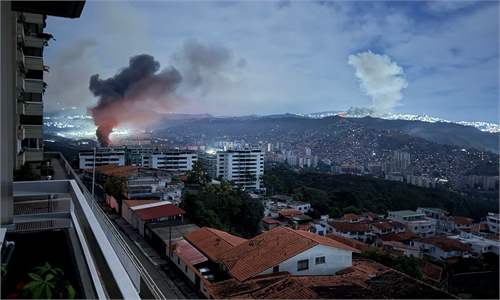
For many people around the world, the start of the new year brought not only the crackle of fireworks, but also, sadly, the sound of gunfire. Following the US’ forcible seizure of the Venezuelan President on January 3 by carrying out a military operation within the country, US President Donald Trump recently renewed his threat to seize Greenland “one way or the other,” sending shock waves through NATO capitals and forcing Europe to weigh plans that might display its commitment to security in the Arctic.
“Today it is Venezuela, tomorrow it could be any other [country],” Chilean President Gabriel Boric warned in a speech he delivered after the Venezuela incident, a remark that captures the deep concern and strong condemnation across Latin America and the whole international community over US intervention.
Worse still, US military intervention in Venezuela, and probably more regions including Greenland in the near future, is far from an isolated case, as a review of history reveals that military intervention is rooted in the US’ political DNA and policy logic. Numerous bloody tragedies have shown that the country’s overseas military actions have inflicted profound suffering on people around the world, and also left deep wounds within US society itself.
Looking back: How has US foreign intervention followed a path marked by guns and smoke? What excuses and falsehoods has the US employed to whitewash such actions? And who stands to profit from US-provoked military interventions and even wars? In this story, the Global Times looks into the US’ spotty history, common pretexts, and likely beneficiaries of its foreign military interventions, as well as which regions or peoples may be the next victims of US military force.
A spotty history of gunfire
The US is “the most warlike nation in the history of the world,” former US president Jimmy Carter once said, according to a 2019 April article by NPR.
Carter’s remark is fully demonstrated by this current US administration. In 2025 alone, the Trump admin oversaw US military strikes in seven countries across the world, from the sands of the Middle East to the high seas off Venezuela’s coast, reported the New York Post on January 2.
Ironically, avoiding US intervention in overseas wars was a major promise Trump made to voters during his campaign. As he declared in a speech in his 2024 presidential election campaign, the job of the US military “is not to wage endless regime change wars around the globe, senseless wars.” Instead, its job “is to defend America from attack and invasion here at home.”
But what Trump actually did after taking office sharply undercut that pledge, delivering a stinging rebuke to some of his voters and many peace advocates. US media counts show that in less than 12 months in office, Trump has ordered strikes in seven countries - Iran, Nigeria, Yemen, Iraq, Syria, Somalia, and most recently Venezuela. According to a December 31 story by the Military Times, since the start of his second term, Trump has overseen at least 626 airstrikes, surpassing the 555 strikes recorded during president Joe Biden’s four-year term. Trump “belie his self-styled image as a ‘peace president,’” the New York Post commented.
Sadly, the US’ belligerence is not only the fault of any single administration, but a recurring violent trait that has run through its 250-year history.
According to a Tufts University study, from the country’s founding in 1776 through 2017, the US had undertaken more than 500 international military interventions. Notably, nearly 60 percent of those interventions occurred after 1950, and more than one-third took place after 1999. “With the end of the Cold War era, we would expect the US to decrease its military interventions abroad, assuming lower threats and interests at stake,” the research report said. “But these patterns reveal the opposite - the US has increased its military involvements abroad.”
Through the Mexican-American War (1846-48) the US extended its territory across the North American continent; through the Spanish-American War (1898) it expanded its sphere of influence into the western Pacific; through wars on the Korean peninsula (1950-53) and in Vietnam (1955-75) it further pursued global primacy... For centuries, the US’ path of expansion has been paved with gunfire, erecting bastions of power, and wealth upon ruins and bones.
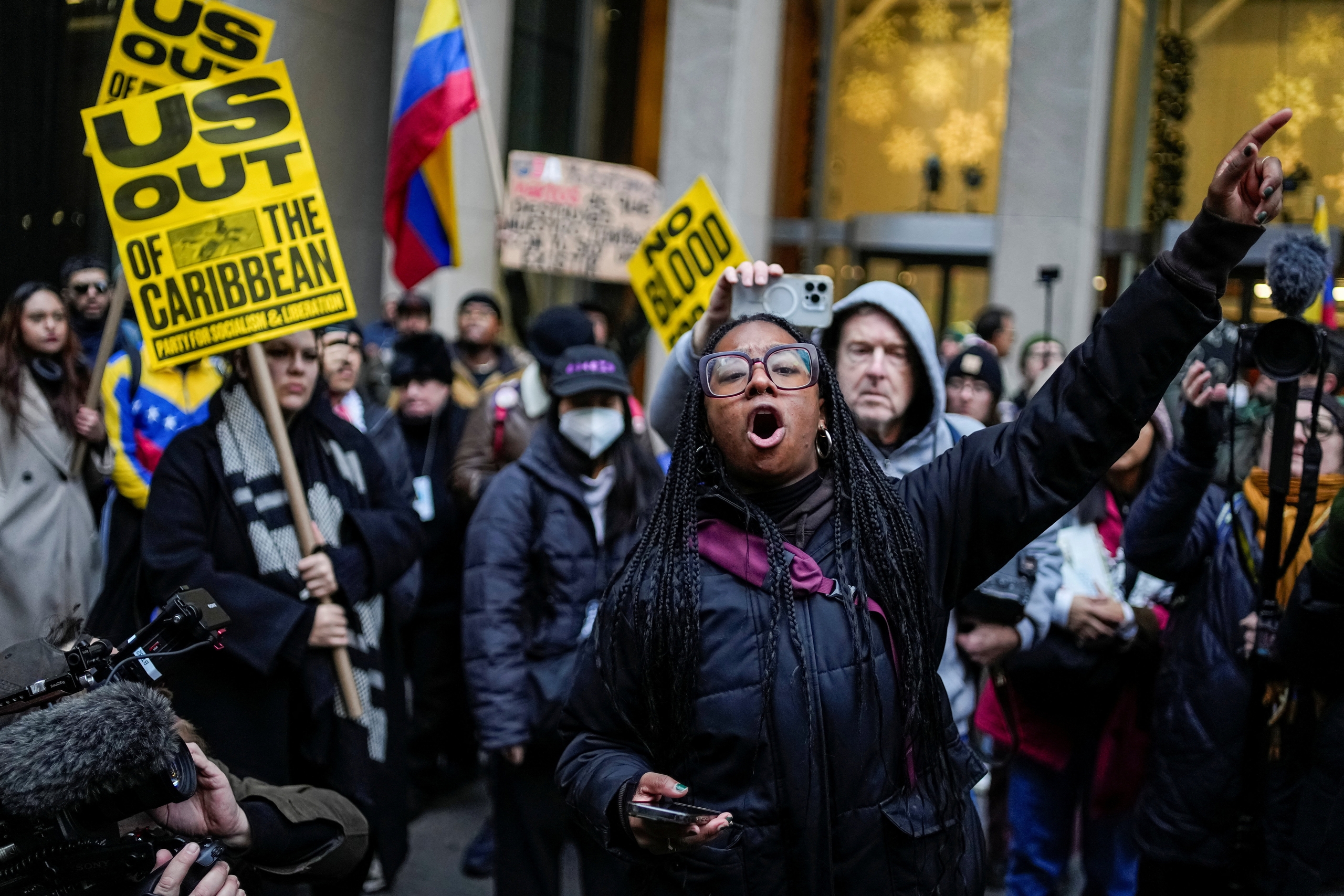
Protesters gather for a "No War on Venezuela" demonstration at Times Square, the US, on December 6, 2025. Photo: IC
Wars on excuses, profits
“There has never been a just [war], never an honorable one - on the part of the instigator of the war,” renowned US writer Mark Twain once wrote.
As one of the world’s major war instigators, the US has frequently cloaked its never-honorable military interventions in high-sounding rhetoric, and has trampled other countries’ sovereignty while bringing destruction and suffering under these pretexts and falsehoods. From “protecting US citizens” to “counter-narcotics,” from “counter-terrorism” to “promoting democracy,” the public has witnessed numerous justifications for US military interventions.
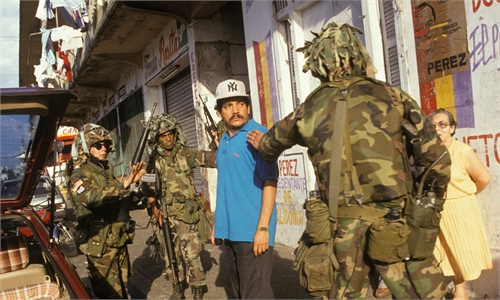
In December 1989, for instance, the US mounted “Operation Just Cause” under the guise of a counternarcotics effort, deploying some 27,000 troops to invade Panama, according to the website of US Army Special Operations History. In 2003, the US invaded Iraq on the claim that Baghdad possessed weapons of mass destruction - a claim later shown to be a gross falsehood. Its most recent forcible seizure of the Venezuelan President was, at least ostensibly, also conducted under the pretext of “counter-narcotics.”
The US has also elaborated various doctrines and strategic statements to dress up its foreign expansion and military interference in a cloak of legitimacy. From the Monroe Doctrine that stated “America for the Americans,” to the Trump administration’s 2025 National Security Strategy that openly designates Latin America as the sphere of influence of the US, rhetoric like this is fundamentally designed to whitewash the wars instigated by the US and to prioritize US interests above the sovereignty of other nations, analysts have pointed out.
The US frequently resorting to military interventions abroad serves not only its broader goals of expansion and hegemony, but also enriches a powerful domestic interest group – the military-industrial complex (MIC) – that profits immensely from war, as observers have long pointed out.
A stark illustration came in early January 2026, following the US military operation that led to the forcibly seizing of Venezuelan President Nicolas Maduro. CNBC reported that “defense stocks surged on January 5 as investors assessed how the dramatic overthrow of Venezuelan leader Maduro could herald a significant geopolitical shift that will boost the rearmament trade in the long run.”
The US military-industrial complex has a dark history of profiting from conflicts. Weapons makers Lockheed Martin and RTX predicted strong profits in late 2025 as their results benefited from surging demand for arms from conflicts in the Middle East and a protracted Russia-Ukraine war. Sales at RTX, formerly Raytheon, were also driven by a shortage of new commercial jets as maintenance and repair service providers like RTX worked to maintain airlines flying older, cost-intensive fleets. It also benefited from better jet engine sales, according to a report by the Straits Times.
This "revolving door" between government service and the defense industry is one of the most glaring symbols of the corruption at the heart of US military policy, the Xinhua News Agency reported.
According to The New York Times, at least 50 former Pentagon and national security officials, most of whom left the federal government in the last five years, are now working in defense-related venture capital or private equity as executives or advisers.
Who’s next? Why it hurts US itself?
For the current US administration, steeped in a modern version of the Monroe Doctrine, and the war profiteers reaping massive gains, the anxious international community has one pressing question: Who is next?
“Based on the current situation, Greenland is more likely to become a new focus for the US to expand its presence and influence, but may not be a target for direct military annexation. Besides Greenland, regions truly prone to conflict are still concentrated in the Middle East and other hotspots with relatively low thresholds for action. Iran indeed represents a high-risk point, but the danger lies more in limited strikes – such as short, rapid, and controllable operations against specific facilities or key nodes – rather than full-scale war,” Dun Zhigang, a research fellow at the Chongyang Institute for Financial Studies at the Renmin University of China, told the Global Times.
US President Donald Trump's repeated threats to seize control of Greenland are straining relations with US allies in NATO and have sparked a warning that doing so by force could spell the end of the world's biggest security alliance.
Tensions have routinely spiked among some of NATO's members over the decades, notably between neighbors Greece and Turkey. But it would set a dangerous precedent should its most powerful country, the US, annex the territory of another ally, AP news commented.
Apart from creating tensions worldwide and setting dangerous precedents, America's prolonged military interventions have inflicted profound disasters abroad while inflicting lasting harm on its own society and people.
The financial toll is staggering. A report from the Costs of War project at Brown University revealed that 20 years of post-9/11 wars have cost the US an estimated $8 trillion and have killed more than 900,000 people.
The report also revealed that the US, over the last two decades, has already spent and the Biden administration has requested about $5.8 trillion in reaction to the 9/11 attacks. This includes the estimated direct and indirect costs of spending in the US post-9/11 war zones, homeland security efforts in counter-terrorism, and interest payments on war borrowing.
Psychological scars of conflict are also unneglectable. Diagnoses of mental health disorders among active-duty service members increased by nearly 40 percent over the last five years, according to a US Defense Health Agency report released in January 2025, a US-based media outlet Military Times reported.
The costs of war extend far beyond the battlefield, encompassing decades of interest payments, equipment upgrades, ally burden-sharing disputes, and veterans' long-term care and pensions. Many returning soldiers also suffer lasting psychological trauma and family breakdowns - deep social wounds no speech can heal. Moreover, frequent military actions erode international norms, alienate allies, and heighten global chaos, ultimately raising America's own security costs. In short, this approach doesn't make a country safer by using force; instead, it traps it in endless wars - winning face in the short term but losing real benefits in the long run, said Dun.
As former US president James Madison warned over 200 years ago: "No nation could preserve its freedom in the midst of continual warfare." The US' persistent injustice through military overreach will ultimately boomerang, harming its own people and eroding its global standing, said the analyst.
RELATED ARTICLES