China-Philippines relations should not be hijacked by selfish interests of a few forces in Manila
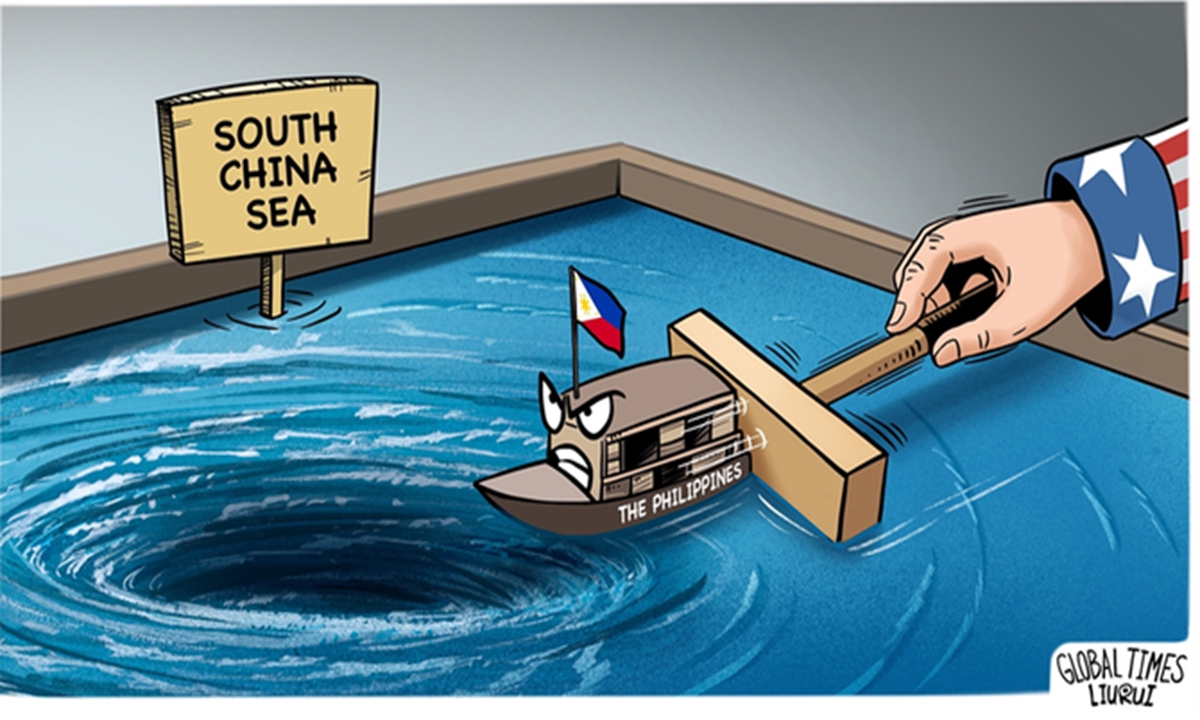
Illustration: Liu Rui/GT
Recently, in response to a statement issued by the Philippine National Maritime Council on the situation in the South China Sea, which claimed current tensions in the region are "the direct result" of China's activities, the deputy spokesperson of the Chinese Embassy in the Philippines delivered a clear and forceful rebuttal, calling the statement "unfounded and misleading" and criticizing Manila for deliberately misrepresenting the United Nations Convention on the Law of the Sea provisions and distorting China's lawful activities. This response not only serves as a strong refutation of the Philippine side's false accusations but also provides a renewed clarification of the essence of the South China Sea issue.
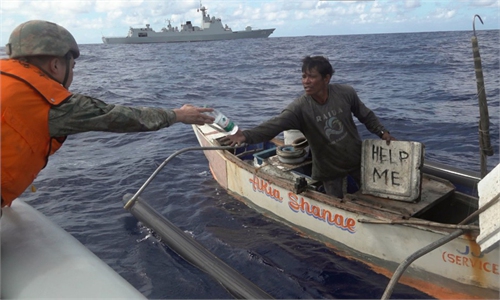
From the misinterpretation of the Chinese Navy's humanitarian rescue of Philippine fishermen in the South China Sea in late December last year, to the frequent hyping up of the tensions in the South China Sea by the Philippine side earlier this year, a series of events reflects that the maritime issues between China and the Philippines are being deliberately pushed by certain forces in the Philippines toward a more complex, confrontational and dangerous direction.
Throughout this process, China has consistently adhered to facts and international law, demonstrating a firm stance and strategic resolve in safeguarding territorial sovereignty and maintaining regional stability. Meanwhile, those Philippine individuals who continue to spread false information and incite confrontation not only fail to contribute to resolving the issues but also place the Philippines' own national interests at uncertain risk.
Regarding the historical, practical and legal disputes over the South China Sea issue, China possesses ample confidence, basis and evidence. Truth always becomes clearer through debate, while lies, no matter how many times repeated, can never become facts. In its statement, the Philippine National Maritime Council rehashes old tunes, claiming that tensions in the South China Sea stem from China's "illegal, coercive, aggressive and deceptive" activities in its so-called maritime zones. Such claims invert black and white, confusing right and wrong.
The Philippine side's recent statements are a continuation of its ongoing attempt to hype up the situation regarding the South China Sea issue and launch attacks and smears against China, with complex domestic political motives hidden behind them.
Upon careful observation, it is not difficult to see that some people in Manila are skillfully exploiting the South China Sea agenda to manipulate public opinion, particularly using the interests of Philippine fishermen - who should be protected - as political tools. This indifference and hypocrisy expose their true mind-set of placing the well-being of ordinary people behind geopolitical games. The Marcos Jr administration lacks any reflection on the potential risks of its own South China Sea policy.
A key reason is that fabricating a virtual "external threat" serves as a cheap means to divert domestic contradictions and consolidate support. In this context, hyping up the South China Sea issue and projecting a tough image toward China becomes a "shortcut" to mask domestic policy failures and solidify political positions.
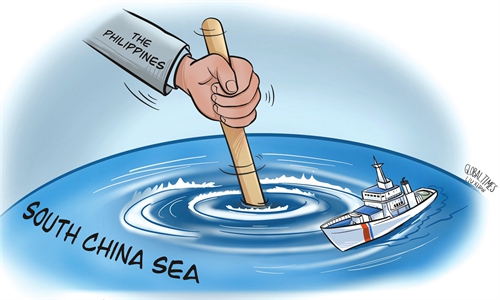
However, this "shortcut" may ultimately drag the Philippines into an unbearable vortex of geopolitical confrontation, fundamentally harming its long-term development interests.
Bilateral relations between China and the Philippines have been at a low point in recent years, with a key driver being certain forces in the Philippines that cannot tolerate good China-Philippines relations. In particular, some Philippine political figures, military personnel and certain opinion influencers have used hyping up the South China Sea issue and adopting a hard-line stance toward China as a "fast track" to seize personal political capital and attract public attention.
This practice is internally eroding and "hijacking" the Philippines' rational South China Sea policy and policy toward China, forming a dangerous "backlash" effect. The pragmatic space for policies is squeezed by populist emotions, and options for dialogue and cooperation are obscured by confrontational rhetoric, ultimately harming the Philippines' national interests and the healthy foundation of China-Philippines relations.
The South China Sea should not become a chessboard for games, nor should China-Philippines relations be hijacked by the selfish interests of a few. Only by moving toward each other, facing history and reality squarely, abandoning hype and confrontation, and returning to dialogue and consultation, can the Philippines align with the fundamental interests of the peoples of both countries.
The author is director of the Research Center for International and Regional Issues at the National Institute for South China Sea Studies. opinion@globaltimes.com.cn
RELATED ARTICLES