Illustration: Liu Rui/GT
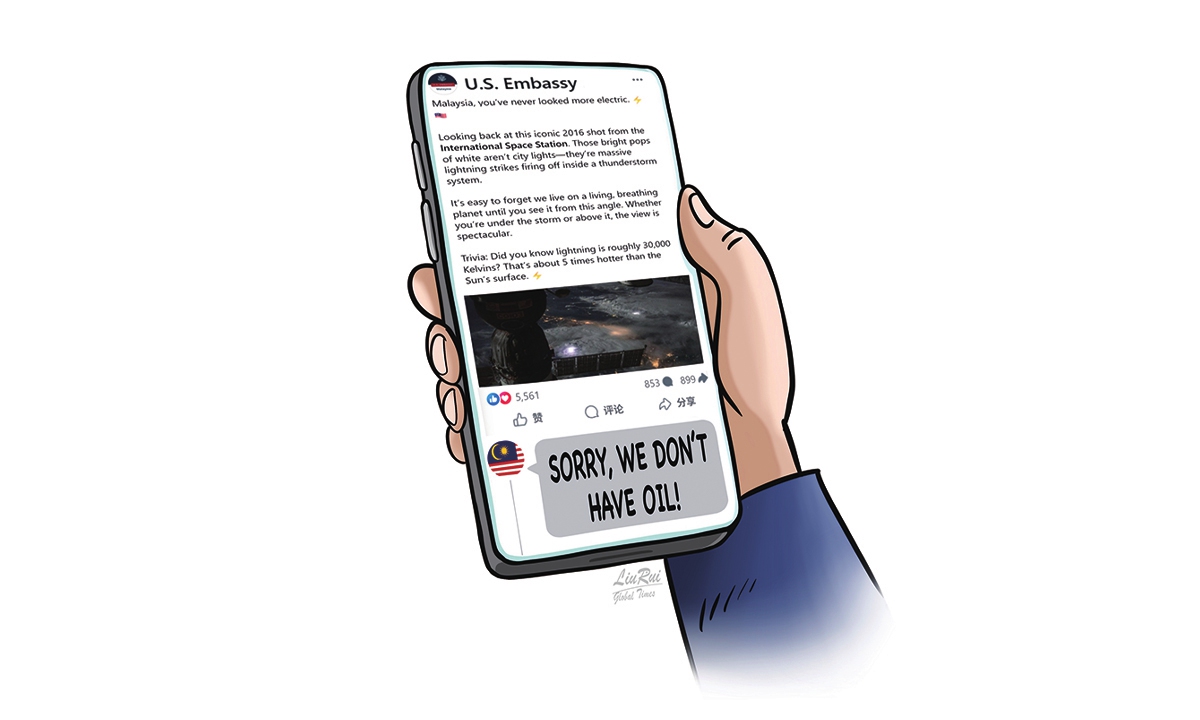
"Malaysia, you've never looked more electric." When the US Embassy in Kuala Lumpur, Malaysia, posted a space-view image of lightning over the country last week, opening the post with this line, it likely did not anticipate the tone the comment section would take like this.
"What you see are bonfires. At night we lit up bonfire to ward off wild animals while we sleep safely on trees," one Malaysian netizen commented. Even more striking was another comment: "Hye, please tell your president we don't have oil ya. We only have Saji Cooking Oil," by netizen Fakhri Kamarudin, which received more than 400 likes.
Within hours, the comment section had erupted into a "storm," with hundreds of Malaysian netizens sarcastically saying that their country had no electricity, oil or minerals - only cooking oil, orangutans and durians - seemingly to demonstrate that Malaysia held no "strategic value" to the US. Where does this satire and irony come from? The answer may lie in the recent crises faced by Venezuela and Greenland.
This humor is more than online banter, it reflects a form of cautious self-protection. It mirrors a clear-eyed understanding shared by many Global South countries: in Washington's worldview, a country's value is often measured by its resources and strategic position - value invites exploitation, while weakness is equated with safety.
"The US embassy's post and the high-altitude perspective of the image itself are imbued with a sense of self-superiority," Li Haidong, a professor at China Foreign Affairs University, told the Global Times. "These netizens' self-mockery reflects an awareness of the risks that come with being noticed by the US - once a country becomes 'useful,' it may be expected to 'burn itself' to serve American interests."
These seemingly lighthearted jokes are closely tied to recent US foreign policy actions. On January 3, the US launched a series of attacks against Venezuela and forcibly seized President Nicolas Maduro and his wife. Malaysian Prime Minister Anwar Ibrahim condemned the move, saying that "such actions constitute a clear violation of international law and amount to an unlawful use of force against a sovereign state," according to the Xinhua News Agency.
Reports later indicated that following Maduro's seizure, Caracas and Washington reached a deal to export up to $2 billion worth of Venezuelan crude to the US. Earlier, US President Donald Trump claimed that Venezuela "will be turning over" up to 50 million barrels of oil to the US, adding he would control the money raised. With such a precedent in mind, it is little surprise that Malaysian netizens rushed to declare that their country has "no oil" as a form of self-defense.
"Whether at the level of official statements or public reaction, these responses reflect a broadly shared understanding across the Global South: vigilance toward, and rejection of, US hegemonic logic have taken root both within governments and among the public," Ge Hongliang, vice dean of the ASEAN College at Guangxi Minzu University, told the Global Times.
Global South countries are realizing that US foreign policy often prioritizes power and resources over international justice or equitable cooperation. From Venezuela to Greenland, all are cast under the shadow of US hegemonic logic: anyone rich in resources or strategically located can be seen by the US as a potential target for intervention, sanctions or threats.
The US rhetoric of "civilization," "progress" and "partnership" often masks naked resource extraction and power projection. Under the logic of American exceptionalism and "America First," US actions appear unbound by international law, global rules, or multilateral institutions - frameworks that some US decision-makers regard as outdated, uncivilized, or obstacles to progress.
To push back against an unequal international order and safeguard regional security, they must, on one hand, maintain a balanced, non-aligned diplomatic stance, uphold strategic autonomy, and build strong economic, technological and industrial capabilities to reduce dependence on powerful states. On the other hand, they must strengthen coordination and solidarity within their regions and across the Global South, expand partnerships, and rely on collective strength and multilateral cooperation to secure greater strategic autonomy. This path is becoming an increasingly clear consensus.
RELATED ARTICLES