GT Voice: Industrial robot exports show China shares tech gains with intl markets
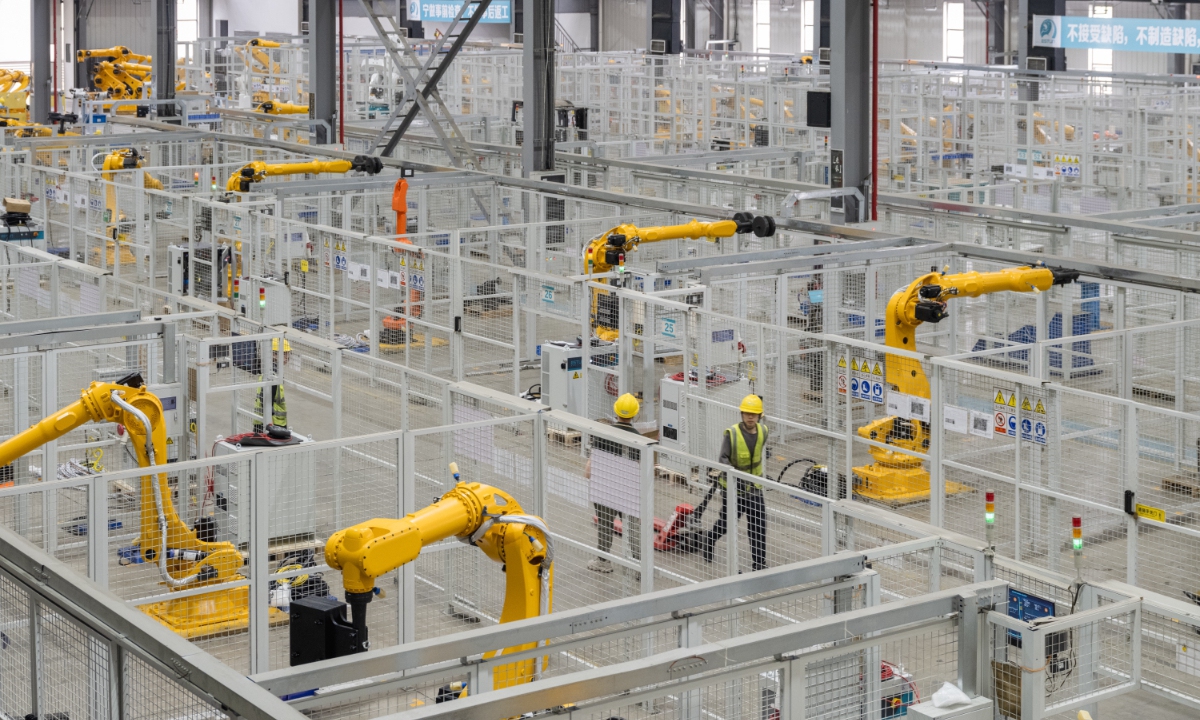
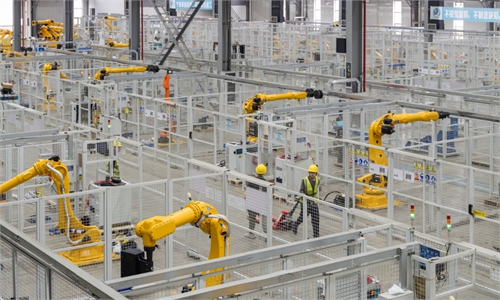
Robotic arms produce robots at a factory of Estun Automation in Nanjing, East China's Jiangsu Province. Photo: VCG
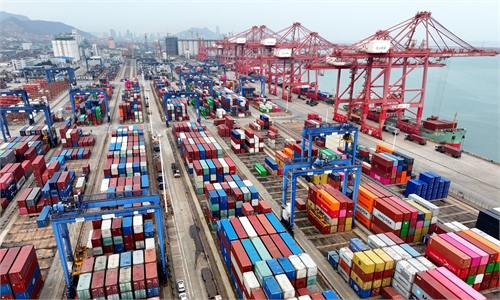
China's industrial robot exports surged 48.7 percent in 2025, surpassing imports for the first time and transforming China into a net exporter of industrial robots, Wang Jun, deputy administrator of the General Administration of Customs (GAC), said at a press conference in Beijing on Wednesday.The figure not only underscores the achievements of high-quality development in China's manufacturing sector but also reflects the accelerating global demand for intelligent transformation in manufacturing. More importantly, it is a vivid example of China sharing technological dividends and development opportunities with the world.
How did China's industrial robotics industry secure an increasingly important position on the global stage? The answer lies in its profound manufacturing foundation, persistent technological breakthroughs, and an open approach aimed at global collaboration.
In recent years, despite a complex and competitive international technological landscape, China has nurtured its robotics industry through its own advantages, including the world's most comprehensive and large-scale industrial ecosystem, which provides rich application scenarios, and sustained strategic national investment in innovation.
During the 14th Five-Year Plan Period (2021-25), China built more than 230 outstanding smart factories and 1,260 5G factories, with newly installed industrial robots accounting for more than 50 percent of the global total, Minister of Industry and Information Technology Li Lecheng said at a press conference in September 2025.
Large-scale application practices have accelerated technological iteration, supporting Chinese companies to achieve breakthroughs in core components, complete machine integration and other fields, and to progressively build comprehensive industrial capabilities that span research and development (R&D), manufacturing and services.
Furthermore, the rapid growth in China's industrial robot exports shows the country is moving into the higher end of global industrial and value chains, creating new opportunities for mutual benefit. On the one hand, the country supplies the global manufacturing sector with more diverse and resilient options for the intelligent and green transition. On the other hand, serving international markets requires Chinese businesses to learn regional and customer-specific needs, which in turn drives R&D and innovation - a virtuous cycle of application-driven demand, technological upgrading, and expanded global services. Asia remains the primary market for China's industrial robot exports, with key destinations including Vietnam, Thailand, and India.
The intelligent and green transformation represents the future direction of global manufacturing, and China, with its substantial manufacturing strength, has become a key force providing new impetus and opportunities for global industrial development.
This is because for a long time, the high cost and technical threshold of industrial robots limited their widespread adoption primarily to developed economies, leaving many developing nations struggling to bridge the technological divide.
The rise of China's industrial robotics sector changed this dynamic. Through scaled development and technological accumulation, China has significantly reduced the cost of entry for smart manufacturing, enabling more countries to pursue automation along a feasible path.
Cost-efficient Chinese robots help developing countries improve production efficiency and integrate into the global industrial chain. For developed countries, these robots promote technological competition and industrial innovation, driving the formation of a multi-level global robot ecosystem.
The leap of China's industrial robots from relying on imports to achieving net exports is a vivid demonstration of how Chinese smart manufacturing empowers global industry.
It not only effectively helps developing countries accelerate industrialization and narrow the development gap, but also promotes the evolution of the global manufacturing system toward a more balanced and inclusive direction. Amid a profound restructuring of the global value chain, the rise of China's industrial robot industry is not a breakthrough of a single force, but a prime example of industrial cooperation for mutual benefit.
As technology continues to evolve and service networks expand, China's industrial robots are poised to play an even more crucial role in the global intelligent transformation, driving the world toward a more inclusive industrial future.
RELATED ARTICLES