Iran briefly closes airspace as US reportedly deploys warships, submarine to Middle East; experts warn against widespread security risks should US choose military action
By Published: Jan 15, 2026 11:15 AM

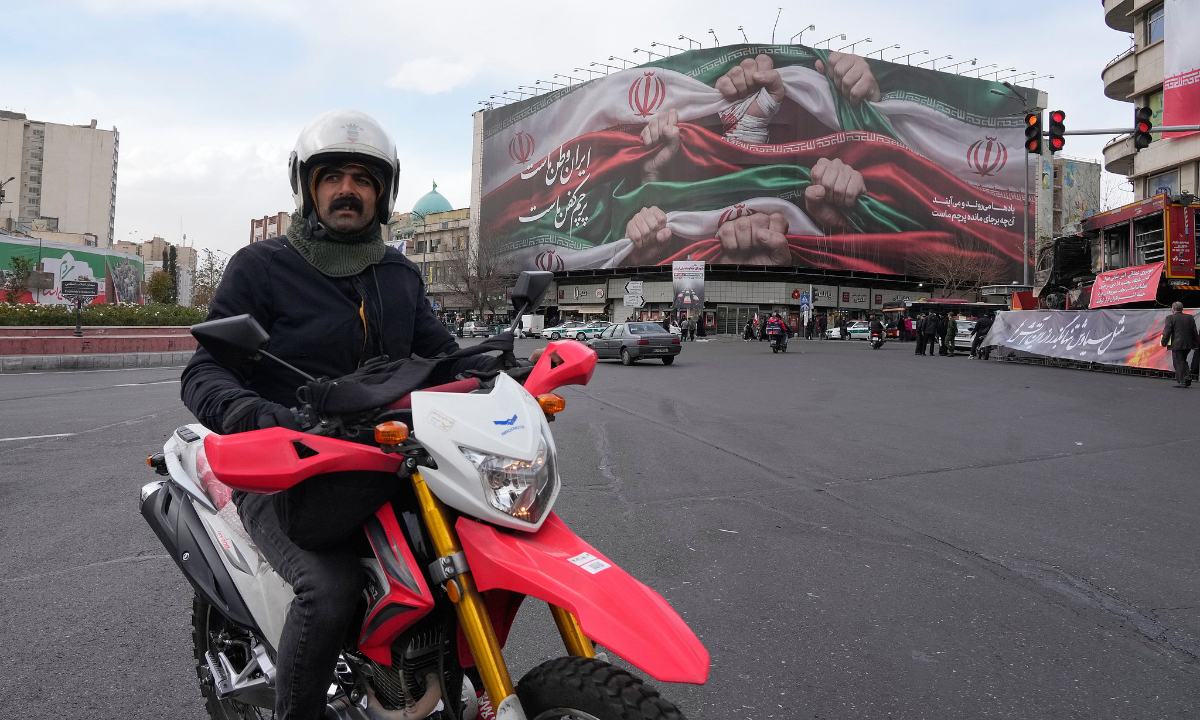
A man drives his motorbike past a huge banner showing hands firmly holding Iranian flags as a sign of patriotism, as one of them flashes the victory sign, in Tehran, Iran, Jan. 14, 2026. Photo: VCG
Iran reopened its airspace after a near-five-hour closure amid concerns about possible military action between the US and Iran that forced airlines to cancel, reroute or delay some flights, Reuters reported on Thursday.Iran closed its airspace to all flights except international ones to and from Iran with official permission at 5:15 p.m. ET (2215 GMT) on Wednesday, according to a notice on the US Federal Aviation Administration website.
US President Donald Trump said Wednesday that he's been told "on good authority" that plans for executions in Iran have stopped, according to Associated Press.
The US president's claims, which were made with few details, come as he's told protesting Iranians in recent days that "help is on the way" and that his administration would "act accordingly" to respond to the Iranian government. But Trump has not offered any details about how the US might respond and it wasn't clear if his comments Wednesday indicated he would hold off on action.
Trump has reportedly deployed three missile destroyers and at least one submarine to the Middle East amid heightened tensions with Iran over its crackdown on protests, according to The New York Times and other US media.
The destroyers are equipped with Tomahawk cruise missiles, bringing them within striking range. Meanwhile, some personnel are being urgently evacuated from Al-Udeid Air Base in Qatar, the largest US military base in the region.
Politico reported the British embassy in Tehran has closed, and the German government has advised airlines to avoid Iranian airspace due to risks of escalation and anti-aircraft weapons.
The US is withdrawing some personnel from its bases in the Middle East, a US official told the Reuters news agency on Wednesday, after a senior Iranian official said Tehran had warned neighbors it would hit US bases if Washington launches strikes on Iran.
A US official, speaking on condition of anonymity, said the US was pulling some personnel from key bases in the region as a precaution given heightened regional tensions, Reuters reported.
Qatar on Wednesday confirmed in a statement that some personnel are departing from the US Al Udeid Air Base in the country over "regional tensions," per Xinhua.
Regarding the evacuation, an informed Iranian official said in Tehran on Wednesday that the move could be part of US psychological warfare against Iran, according to Xinhua News Agency.
The official added that the Iranian armed forces are fully prepared for any scenario to unfold, are monitoring all the developments and US movements in the neighboring countries, and will take the necessary actions in case of any attack against the country.
After the reported US personnel evacuation from Qatar base, the Chinese Embassy in Qatar on Wednesday reminded Chinese nationals and Chinese-funded enterprises in the country to closely follow relevant news reports and strengthen security precautions.
Another Iranian official, speaking on condition of anonymity told the Reuters on Wednesday that direct contacts between Iran's Foreign Minister Abbas Araghchi and US Special Envoy Steve Witkoff had been suspended, reflecting mounting tensions.
The Iranian official was quoted by Reuters as saying that Tehran had asked US allies in the region to "prevent Washington from attacking Iran," saying that Tehran has told regional countries that US bases in those countries will be attacked if US targets Iran.
Reuters reported that Trump appears to have decided on a military strike against Iran. Two European officials told the news agency that US military intervention appeared likely.
An Israeli official also said it appeared Trump had decided to intervene, although the scope and timing of any strike had yet to be made clear.
In recent days, Trump has further escalated rhetoric about potentially striking Iran, threatening to "take very strong action" in a CBS News interview broadcasted on Tuesday night.
Addressing a media question regarding US President's related claim, Chinese Foreign Ministry spokesperson Mao Ning said that "We hope the Iranian government and people will overcome the current difficulties and uphold stability in the country. We oppose external interference in other countries' internal affairs, object to the use or threat of force in international relations, and hope parties will act in ways conducive to peace and stability in the Middle East," Mao added.
Sun Degang, director of the Center for Middle Eastern Studies at Fudan University, told the Global Times that should Washington ultimately decide to use force against Iran, it would most likely opt for a limited, punitive strike.
In his view, a strike of excessive scale or intensity could easily drag the US into a prolonged war of attrition with Iran—an outcome Washington is keen to avoid.
Historical experience suggests that when the US intervenes militarily against Iran, Tehran often strikes back by targeting US-linked countries in the Middle East, Niu Xinchun, executive director of the China-Arab Research Institute at Ningxia University, told the Global Times, noting that the scale of US intervention in Iran has a direct bearing on regional security. Should Washington choose large-scale military action, the entire Middle East would face severe and widespread security risks, the expert warned.
RELATED ARTICLES