BRI represents a turning point for Africa as it aligns with the continent’s pragmatic needs
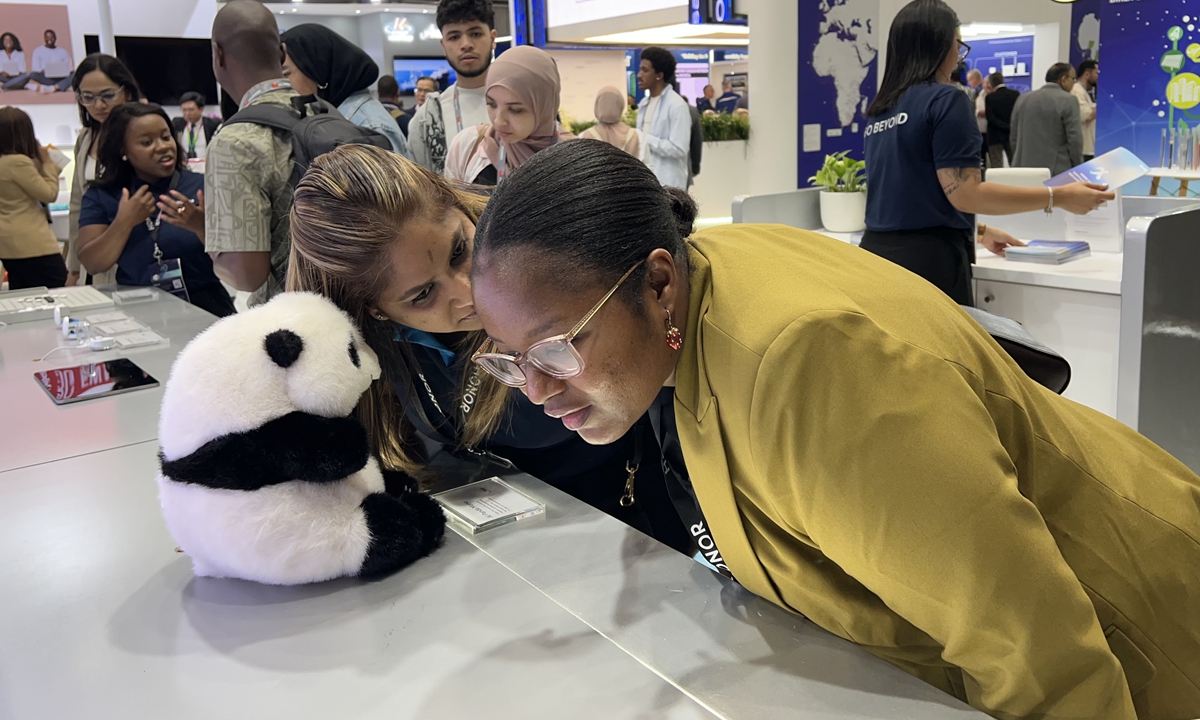
Two attendees to the 28th Africa Tech Festival that is held in Cape Town, South Africa, on November 11, 2025 local time, learn about a plush toy giant panda integrated with artificial intelligence systems in the Chinese enterprises' exhibition area. Photo: VCG
Chinese Foreign Minister Wang Yi has concluded his Africa visit this week, continuing a 36-year tradition for Africa to be the destination of the Chinese foreign minister's first overseas trip of the year.
Wang, also a member of the Political Bureau of the Communist Party of China (CPC) Central Committee, said that maintaining this diplomatic tradition for 36 consecutive years reflects the profound friendship of the Chinese people toward African people, as well as a commitment and spirit - When African brothers and sisters are in need, China will always be the first friend to stand by your side, according to a release from the Foreign Ministry on Tuesday.
Over the years, this tradition has demonstrated that a consistent pattern of diplomatic outreach—rooted in the history of China-Africa cooperation—has fostered one of the world's most pragmatic and productive partnerships in contemporary international relations. The tradition did not jump out of the magic box but is rooted in the shared history of anti-colonial struggles and the solidarity built from it.
So the diplomatic tradition for 36 consecutive years is a bold affirmation and testament that no matter how China grows in influence and economy or even however, the world changes, China would remain trustworthy and reliable friend of Africa. This important bit of history is necessary to disclaim any notion that contemporary China-Africa cooperation is transactional or opportunistic.
While the course of the partnership, as reflected in the tradition of the Chinese foreign minister's first visit to Africa at the start of each year, draws from history, it is not merely a tribute to historical memory. It is practical in nature and aligns with strategic efforts to address Africa's core concerns, including support to narrow or even close the longstanding deficit in infrastructure connectivity that has long hindered the region's integration and Pan-African unity.
In a world facing increasing uncertainty, China and Africa should deepen strategic engagement and play constructive roles in building an international governance architecture that is broad and inclusive—an effective antidote to any form of bullying. Although the geopolitical landscape is fraught with uncertainties and potential disruptions, China and Africa, together with the broader Global South, should consolidate themselves as a stable pole of international rule of law, certainty, and stability.
The nature of China-Africa cooperation is not built solely on a shared historical memory of solidarity in anti-colonial and anti-imperialist struggles, but also on a common vision of building resilient economies and political stability, delivering the social dividends of peace and improved living conditions for their respective peoples. In their respective processes of national development, China and African countries have identified critical areas of engagement, including mutual learning and experience-sharing in governance, thereby expanding the value chain.
This cooperation has produced a solid and credible track record in key areas such as trade and investment, industrial and production capacity cooperation, and infrastructure development, which have already achieved transformative milestones with far-reaching impacts across Africa.
Cooperation under BRI
With a key cooperation forum and the Belt and Road Initiative (BRI), China hopes to raise its cooperation with Africa to a new stage, Chinese Foreign Minister Wang Yi. Wang made the remarks on Saturday when meeting his Rwandan counterpart Louise Mushikiwabo in Kigali, capital of Rwanda, the first stop in his new year African trip.
]The significance of the BRI is best illustrated by the fact that Africa is the region with the largest number of partner countries. The China-proposed initiative has delivered—and continues to deliver—on Africa's critical development needs, enabling not only connectivity within the continent but also stronger links with the rest of the world.
From Nigeria's first-ever deep-sea port, the Lekki Deep Sea Port, to the Mombasa-Nairobi Standard Gauge Railway, and Ethiopia-Djibouti's first electrified railway, among many other projects, the state of infrastructure connectivity across the continent is steadily approaching the bold vision of African industrial and infrastructure integration.
BRI represents a major turning point for Africa because it objectively aligns with the continent's historic need to open pathways toward sustainable and inclusive development. In the past years, many African countries have also tailored their respective policies to engage with the initiative.
The BRI framework for international cooperation, in delivering tangible outcomes to partner countries, including those in Africa, enhances their capacities and contributes to their strategic resilience. At the current stage of high-quality development, the BRI's reputation for sustainability as well as timely, quality delivery is increasingly recognized as that of one of the most reliable international public goods.
People-to-people exchange
On January 8, the launching ceremony of the 2026 China-Africa Year of People-to-People Exchanges was held at the AU headquarters in Addis Ababa, the capital of Ethiopia. The people-centric engagement shows that a historic partnership of China-Africa proportion is not only more secure in the intimate bosom of the people but should better flourish at the people's conscious ownership of its process.
While people-to-people exchanges constitute the most solid foundation of China-Africa friendship, mutual learning provides a strong platform on which cooperation can continue its upward trajectory.
China has also extended zero-tariff access to imports from all 53 African countries with which China has diplomatic relations. The zero-tariff treatment extended to almost all African countries also provides a measure of certainty in a rapidly changing world, where major developed capitalist countries in the West are retreating from globalization.
This zero-tariff treatment not only helps secure a stable international market for African countries, but also supports the structural transformation of many African national economies away from mono-structural dependence on a single dominant commodity—a legacy of colonial domination. At the same time, it promotes the long-sought diversification of their economies by providing a stable export market for a wider range of products.
Charles Onunaiju is the director of the Centre for China Studies in Nigeria
RELATED ARTICLES