PLA Information Support Force seeks combat edge through quantum technology and supercomputing: media report
By Published: Jan 15, 2026 06:24 PM
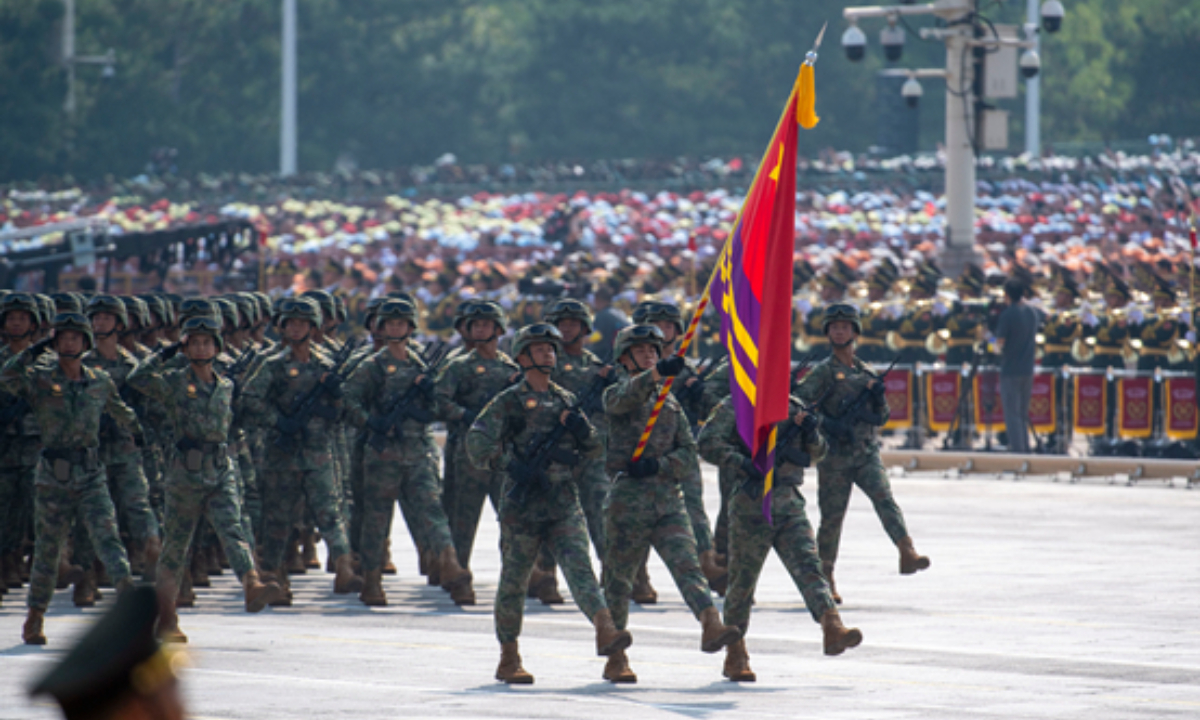
A formation from the Chinese People’s Liberation Army (PLA) Information Support Force marches past the Tiananmen Square in Beijing during China’s V-Day military parade on September 3, 2025. Photo: VCG
The Chinese People’s Liberation Army (PLA) Information Support Force is reportedly developing more than 10 types of experimental equipment, aiming to boost the combat capability of new qualities using quantum technology and supercomputing. A Chinese expert said on Thursday that quantum technology is characterized by high confidentiality, while supercomputers could enable fast intelligence processing and transmission, which provide advantages on the battlefield.
In a report about a center under the PLA Information Support Force that has been promoting the military application of the combination of quantum technology and supercomputing, the Science and Technology Daily recently said that works are being carried out at a supercomputing lab of the National University of Defense Technology to wrap up a pre-study project on military intelligence.
The report quoted a leader of the center as saying that "speed" and "changes" are defining features of the cyber and information domain. Since its establishment, the center has actively adapted to the changes in warfare, science and technology, and adversaries. It has organically integrated the guidance of operational requirements with the impetus of technological application, and made scientific plans for its development direction, goals, systematic layout and major tasks.
In early 2025, the center focused on cutting-edge directions including cloud-native technologies, artificial intelligence and quantum technology, accelerated the establishment of a mechanism for responding to new-domain and new-quality military requirements and designing technical solutions in the cyber and information domain, and advanced the dynamic tracking of frontier technologies, sorting out achievements, and practical application of such technologies in this domain, the Science and Technology Daily reported.
It also launched a number of research projects in fields such as quantum technology, took the lead in conducting research and development on more than 10 types of experimental equipment, and organized the trial application and transformation of multiple achievements in frontline mission scenarios, according to the report.
Song Zhongping, a Chinese military affairs expert, told the Global Times on Thursday that communications using quantum technology are very hard to decrypt, thus providing a high level of confidentiality, which is crucial in combat.
Supercomputing, on the other hand, can gather and calculate massive data. Operating on a supercomputing platform allows for highly accurate and rapid generation of conclusions, which in turn facilitates intelligence analysis and data analytics. With the support of sophisticated algorithms, it becomes possible to obtain the latest information and intelligence at the fastest speed, Song said.
Warfare hinges on the speed of information acquisition, and it is critical to ensure that intelligence remains unaltered, free from eavesdropping and theft during transmission and when issuing orders. This is why combining quantum technology with supercomputing holds significant meaning, Song said.
On the frontline of a certain mission, Liu Wei, an associate research fellow from the center, led a team to conduct in-depth research on the "cyber and information plus perception" empowerment system, and continuously enhanced the capabilities of real-time detection, precise identification, cross-domain integration and rapid support under actual combat conditions, the Science and Technology Daily reported.
Taking full advantage of the public service platform system’s strengths in system integration and full-domain support, the team built a brand-new model of cyber and information empowerment for battlefield perception, the report said.
RELATED ARTICLES