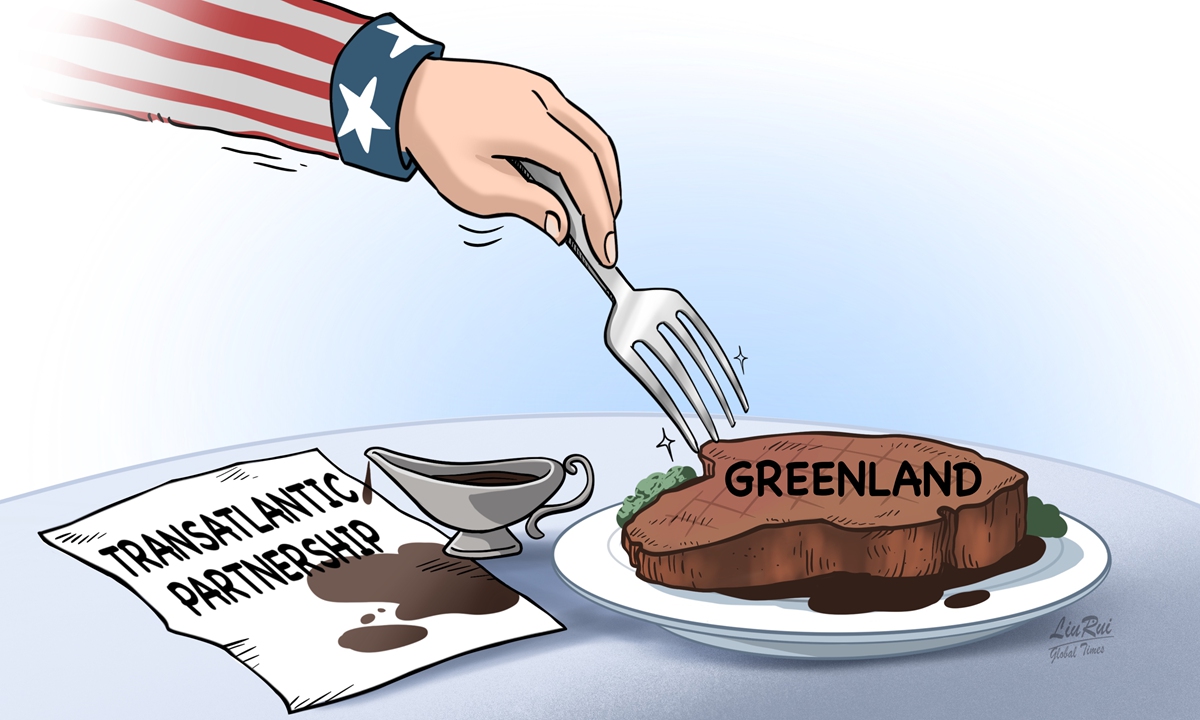
Illustration: Liu Rui/GT
When the US put its thumb on Venezuela, Europe fell into a "self-contradictory state" - politically endorsing US objectives while technically opposing its methods - and responded with ambiguous and hesitant reactions. However, when the US set its sights on Greenland, Europe could no longer cling to its last shred of illusion about its most important ally, forcing it to hastily confront the nightmare of the return of "US imperialism."
The economic, security and political contradictions between Europe and the US have become increasingly difficult to conceal and, in recent years, have even escalated. For Europe, these issues still seemed manageable through economic concessions as well as security and political compromises. Yet, in its bid for Greenland, the US' comprehensive pressure, even threatening the use of force, struck directly at the heart of the transatlantic relationship, rendering Europe's strategies of compromise, concession or appeasement ineffective.
Beyond harboring wishful thinking about the US, Europe's hasty and ill-considered response to the US plan to acquire Greenland stems more from its insufficient understanding of the primary manifestation of current US hegemony - "resource imperialism." It is not rare in the US-dominated international order, as evidenced by its launching of multiple wars to secure control over the Middle East. Yet, Washington's current version of "resource imperialism" aims to strengthen its own resource advantages by seizing control of resource-rich regions, even though the US has achieved energy independence. It leverages all policy tools, including military means, to achieve exclusive domination.
The US ambition for resource control has long been evident. During the so-called negotiation over the Ukraine crisis, the US paid lip service to a genuine peaceful resolution while earnestly seeking to control Ukraine's strategic resources. It turned a deaf ear to the legitimate security concerns of all parties while meticulously planning to continue extracting gains through "postwar reconstruction," fully exposing the essence of its "resource imperialism." Had Europe harbored less blind faith and dependence on the US and drawn more reasonable parallels between "Ukraine today" and "Greenland tomorrow," its response today might have been more composed and less rushed.
The core objective of the US strategy to control resources is not driven by market demand or the pursuit of short-term energy gains, but by the desire to secure long-term and exclusive dominance. This explains why the US continues to treat Venezuela as a primary target in Latin America. The reason lies in the fact that should Venezuela's world-leading oil reserves fall into the hands of other nations, US energy advantage in great power competition would be diminished.
The same logic applies to Greenland. Although resource extraction there faces formidable challenges due to the fragile ecosystems, Greenland is estimated to possess around 1.5 million tons of rare earth reserves. From the US perspective, even if these resources are difficult to monetize in the short term, controlling Greenland would deny its competitors access to such critical reserves.
Greedy expansion is inherent to imperialism and US "resource imperialism" will not confine itself merely within the scope of the Western Hemisphere. Consequently, Greenland, Canada, Europe and the Arctic will all become targets of the "empire." The US' pressure over Greenland not only infringes upon Denmark's sovereignty and territorial integrity, but also shatters Europe's nostalgic attachment to alliance with the US back in the "good old days." More critically, it poses a severe threat and undermines the security of global supply chains and industrial networks built on the principle of market-based division of labor, as well as the stability of the international economic order.
At the same time, Europe is unwilling to submit to the pressure from the US. Some European countries have proposed strengthening their military presence in the Arctic and sharing the burden of US responsibilities, thereby countering Washington's argument that "Greenland is not safe in Europe's hands." At the same time, Europe is considering sanctions against US companies to signal the economic costs Washington could face as transatlantic relations deteriorate. The EU is also accelerating the trade agreements with Mercosur countries, reflecting a clear intent to reject the US' attempt to treat Latin America as its exclusive sphere of influence.
While the ultimate outcome of the US-Europe standoff over Greenland remains uncertain, Europe will not be alone in its resistance against "resource imperialism." Both China and Europe heavily rely on external markets for traditional energy resources and are likely to become primary victims when "resource imperialism" disrupts market mechanisms. They are also proactive advocates of multilateralism and opponents of hegemony, as well as partners committed to building a just and equitable international order. Advancing green transformation together to achieve resource independence and jointly resisting and opposing hegemonic practices in the resource sector can serve as new shared goals for China-Europe cooperation.
The author is a professor at the Academy of Regional and Global Governance at Beijing Foreign Studies University. opinion@globaltimes.com.cn
RELATED ARTICLES