China unveils fresh policy boost to fuel a good start in 15th Five-Year Plan period
Nation still has room for RRR and interest rate cuts, central bank says
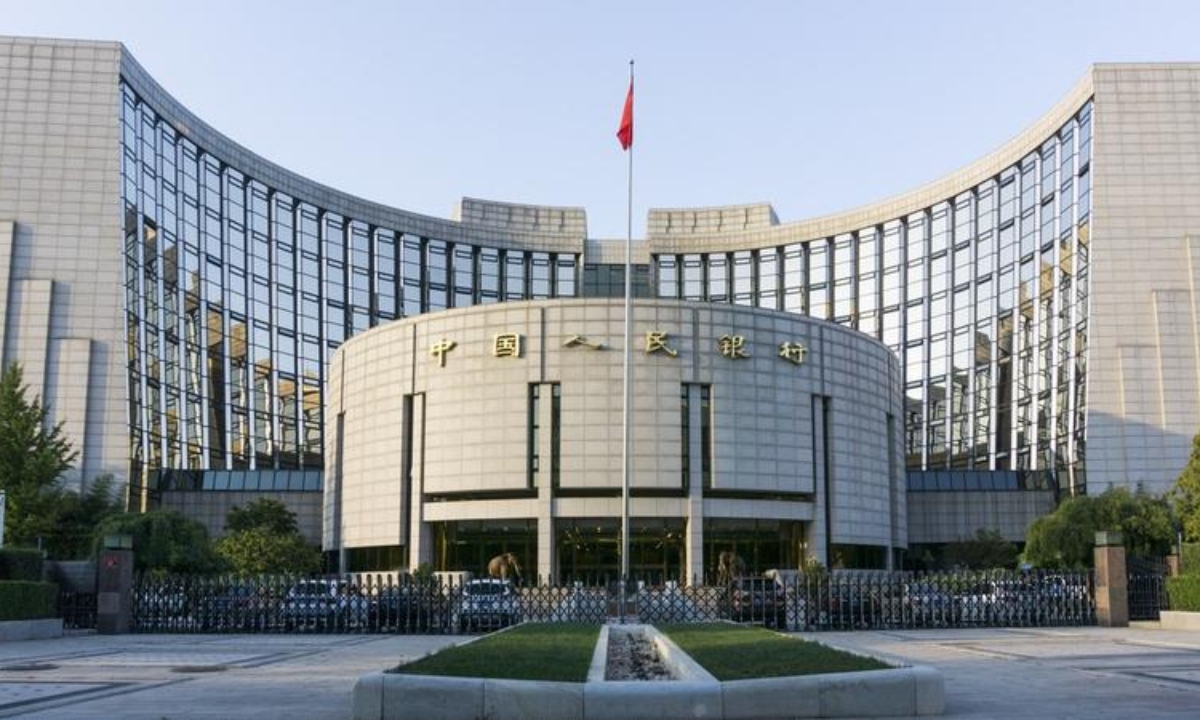
The headquarters of the People's Bank of China in Beijing Photo: IC
The People's Bank of China (PBC), the country's central bank, on Thursday unveiled a raft of support measures, including a cut in interest rates on all structural monetary policy tools and raising the quota of re-lending for tech innovation and tech transformation, as the central bank stepped up counter-cyclical and cross-cyclical adjustments to fuel a good start of the 15th Five-Year Plan period (2026-30).
Starting Monday, the PBC will cut interest rates on all structural monetary policy tools by 0.25 percentage points. The one-year relending rate will be reduced from 1.5 percent to 1.25 percent, with rates for other maturities adjusted accordingly, read a notice on the PBC's website, noting that the move will better leverage the incentive role of structural monetary policy tools and guide financial institutions to increase support for major strategies, key areas, and weak links.
The PBC has also decided to increase the quota of relending for tech innovation and tech transformation from 800 billion yuan ($114.72 billion) to 1.2 trillion yuan. And, starting from 2026, the central bank will extend the support to cover private small and medium-sized enterprises with higher research and development (R&D) investment levels, according to a separate PBC notice.
In addition, the PBC has decided to increase the relending quota for agriculture and small businesses by 500 billion yuan. Within the total quota, a dedicated 1-trillion-yuan relending facility will be allocated for private enterprises, focusing on supporting small and medium-sized private enterprises, according to the central bank.
To promote the comprehensive green transformation of economic and social development, the PBC has decided to include projects with direct carbon emission reduction effects, such as energy-saving retrofitting and green upgrading, into the support scope of carbon-reduction supporting tool, according to the PBC.
The 2025 Central Economic Work Conference (CEWC) pointed out that the country will continue implementing a moderately loose monetary policy in 2026, and the PBC will, in line with the decisions and deployments of the Communist Party of China Central Committee and the State Council, to strengthen counter-cyclical and cross-cyclical adjustments to effectively fuel a solid start of the 15th Five-Year Plan period, Zou Lan, deputy governor of the PBC, said at a press conference on the release of these policies on Thursday.
During implementation, these policies will coordinate with fiscal policies such as interest subsidies, guarantees, and risk sharing so as to further amplify policy effectiveness and jointly expand effective domestic demand, Zou stressed.
"The improvement in these structural policies underscores that the PBC aims to build a scientific and stable monetary policy during the 15th Five-Year Plan period. With focus on the real economy, it's expected that more money will flow into tech innovation, green development, agriculture, and small business sectors this year so as to bolster the key field and weak links of national economy," Cao Heping, an economist at Peking University, told the Global Times on Thursday.
Considering China's longer-term 2035 vision as well as the general principle of pursuing progress while ensuring stability pointed out at the CEWC, the 2026 GDP growth target may be set at around 5 percent year-on-year, Wen Bin, chief economist at China Minsheng Bank, told the Global Times on Thursday.
"In order to maintain a reasonable growth rate, the primary goal is to stabilize employment," Wen said, noting that macroeconomic policies must create a sound environment for the main force of employment such as the private economy and the service sector. He said there is both room and necessity for further reduction in the country's reserve requirement ratio (RRR) and policy rate so as to continuously lower the financing costs of the real economy.
China still has room for cuts in the RRR and interest rates this year, with a firm yuan performance and stabilizing bank net interest margins providing the scope, said Zou.
The average RRR for financial institutions currently stands at 6.3 percent, indicating that further RRR cuts remain possible, the official said.
Amid stepped-up policy support, multiple global financial institutions and organizations also expressed optimism on China's economic outlook.
The IMF recently released its latest World Economic Outlook report in Beijing, upgrading China's economy to 5.0 percent in 2025 and 4.5 percent in 2026. These projections reflect an upward revision of 0.2 and 0.3 percentage points respectively, compared to its forecast made in October, which the organization said is driven by the country's welcome macroeconomic policy stimulus measures and lower-than-expected tariffs on China's exports.
In addition, financial heavyweight Standard Chartered raised its forecast for China's 2026 GDP growth to 4.6 percent from 4.3 percent, supported by the country's gains in total factor productivity and resilient exports, according to a note the bank sent to the Global Times.
RELATED ARTICLES