A benchmark of intelligent manufacturing
How Xiaomi’s EV factory becomes a ‘must-see’ for global visitors
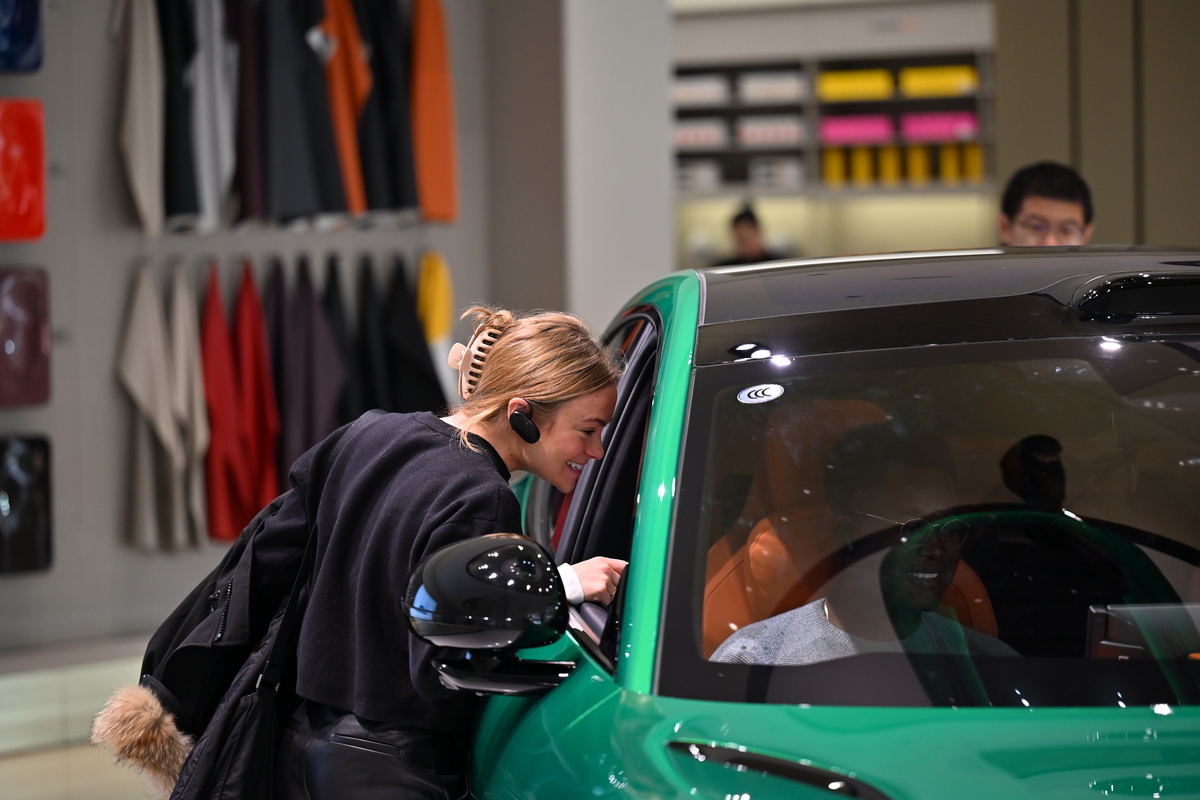
A foreign visitor inspects a Xiaomi YU7 EV at the Xiaomi EV Hyperfactory showroom on December 10, 2025. Photo: Tao Mingyang/GT
Molten aluminum glows briefly before disappearing into a steel mold. Seconds later, a single, solid vehicle structure emerges - still hot, still humming. This is die casting, a manufacturing method long used in the auto industry: metal is melted, injected into a mold under extreme pressure, held until solidified, then cooled and finished into high-strength automotive components.
The principle is straightforward, while the execution is not.
Inside Xiaomi's electric vehicle (EV) Hyperfactory in Beijing, a die-casting machine with 9,100 tons of clamping force and a total weight of 718 tons compresses what were once 72 separate parts into a single structural unit. The result is a stronger body frame - and a sharply simplified production process.
For Lucy, a visitor from the US, the scale and precision of the operation were striking. "It's my first time visiting a car manufacturing company, and I thought it was incredible," she said. From the start of the tour, she watched aluminum ingots turn into car frames, while robotic arms handled assembly and sensors tracked each step of the process in real time.
Powered by scale and automation, the Xiaomi EV Hyperfactory has increasingly become what locals describe as a "must-see industrial site" in Beijing, drawing visitors from both China and abroad. According to Ma Lan, chief of staff of Xiaomi EV and GM of General Management Department of Xiaomi Yizhuang Region, the facility has so far hosted more than 400 organized visits for guests spanning over 70 countries and regions, including foreign officials, industry experts, media representatives, investors, key suppliers, and business partners.
Such digitally driven, intelligent factories are not isolated cases in China. The Xiaomi EV Hyperfactory has become one of the key windows through which the outside world observes the evolution of China's advanced manufacturing sector.
Global attention
Covering an area of 718,000 square meters - roughly the size of the Forbidden City - the Xiaomi EV Hyperfactory operates at a pace where one new-energy vehicle rolls off the line every 76 seconds. Smarter, more flexible, and more energy-efficient: these are the defining traits of the modern auto plant. Digital technologies now span the entire production chain, while artificial intelligence and robotics are reshaping manufacturing logic at unprecedented speed.
Traveling through the heart of the body workshop by shuttle, what stands out is not a single robotic arm in motion, but more than 700 robots working in coordinated precision. Across more than 200 key processes, automation has reached 100 percent, according to a factory representative.
For many foreign visitors, the Xiaomi EV Hyperfactory offers a first close-up look at China's EV manufacturing capabilities. Rohan, a visitor from Columbia University in New York, described the experience as "incredible."
He noted that the factory tour, showroom, and even the on-site go-kart track were both engaging and informative. Watching aluminum transform into finished vehicles on highly automated lines highlighted, in his words, the system's organization, efficiency, and flexibility.
Foreign visitors are not limited to students or car enthusiasts. Diplomats and automotive executives have also been frequent guests.
In November 2024, more than 30 diplomatic envoys and trade officials from 18 countries - including Argentina, Egypt, Austria, Germany, Singapore, Turkey, and Indonesia - visited the Xiaomi EV Hyperfactory. The vehicle design, production efficiency, and hands-on experience with the high-speed SU7 Ultra left a strong impression on many of them, according to an article published on the website of Foreign Affairs Office of the Beijing Municipal Government.
Huub Buise, minister counselor at the Dutch Embassy in China, said he was impressed by Xiaomi's EV Hyperfactory and saw significant potential for deeper China-Europe cooperation in new energy. Mahmoud Tialab, second secretary at the Egyptian Embassy in China, said the plant stood out among those he had visited, adding that Egypt is already in contact with Xiaomi to explore possible cooperation, according to the article.
Recalling numerous overseas visitors to the facility, Ma shared a memorable story with the Global Times. In late October 2025, a Jamaican government delegation visiting China for disaster prevention and mitigation exchanges made a special stop at the factory. "They were immediately drawn to our Emerald Green model," Ma said. "They told us the color closely resembles the green in Jamaica's national flag, which made them feel an instant connection." Delegation members repeatedly asked when the vehicle would enter the Jamaican market and said they would be among the first buyers, she noted.
World-class benchmark
The Xiaomi EV Hyperfactory moved from groundbreaking to completion in just 14 months, and work on its second and third phases is now progressing steadily. Analysts say the pace reflects China's execution efficiency and manufacturing innovation during its broader industrial transition.
Another visiting student named Evert from Columbia University noted that what stood out most was the speed at which the entire manufacturing system had been built. "That this can be done from the ground up in such a short time really speaks volumes," he said, citing China's strengths in manufacturing coordination, efficiency, and technological integration.
Founded in 2010, Xiaomi began as a consumer electronics company focused on smartphones and home appliances. On July 8, 2024, founder and CEO Lei Jun announced on social media that Xiaomi's next-generation smartphone smart factory in Beijing's Changping district had officially begun operations. The facility has an annual capacity of 10 million flagship phones, and has been certified as a national-level intelligent manufacturing benchmark enterprise.
A Financial Times report has noted that Xiaomi's pivot from an asset-light consumer electronics business to a manufacturing high-flyer aligns with the Chinese government's call for domestic companies to develop new quality productive forces.
From a broader perspective, the transition also fits into China's medium-term development blueprint, as the Recommendations of the Central Committee of the Communist Party of China for Formulating the 15th Five-Year Plan for National Economic and Social Development stated that China should promote technological transformation and upgrading to shift toward digital and intelligent development in the manufacturing sector, develop smart, green, and service-oriented manufacturing, and work faster to transform industrial models and enterprises' organizational forms.
"Xiaomi's rise could probably happen only in China," the Wall Street Journal wrote in an article on February 28, 2025. Chinese EV makers control nearly every aspect of manufacturing and can turn to domestic suppliers for most of their materials and parts, said the article, noting that this makes their operations more efficient than those of non-Chinese car manufacturers, which depend on a global supply chain that is susceptible to delays, price fluctuations and logistical hiccups.
The Diplomat magazine recently said China chose openness over protectionism in its EV industry and introduced foreign competitors such as Tesla to spur domestic innovation. Ma told the Global Times that executives from leading global automakers - including Mercedes-Benz, BMW, and Ferrari - have visited the factory for exchanges.
"This provides us with an excellent learning opportunity," she said. "At the same time, these executives gain a more comprehensive understanding of China's market demands and innovation rhythm." Such two-way observation and dialogue are laying the groundwork for deeper industrial collaboration in the future.
Ma also noted that Xiaomi EV plans to enter overseas markets by 2027. Looking ahead, the factory's openness carries a clear strategic significance: it acts like a prism, reflecting global recognition of China's ability to reshape high-end manufacturing through intelligence and sustainability, while also signaling the world's shared expectation for a more efficient, sustainable, and collaboratively open industrial future.
RELATED ARTICLES