China breaks ground on world’s first dual-reactor coupled nuclear energy project, building low-carbon transition
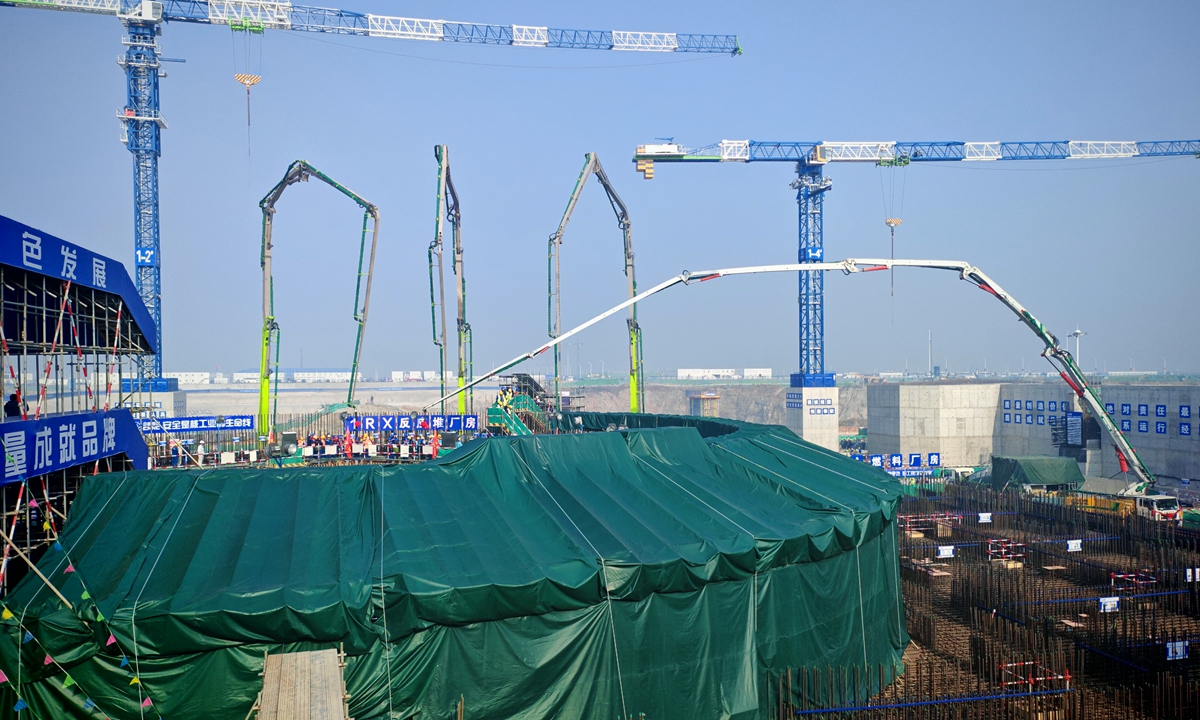
Concrete pouring begins for the nuclear island of Unit 1 at the Xuwei Nuclear Heating and Power Plant in Lianyungang, East China's Jiangsu Province, on January 16, 2026. Photo: Liang Rui/GT
On Friday, concrete pouring began for the nuclear island of Unit 1 at the Xuwei Nuclear Heating and Power Plant in Lianyungang, East China's Jiangsu Province, a project developed by China National Nuclear Corporation (CNNC). As the first nuclear power unit to break ground in China in the opening year of the country's 15th Five-Year Plan, the move marks the entry of the world's first large-scale project coupling nuclear energy with the petrochemical industry into its main construction phase, offering a scalable Chinese solution for achieving global carbon peaking and carbon neutrality goals.According to CNNC, the Jiangsu Xuwei Nuclear Heating and Power Plant is the world's first project to couple a pressurized water reactor with a high-temperature gas-cooled reactor, the first commercial-scale deployment of high-temperature gas-cooled reactor technology, and the first nuclear project globally to adopt an integrated, plant-wide construction approach under a nuclear engineering, procurement and construction model.
The project is designed primarily for industrial heat supply while also providing electricity. It combines China's independently developed third-generation nuclear technology, the Hualong One, with fourth-generation high-temperature gas-cooled reactor technology.
In operation, the main steam from the Hualong One is used to heat demineralized water to produce saturated steam, which is then reheated by the main steam from the high-temperature gas-cooled reactor. Under design conditions, the plant will be capable of simultaneously supplying high-quality industrial steam and generating electricity.
The first phase of the project includes two Hualong One units and one high-temperature gas-cooled reactor unit. Once completed and put into operation, the phase-one project will supply 32.5 million tons of industrial steam annually and generate more than 11.5 billion kilowatt-hours of electricity at peak output.
It is expected to reduce standard coal consumption by 7.26 million tons per year and cut carbon dioxide emissions by 19.6 million tons annually. The project will provide large-scale supplies of high-quality, low-carbon industrial steam to Lianyungang's trillion-yuan petrochemical industrial base, offering reliable clean energy support for the green transformation of the petrochemical industry in the Yangtze River Delta.
Bai Wei, chief design engineer of the Xuwei project at China Nuclear Power Engineering, told the Global Times that coupling design supported by digital simulation is one of the project's key technical challenges.
By leveraging the resources of design institutes and universities, the project team has carried out hierarchical and specialized digital simulation for control system design, progressing from simple to complex scenarios and achieving multi-dimensional coupling. Full use of digital technologies has helped support the coordinated control logic design for the integrated system, Bai said.
Li Quan, project manager of China Nuclear Industry Huaxing Construction Co., Ltd, who is in charge of civil construction of the Xuwei project, introduced the R&D and application of intelligent equipment in construction to the Global Times. Advanced technologies such as laser intelligent tracking Metal Active Gas Automatic Welding have been deployed, improving efficiency by at least three times compared with traditional manual shielded metal arc welding.
According to the CNNC, the project marks the beginning of China's transition in nuclear energy from a power-generation-focused model to diversified energy supply. It opens a new chapter in providing a replicable and scalable "Chinese solution" for the low-carbon transformation of high-energy-consuming industries worldwide, injecting strong momentum into the realization of global carbon peaking and carbon neutrality goals.
Advancing carbon peaking and carbon neutrality is China's solemn commitment to the international community and an inherent requirement for achieving sustainable development.
The 2025 white paper titled Carbon Peaking and Carbon Neutrality China's Plans and Solutions mentioned pursuing robust, safe and orderly development of nuclear power. Nuclear power is an efficient and high-quality clean energy source. China is committed to developing nuclear power with the absolute requirement that safety is guaranteed, and to promoting the use of nuclear energy in clean heating, industrial heating, and seawater desalination.
The green and low-carbon transformation of the energy structure is key to achieving carbon peaking and carbon neutrality. Beyond nuclear power units, the CNNC also actively promotes the comprehensive utilization of nuclear energy, including regional heating, industrial steam and cooling supply, seawater desalination, nuclear-powered hydrogen production, and isotope production.
RELATED ARTICLES