Shenzhou-20 taikonauts make 1st public appearance after safe return following debris incident, recounts details
By Fan Anqi and Published: Jan 16, 2026 07:32 PM

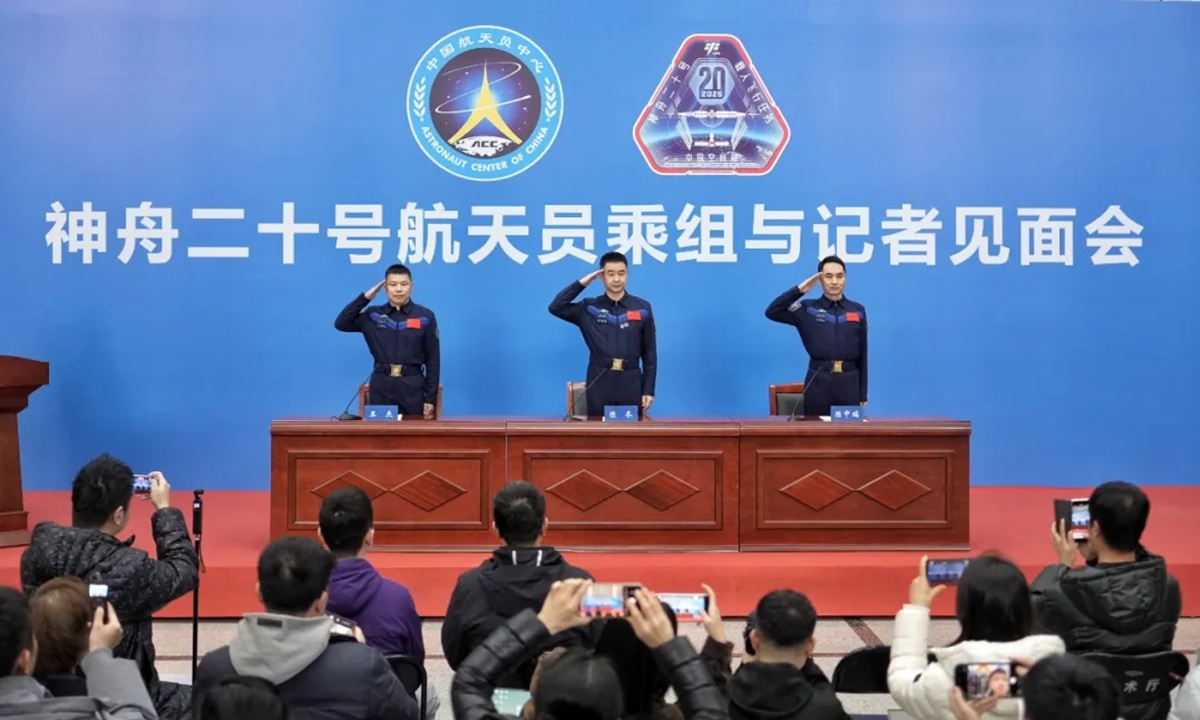
The Shenzhou-20 crew make their first official public appearance on January 16, 2025 in Beijing after returning safely to Earth. Photo: China Space News
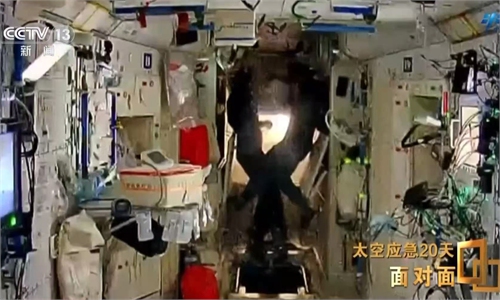
The Shenzhou-20 crew - Chen Dong, Chen Zhongrui and Wang Jie -made their first official public appearance on Friday in Beijing after they returned safely to Earth by "transferring" to the Shenzhou-21 spacecraft 63 days ago. They briefed the press on the emergency response process after discovering a window crack caused by an unexpected hit by space debris, and showed how China's manned space program made it all possible in just 20 days.
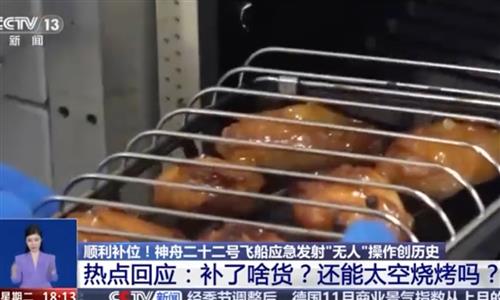
The crew also fondly recalled the delicious "space barbecue" and the aroma of roasted chicken wings and steak became a warm highlight of their life in orbit.
During the final pre-return checks, the crew discovered a triangular penetrating crack on the return capsule's porthole, preliminarily assessed as having been caused by a space debris strike, the Global Times learned at the press conference held on Friday at Beijing Aerospace City.
Commander Chen Dong immediately photographed the damage and transmitted the images to ground control. Working closely with the Shenzhou-21 crew, the team conducted detailed observations and discussions of the window's condition, fully supporting ground teams in verification and reassessment.
The crew swiftly activated emergency protocols and carried out preparations under ground instructions after the return was postponed. Thanks to precise analysis and efficient support from the ground team, the Shenzhou-20 taikonauts successfully transferred to the Shenzhou-21 return capsule and landed safely on Earth.
From the initial detection of the hazard to the completion of the capsule swap, return, and the subsequent successful docking of Shenzhou-22 with the space station, the entire process took just over 20 days, demonstrating the safety and efficiency of China's manned spaceflight program.
Chen Dong, the most experienced spacewalker in China with six extravehicular activities (EVAs) to date, reflected on his spaceflight at the press conference. His EVAs ranged from equipment installation during the space station's construction phase to the mounting of space debris protection panels during the operational phase, each contributing to safeguarding the orbital "home."
Having accumulated more than 400 days in orbit—the longest total for a Chinese taikonaut—he noted that repeated missions have refined the ground training system, made in-orbit coordination with ground teams increasingly seamless and efficient, and enriched health protection measures, steadily boosting his confidence in mission success.
For third-batch taikonaut Chen Zhongrui, the Shenzhou-20 mission marked his first spaceflight, yet he completed a 204-day stay with composure. He executed three EVAs during the mission, and completed more than eight hours of extravehicular work.
Wang Jie, also from the third batch and serving as flight engineer, shouldered major responsibility for the environmental control and life support system during the extended six-person residency following the return delay involving the Shenzhou-20 and Shenzhou-21 crews.
"This system is the 'lifeline' of the space station," Wang explained. "We treat it like caring for a living organism—conducting daily parameter inspections and fine-tuning oxygen and water supplies," He said. He also optimized work-rest schedules and sleep environments to ensure crew well-being during the extended stay.
The "space barbecue" that attracted widespread attention from netizens left a deep impression on him. He recalled that the thermal baking device integrated with a "range hood" function was easy to operate, and that the aroma of roasted chicken wings and steak filled the cabin, becoming a warm highlight of their space life.
A highlight fondly remembered by netizens was the "space barbecue," enabled by an integrated ventilation-equipped high-temperature oven that easily produced fragrant roasted chicken wings and steaks, adding warmth to orbital life.
Following their return, the Shenzhou-20 crew completed the quarantine and recuperation phases and has now entered the recovery observation stage, they said at the press conference.
Under the attentive care of the Astronaut Center of China's medical support team, the crew are in good physical and mental condition. Medical examinations showed normal results, with muscle strength, endurance, and cardiopulmonary function largely restored to pre-flight levels.
After completing the recovery program and undergoing final health evaluations, the three taikonauts will transition to regular training.
RELATED ARTICLES