Illustration: Chen Xia/GT
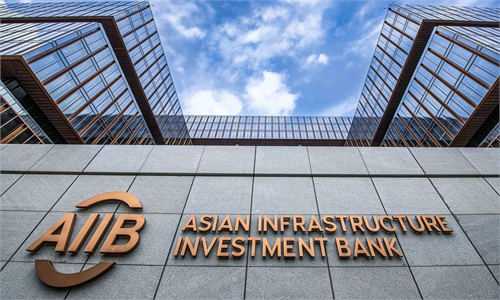
Asian Infrastructure Investment Bank (AIIB), the first multilateral development bank initiated by China, marked its 10th anniversary of operation on Friday. Established on January 16, 2016, with 57 founding members, the AIIB was a new type of multilateral development institution. It advances China's vision of fostering innovation in the multilateral development banking system and contributing to the reform and improvement of global governance.
After China proposed establishing the AIIB, the initiative received positive responses from many developing countries in Southeast Asia, South Asia and Central Asia, while also drawing skepticism from some developed countries.
One major concern was that the AIIB might become merely a "Chinese bank" rather than a genuinely international multilateral institution. However, since its inception, the AIIB has consistently demonstrated true multilateralism through concrete actions, contributing unique strengths to regional development and multilateral cooperation. It has become a model of international multilateral cooperation, underscoring the enduring vitality of multilateralism.
Over the past decade, the bank has grown from its initial 57 founding members to 111 in six continents - Asia, Europe, Africa, North America, South America and Oceania - covering 81 percent of the world's population and 65 percent of global GDP. As of January 2026, the bank has approved more than 320 projects, mobilizing over $200 billion in capital for infrastructure development - a remarkable achievement in operational performance.
Moreover, the AIIB has integrated itself into the family of multilateral development bank, establishing partnerships with a wide range of institutions, including the World Bank Group, the Asian Development Bank, other international financial institutions and the private sector. Its collaboration with the World Bank has been particularly noteworthy. Through close information sharing and co-financing, the two institutions had jointly invested in 56 projects totaling $13.6 billion as of August 2025, making the AIIB the World Bank's largest co-financing partner.
Why has AIIB become a model of multilateral cooperation? In its institutional design, AIIB ensures that it is collectively owned and governed by its members through mechanisms such as shareholding arrangements, maintaining developing country majority ownership while securing extensive participation from developed economies. This has fundamentally established AIIB as a "truly international multilateral institution," earning it credibility globally.
From the perspective of institutional operation, AIIB has consistently upheld itself to international, rules-based and high-standard principles in its organizational objectives, operational rules and project evaluation criteria.
In terms of organizational goals, AIIB adheres to an internationalized operational strategy, strictly follows the governance models and management principles of multilateral development banks, and remains closely aligned with mainstream global goals. Guided by its core values of "Lean, Clean, and Green," AIIB collaborates with members, clients and partners to mobilize new capital for investments in green, technology-driven infrastructure projects that enhance connectivity.
During its first 10 years, AIIB has remained focused on shared development, emerging as a new type of multilateral development bank that advances global common prosperity; it has consistently pursued innovation, evolving into a forward-looking platform for development practices, and upheld openness and inclusiveness, establishing itself as a new paradigm for the international community's commitment to multilateralism. Moving forward, AIIB is expected to play an even greater role in advancing multilateral cooperation in global governance.
The author is deputy director of Fudan University's Center for the Study of the UN and International Organizations. opinion@globaltimes.com.cn
RELATED ARTICLES