Readout differences following US, Japanese defense chiefs’ meeting reveal Tokyo’s one-sided push for US backing against China, yet to achieve its goal: experts
By Published: Jan 16, 2026 10:19 PM

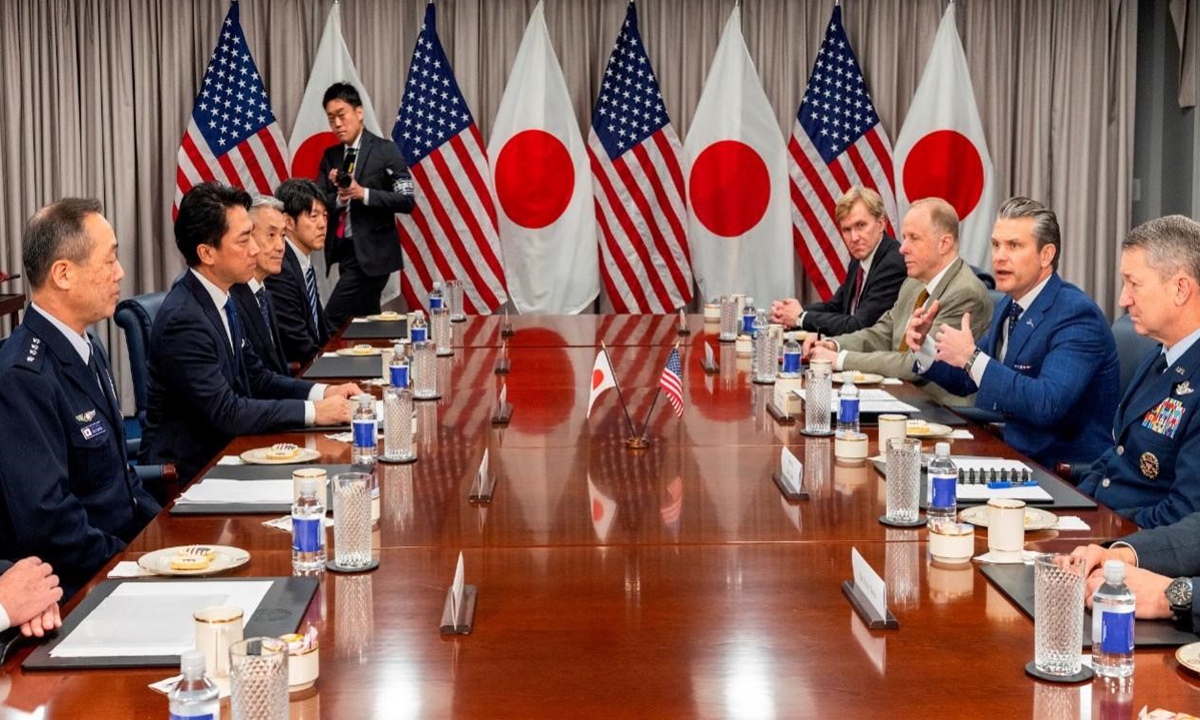
US Secretary of Defense Pete Hegseth participates in a meeting with Japanese Defense Minister Shinjiro Koizumi at the Pentagon in Arlington, Virginia, DC, USA, 15 January 2026. Photo: VCG
Japanese Defense Minister Shinjiro Koizumi met US Secretary of Defense Pete Hegseth at the Pentagon on Thursday local time. The readout released by Japan on Friday claimed that the two sides agreed to reinforce the deterrence capabilities of the US-Japan alliance, especially to expand presence in Japan's southwestern region which is described by Japanese media as a move to counter China while the US' version only mentioned the importance of the alliance without mentioning the specific direction toward which the US and Japan will increase cooperation.Some Chinese experts reached by the Global Times on Friday said that the different wording in the readouts released by the two sides showed that Japan aims to enhance Japan-US defense cooperation to project an image of "Washington supporting Tokyo," but it is largely a one-sided push by Japan and it has yet achieved its intended purpose.
The visit of the Japanese official came against the backdrop of the Japanese Prime Minister Sanae Takaichi's erroneous remarks concerning the Taiwan question drawing widespread criticism at home and abroad.
In a readout released by the Japanese Ministry of Defense, the Japanese side claimed that "in light of the rapidly intensifying security situation in the Indo-Pacific region," the two sides exchanged views on specific measures to further expand the Japan-US joint presence in the southwest region and in defense equipment and technology.
However, in a readout released by the US Department of War, the Pentagon did not go into details of the further Japan-US defense cooperation, nor naming the so-called intensifying security situation in the "Indo-Pacific" region. Instead, it generally elaborated the importance of the Japan-US alliance.
After the meeting, Japanese newspaper Yomiuri Shimbun claimed that both sides confirmed that, in response to China's increasingly active operations around the southwestern islands and other areas, they will further expand joint exercises between the US military and the Self-Defense Forces.
Kyodo News reported the latest meeting between the two defense ministers, claiming that the measures that the two sides agreed in the meeting aimed to addressing the presence of China around Taiwan island, East China Sea, and South China Sea as well as North Korea that has been pushing nuclear and weapon development.
After the meeting, when reporters asked Koizumi whether he had discussed responses to China, he said that he cannot provide specific details, according to Jiji Press.
This is Koizumi's first visit to the US since being appointed defense minister in October. Prior to Washington, he also visited Honolulu and Los Angeles, the Asahi Shimbun reported.
The Japanese defense minister seeks to use the US as a "banner to bolster its position," portraying a narrative of strengthened Japan-US cooperation in the so-called southwestern direction. Ostensibly targeting China, it is aimed to pushing forward and accelerate the production of missiles and other weapons systems by seeking US support for the development of Japan's defense industry, Zhang Junshe, a Chinese military affairs expert, told the Global Times on Friday.
It can be seen that the so-called "strengthening of defense cooperation" to counter China is a unilateral assertion by Japan, aimed at signaling to the outside world that the US supports its position, as this explicit support is not specifically reflected in the statement released by the US side, he added.
"Whether it is Japan's so-called 'defense strengthening' in the southwestern direction or its expansion of lethal weapons production, both actions touch on the restrictions imposed on Japan as a defeated and aggressor nation of WWII," Zhang said, warning that Japan's current actions clearly challenge the post-World War II international order, undermine regional peace and stability, and lay the groundwork for the revival of militarism.
Before the meeting, some videos and photos circulating on social media X platform posted by Reuters, @USForcesJapan and Hegseth himself showing that Koizumi and Hegseth kickstarted their day by working out together at the Joint Base Myer-Henderson Hall in Arlington, Virginia.

Japanese Defense Minister Shinjiro Koizumi (Left) and US Defense Secretary Pete Hegseth take part in military-style exercises at a US military facility near Washington on January 15, 2026. Photo: VCG
According to Japanese media reports, Koizumi revealed during the meeting that he had experienced "mild dehydration" due to the high intensity of the PT exercises, and that it was only after undergoing medical checks by the US side that he was able to meet with the US secretary of defense.Japanese Defense Minister Shinjiro Koizumi (Left) and US Defense Secretary Pete Hegseth take part in military-style exercises at a US military facility near Washington on January 15, 2026. Photo: VCG
This detail precisely reflects Japan's attempt to "curry favor" or "pander to" the other side, Song Zhongping, another military affairs expert, said, noting that the US defense chief is known as regularly posing workout challenges.
Song pointed out that the Japan-US defense ministers' meeting shows that both sides have their own calculations.
Currently, Japan is relatively more proactive: on one hand, it is continuously involving the US in strengthening military posture in the southwestern direction, with a focus on Taiwan; on the other hand, it seeks to jointly produce US-made weapons and equipment. In these maneuvers, Japan tries to pull the US in, Song continued.
For the US government, as long as Japan's actions generate tangible benefits, they are acceptable. However, the US may not genuinely back Japan, as the NATO example clearly illustrates, Song added.
In recent years, Japan's increasingly arrogant right-wing conservative forces have been pushing for greater military buildup and remilitarization, leading the nation down a perilous path. History has demonstrated that unchecked Japanese militarist ambitions would pose a grave threat to other Asian nations and ultimately bring catastrophic disasters upon the Japanese people, Zhang Xiaogang, spokesperson for the Ministry of National Defense (MND), told at a press conference on Friday.
China stands ready to work with all peace-loving countries to resolutely contain any dangerous attempts to revive militarism, jointly uphold the outcomes of the victory in WWII, and safeguard peace and stability in the region and beyond, Zhang said.
RELATED ARTICLES