Canadian PM says Canada to buy up to Chinese 49,000 EVs at most-favored nation terms, sends positive signal for bilateral trade ties: expert
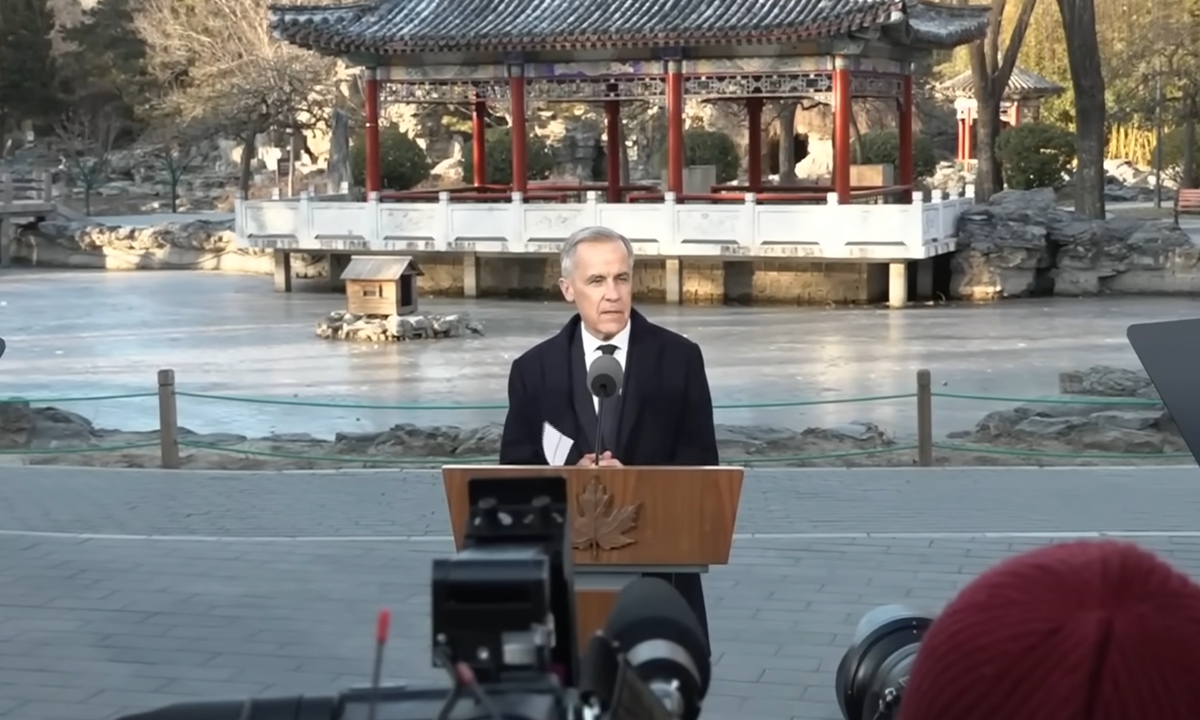
Canadian Prime Minister Mark Carney speaks in Beijing on January 16, 2025. Photo: screenshot from AP
Canada and China have struck an initial trade deal that will slash tariffs on electric vehicles and canola, Prime Minister Mark Carney said on Friday during his visit to China on Friday, Reuters reported. According to the report, citing Carney, Canada will initially allow in up to 49,000 Chinese electric vehicles at a tariff of 6.1 percent on most-favoured nation terms.
A Chinese analyst said this sends a positive signal for bilateral economic and trade ties, but stressed that the quota remains limited and more efforts are needed to stabilize bilateral ties.
The 6.1 percent tariff rate compares with the 100 percent tariff on Chinese electric vehicles imposed by the government of former Prime Minister Justin Trudeau in 2024, per Reuters.
This is a return to levels prior to recent trade frictions, Carney told reporters in Beijing, according to the report.
Under the new deal, Carney said, Canada expects China will lower tariffs on its canola.
The Global Times learned that the Chinese government has not yet released relevant information as of press time.
Canada's decision sends a positive signal for bilateral economic and trade ties but the quota remains limited, with more efforts needed from the Canadian side for China-Canada cooperation in the field, Gao Lingyun, a researcher at the Chinese Academy of Social Sciences, told the Global Times on Friday.
"Chinese companies are still facing discriminatory treatment in Canada, particularly in the EV sector, and if such concerns are not properly addressed, businesses will struggle to form stable expectations, undermining confidence in bilateral economic and trade cooperation," Gao said.
"For Canada to build its own competitive EV sector, we will need to learn from innovative partners, access their supply chains, and increase local demand," Carney said, according to Reuters.
He pointed to a stronger partnership with China in clean energy storage and production, driving new investments. Carney said he expected the EV pact would drive "considerable" Chinese investment into Canada's auto sector, create good careers in Canada and speed it towards a net zero future, according to the report.
Zhou Mi, a senior researcher at the Chinese Academy of International Trade and Economic Cooperation, told the Global Times on Friday that this move announced by Carney carries symbolic importance.
"There is no fundamental trade conflict between China and Canada, and imposing tariffs on Chinese EVs is an action that runs counter to Canada's own interests, which not only harms the interests of Canadian consumers, but also adversely affects the domestic automotive industry and damages Canada's international reputation," Zhou said.
If Canada sincerely fulfills its promise to buy those EVs from China, it will help enhance Canada's competitiveness in the field of green energy transition, while opening up greater space for deeper cooperation between the two countries in other areas. This will contribute to advancing the trade liberalization and multilateralism that both sides jointly support, he said.
RELATED ARTICLES