IN-DEPTH / IN-DEPTH
From a student letter to a sustainable bridge of communication, S.Korean youth delegation forges deeper ties with China
‘Rowing together in the same boat’
Editor's Note:
Chinese President Xi Jinping often quotes an ancient saying on many diplomatic occasions: "No mountain or ocean can separate those who share the same aspirations." This powerful message underscores the undeniable force of friendship and cooperation in bridging hearts across nations, cultures, and civilizations. Inspired by President Xi's vision, people-to-people exchanges between China and the world have been flourishing.
People from diverse backgrounds and fields, united by common goals and dreams, traverse mountains and oceans to connect with each other. Through letters, face-to-face dialogues and vibrant cultural events, they are collectively weaving a magnificent tapestry of building a community with a shared future for humanity.
The Global Times presents "Intertwined Destinies, Shared Paths," a series spotlighting the touching stories written by these "friendship ambassadors." They are scholars pushing the boundaries of research, diplomats advocating for deeper cooperation on the global stage, artists igniting imaginations with their creations, and ordinary people extending heartfelt love beyond national borders driven by their genuine sincerity.
Their stories illuminate the spark of cultural exchanges, the driving force of technological innovation, the bountiful harvest of economic cooperation, and the enduring warmth of human connection - all contributing to a more peaceful, prosperous and open world. This is the tenth installment of the series.
On the afternoon of January 5, 2026, Chinese President Xi Jinping held talks in Beijing with South Korea President Lee Jae-myung, who was on a state visit to China.
Simultaneously, a 16-member delegation of students and faculty members from the International Division at Hankuk University of Foreign Studies (HUFS) embarked from Seoul, South Korea to Shanghai, China.
This cross-border encounter between Chinese and South Korean youth stemmed from a letter sent to President Xi by a group of students from the HUFS. The letter had garnered a resounding response.
"The youth of the two countries are now jointly confronting such contemporary challenges as the rise of protectionism, climate change, population aging, and employment difficulties. Nevertheless, we firmly believe that challenges also present opportunities. It is precisely these shared concerns that have afforded young people from both countries more chances to understand each other better, draw closer together, and pool their wisdom," the young Korean students wrote in their letter to President Xi on October 20, 2025.
To their surprise and delight, the letter had reached President Xi.
At a welcoming banquet given by President Lee Jae-myung on November 1, 2025 during
President Xi's state visit to the Repulic of Korea, Xi specifically mentioned that he has received a letter from ROK students expressing their expectations for the development of China-ROK relations, and stated that young people are the future of China-ROK relations, the Xinhua News Agency reported.
"The top leaders of both countries view youth exchanges as the future of bilateral ties. This delegation's visit represents a critical step toward deepening mutual understanding and practical cooperation between our peoples," said Hwang Jae-ho, head of the delegation and a professor of the HUFS.
"The exchanges underscored the youth interaction as a cornerstone of bilateral relations," he told the Global Times.
The delegation's itinerary centered on three themes: youth dialogues, historical awareness, and technological collaboration.
"While our group may be modest [in scale], it is the first South Korean youth group to visit China since President Xi's emphasis on bilateral youth exchanges in November 2025," Hwang told the Global Times. "Young people have taken the first step, leaving a solid imprint on the process of China-South Korea relations."
Youth-led future cooperation
"While academic exchanges in the past were often constrained by their short-term, one-time nature where the participants would attend events briefly before returning home, limiting the potential for substantive and fundamental progress. This trip, however, breaks that conventional method," said Lee Jeong-hoon, a member of the delegation. "What makes this experience particularly valuable is that it creates a sustainable framework for youth engagement that can generate lasting impact."
Even after having returned to South Korea, Lee, a fourth-year student from the HUFS, remains deeply inspired by his recent journey to China.
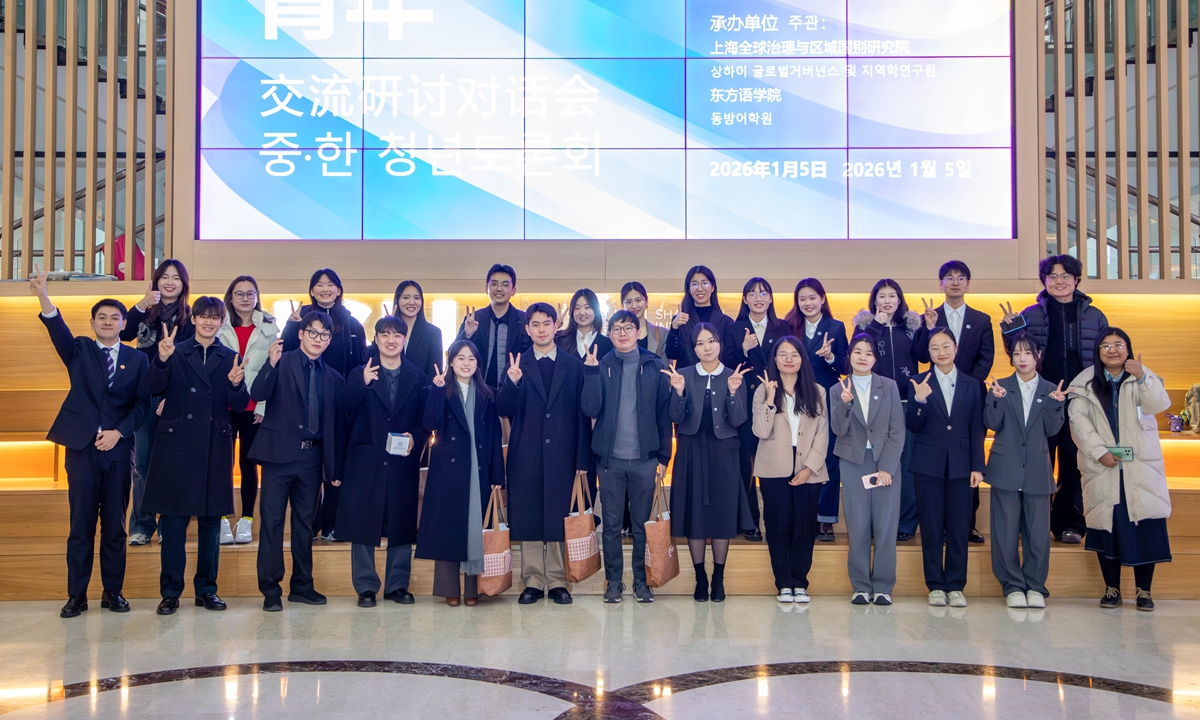
On January 5, the visiting South Korean student delegation started their itinerary with a focused China-South Korea youth exchange seminar held at the Shanghai International Studies University (SISU).
Youth representatives from both countries, drawing on their own experiences, engaged in candid discussions on topics including cross-cultural communication, traditional cultures, and language learning. They also shared their visions for the future of bilateral cooperation.
"Prior to the visit, I had no personal ties or points of relation with China. I merely observed China through the media, books, and lectures. Therefore, through this visit to China, I came to realize that my understanding of the country had been shaped by misunderstandings and preconceived notions, and they differed from the reality on the ground," Lee Jeong-hoon said.
"If the younger generation, the backbone of the future, lacks exchanges and judges each other solely based on negative information in the media, misunderstandings will continue to deepen. Increasing opportunities for exchanges is the only way to reduce misunderstandings," said Kim Jung-hyuk, a senior student from the HUFS.
During the seminar, Lee Je-hyun, a senior HUFS student, noted that what particularly challenged his pre-existing perceptions was the strong sense of responsibility and realism among Chinese students regarding shared generational challenges such as employment uncertainty, social pressure, and climate change.
"The concerns closely mirror those faced by young people in Korea as well. Rather than focusing on differences, we emphasized cultural exchanges, academic cooperation, and sustained people-to-people interaction as practical pathways forward," Lee Jeong-hoon noted.
This consensus led him to propose the Chinese idiom Tongzhou Gongji, literally "rowing together in the same boat," meaning tiding over difficulties together and jointly pursuing win-win cooperation.
"Today's Chinese and South Korean youth have a distinct international outlook, characterized by openness, inclusiveness and a strong sense of responsibility. They not only focus on their own future, such as employment and daily life, but also actively care about regional and global issues. Seeking to build on mutual understanding and in-depth cooperation, they strive to promote the sustained sound development of China-South Korea relations and jointly safeguard East Asia's peace and prosperity," Jiang Feng, professor at the SISU, shared with the Global Times after the seminar.
Bridging history and future
China and the South Korea have a history of standing side by side and supporting each other in hard times. And today, the two countries share numerous resonances and common understandings.
On January 7, President Lee Jae-myung visited the historic site of the Provisional Government of the Republic of Korea (PGRK) in Shanghai.
2026 marks the 100th anniversary of the site's establishment.
According to Xinhua, from 1910 to 1945, the Korean Peninsula was under Imperial Japan's colonization. After the March 1st Movement against Japanese colonial rule on the Korean Peninsula was brutally suppressed in 1919, a large number of Korean patriots fled into exile in China.
In the year 1919, the Provisional Government of the Republic of Korea was established in Shanghai. The building, constructed in 1925, housed the provisional government from 1926 to 1932.
It was against this backdrop that the delegation of HUFS chose the former PGRK site as the second stop of their Shanghai visit.
"Visiting the former site of the PGRK in Shanghai made me to reflect on the fact that Korean independence movement received the China's invaluable support during a critical period in history. For me, this realization underscored the necessity of reestablishing a stable and forward-looking relationship between the two countries today," Park Sih-yeon, a senior student from the HUFS, told the Global Times.
The same spirit of cross-border solidarity continues to resonate among today's youth. Beek Jong-woo, a junior student from the HUFS, told the Global Times that what struck him most during the dialogues with Chinese students was how discussions naturally flowed from personal experiences.
"Many participants shared warm memories from traveling to, studying or living in each other's countries, which immediately created a sense of closeness and trust," Beek said.
Shared future, joint efforts
From Shanghai to Hangzhou, East China's Zhejiang Province, historical footprints intertwined with modern warmth.
Hangzhou is 30-minute ride by the fastest high-speed train from Shanghai.
On January 7, the HUFS delegation visited Alibaba's campus in Hangzhou. The students not only learned about its development journey but also experienced firsthand how technology deeply empowers social life in China.
Lee Jeong-hoon set out to find a meaningful personal connection to the city. While he was trying to locate the exact spot where his father had a photograph taken decades earlier in Hangzhou's scenic West Lake, a student from SISU introduced him to an AI application developed by Alibaba. The tool could pinpoint the precise location from the old photo and provide detailed navigation directions.
"Thanks to this technology, I was able to recreate the image, turning a personal family memory into a shared present experience. Together, these moments showed me that China's development today is not only about ambitious planning and technological advancement, but also about how innovation is thoughtfully integrated into everyday life and human connections," he said.
"China's development speed in artificial intelligence and cloud computing is truly impressive," said Lee Je-hyun. "From flight bookings to travel planning, AI has been seamlessly integrated into every aspect of daily life."
Hwang noted that South Korea once led in some cutting-edge technology fields, and China-South Korea cooperation long followed a vertical division of labor pattern. However, amid shifting international tech competition in recent years, China has steadily advanced independent innovation, and now stands at the global forefront in multiple digital industries such as artificial intelligence and new-energy vehicles.
This shift prompts South Korea to seek a more balanced and deeper collaborative framework with China within the new landscape, he said.
In today's world, where the digital economy and technological competition increasingly dominate global development, China's experience in digital innovation now offers significant lessons for global players, including South Korea, Hwang said.
"This further resonates with the shared vision of China and South Korea to deepen exchanges and jointly seize development opportunities in emerging industries," he pointed out.
Currently, a sound, stable and continuously deepening China-South Korea relationship aligns with the fundamental interests of both peoples and contributes to peace, stability, development and prosperity in the region and beyond, said Jiang of the SISU.
The revitalization of bilateral ties aligns with robust people-to-people exchanges and economic connections. In 2024, bilateral people-yo-people exchanges reached 7.725 million trips. Ongoing visa facilitation measures have added more warmth to this closeness and connectivity. Trade has also grown resiliently. China has remained South Korea's largest trading partner for 21 consecutive years, while South Korea has regained its position as China's second-largest trading partner, Xinhua reported.
Hwang said he is firmly convinced that as China-South Korea relations have witnessed a comprehensive warming, the number of Chinese-bound delegations engaged in active communication, like the HUFS faculty and student group, will keep growing.
Echoing this sentiment, student Lee Jeong-hoon shared his commitment to mobilize youth involvement. "As a graduate of international studies, I plan to deepen my engagement and lead the initiatives that enable young people to contribute effectively to Korea-China cooperation," he said. "By sharing our experiences through campus seminars and social networks, we can demonstrate that bilateral engagement is not only possible but also transformative."
Chinese President Xi Jinping often quotes an ancient saying on many diplomatic occasions: "No mountain or ocean can separate those who share the same aspirations." This powerful message underscores the undeniable force of friendship and cooperation in bridging hearts across nations, cultures, and civilizations. Inspired by President Xi's vision, people-to-people exchanges between China and the world have been flourishing.
People from diverse backgrounds and fields, united by common goals and dreams, traverse mountains and oceans to connect with each other. Through letters, face-to-face dialogues and vibrant cultural events, they are collectively weaving a magnificent tapestry of building a community with a shared future for humanity.
The Global Times presents "Intertwined Destinies, Shared Paths," a series spotlighting the touching stories written by these "friendship ambassadors." They are scholars pushing the boundaries of research, diplomats advocating for deeper cooperation on the global stage, artists igniting imaginations with their creations, and ordinary people extending heartfelt love beyond national borders driven by their genuine sincerity.
Their stories illuminate the spark of cultural exchanges, the driving force of technological innovation, the bountiful harvest of economic cooperation, and the enduring warmth of human connection - all contributing to a more peaceful, prosperous and open world. This is the tenth installment of the series.
A group photo is taken of students from the International Division of Hankuk University of Foreign Studies and Shanghai International Studies University after a China-South Korea youth exchange seminar in Shanghai on January 5, 2026. Photo: Courtesy of the Shanghai International Studies University
On the afternoon of January 5, 2026, Chinese President Xi Jinping held talks in Beijing with South Korea President Lee Jae-myung, who was on a state visit to China.
Simultaneously, a 16-member delegation of students and faculty members from the International Division at Hankuk University of Foreign Studies (HUFS) embarked from Seoul, South Korea to Shanghai, China.
This cross-border encounter between Chinese and South Korean youth stemmed from a letter sent to President Xi by a group of students from the HUFS. The letter had garnered a resounding response.
"The youth of the two countries are now jointly confronting such contemporary challenges as the rise of protectionism, climate change, population aging, and employment difficulties. Nevertheless, we firmly believe that challenges also present opportunities. It is precisely these shared concerns that have afforded young people from both countries more chances to understand each other better, draw closer together, and pool their wisdom," the young Korean students wrote in their letter to President Xi on October 20, 2025.
To their surprise and delight, the letter had reached President Xi.
At a welcoming banquet given by President Lee Jae-myung on November 1, 2025 during
President Xi's state visit to the Repulic of Korea, Xi specifically mentioned that he has received a letter from ROK students expressing their expectations for the development of China-ROK relations, and stated that young people are the future of China-ROK relations, the Xinhua News Agency reported.
"The top leaders of both countries view youth exchanges as the future of bilateral ties. This delegation's visit represents a critical step toward deepening mutual understanding and practical cooperation between our peoples," said Hwang Jae-ho, head of the delegation and a professor of the HUFS.
"The exchanges underscored the youth interaction as a cornerstone of bilateral relations," he told the Global Times.
The delegation's itinerary centered on three themes: youth dialogues, historical awareness, and technological collaboration.
"While our group may be modest [in scale], it is the first South Korean youth group to visit China since President Xi's emphasis on bilateral youth exchanges in November 2025," Hwang told the Global Times. "Young people have taken the first step, leaving a solid imprint on the process of China-South Korea relations."
Youth-led future cooperation
"While academic exchanges in the past were often constrained by their short-term, one-time nature where the participants would attend events briefly before returning home, limiting the potential for substantive and fundamental progress. This trip, however, breaks that conventional method," said Lee Jeong-hoon, a member of the delegation. "What makes this experience particularly valuable is that it creates a sustainable framework for youth engagement that can generate lasting impact."
Even after having returned to South Korea, Lee, a fourth-year student from the HUFS, remains deeply inspired by his recent journey to China.
On January 5, the visiting South Korean student delegation started their itinerary with a focused China-South Korea youth exchange seminar held at the Shanghai International Studies University (SISU).
Youth representatives from both countries, drawing on their own experiences, engaged in candid discussions on topics including cross-cultural communication, traditional cultures, and language learning. They also shared their visions for the future of bilateral cooperation.
"Prior to the visit, I had no personal ties or points of relation with China. I merely observed China through the media, books, and lectures. Therefore, through this visit to China, I came to realize that my understanding of the country had been shaped by misunderstandings and preconceived notions, and they differed from the reality on the ground," Lee Jeong-hoon said.
"If the younger generation, the backbone of the future, lacks exchanges and judges each other solely based on negative information in the media, misunderstandings will continue to deepen. Increasing opportunities for exchanges is the only way to reduce misunderstandings," said Kim Jung-hyuk, a senior student from the HUFS.
During the seminar, Lee Je-hyun, a senior HUFS student, noted that what particularly challenged his pre-existing perceptions was the strong sense of responsibility and realism among Chinese students regarding shared generational challenges such as employment uncertainty, social pressure, and climate change.
"The concerns closely mirror those faced by young people in Korea as well. Rather than focusing on differences, we emphasized cultural exchanges, academic cooperation, and sustained people-to-people interaction as practical pathways forward," Lee Jeong-hoon noted.
This consensus led him to propose the Chinese idiom Tongzhou Gongji, literally "rowing together in the same boat," meaning tiding over difficulties together and jointly pursuing win-win cooperation.
"Today's Chinese and South Korean youth have a distinct international outlook, characterized by openness, inclusiveness and a strong sense of responsibility. They not only focus on their own future, such as employment and daily life, but also actively care about regional and global issues. Seeking to build on mutual understanding and in-depth cooperation, they strive to promote the sustained sound development of China-South Korea relations and jointly safeguard East Asia's peace and prosperity," Jiang Feng, professor at the SISU, shared with the Global Times after the seminar.
Bridging history and future
China and the South Korea have a history of standing side by side and supporting each other in hard times. And today, the two countries share numerous resonances and common understandings.
On January 7, President Lee Jae-myung visited the historic site of the Provisional Government of the Republic of Korea (PGRK) in Shanghai.
2026 marks the 100th anniversary of the site's establishment.
According to Xinhua, from 1910 to 1945, the Korean Peninsula was under Imperial Japan's colonization. After the March 1st Movement against Japanese colonial rule on the Korean Peninsula was brutally suppressed in 1919, a large number of Korean patriots fled into exile in China.
In the year 1919, the Provisional Government of the Republic of Korea was established in Shanghai. The building, constructed in 1925, housed the provisional government from 1926 to 1932.
It was against this backdrop that the delegation of HUFS chose the former PGRK site as the second stop of their Shanghai visit.
"Visiting the former site of the PGRK in Shanghai made me to reflect on the fact that Korean independence movement received the China's invaluable support during a critical period in history. For me, this realization underscored the necessity of reestablishing a stable and forward-looking relationship between the two countries today," Park Sih-yeon, a senior student from the HUFS, told the Global Times.
The same spirit of cross-border solidarity continues to resonate among today's youth. Beek Jong-woo, a junior student from the HUFS, told the Global Times that what struck him most during the dialogues with Chinese students was how discussions naturally flowed from personal experiences.
"Many participants shared warm memories from traveling to, studying or living in each other's countries, which immediately created a sense of closeness and trust," Beek said.
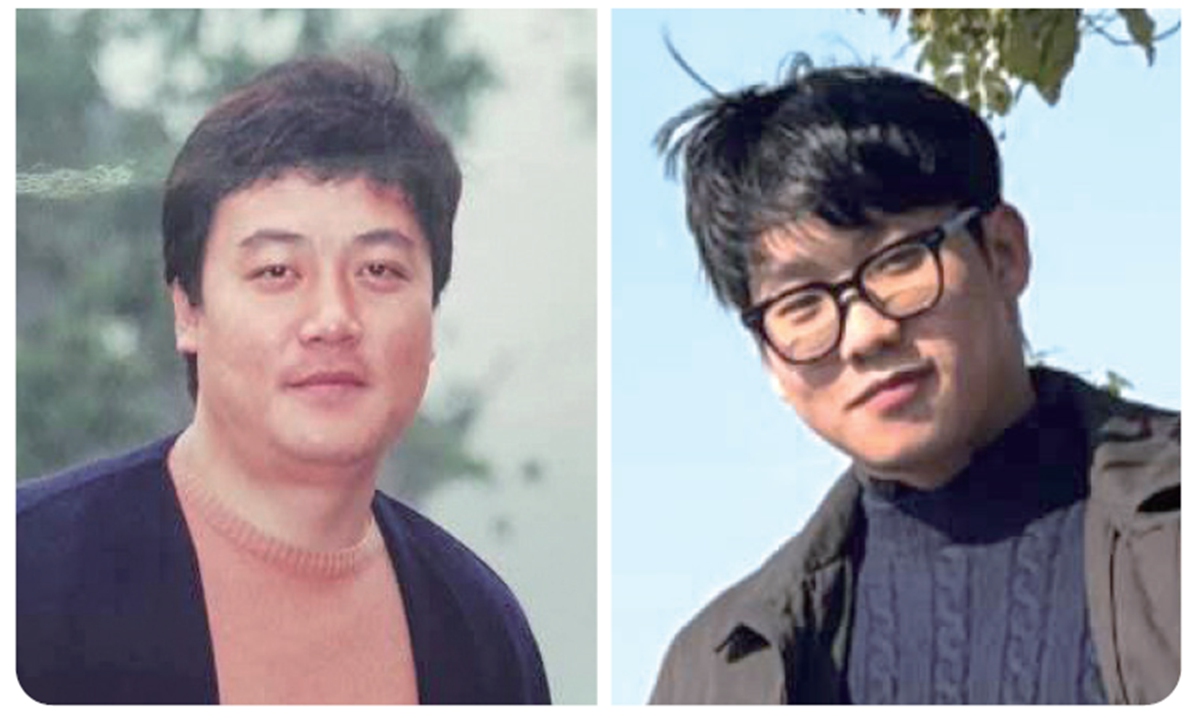
A photo of Lee Jeong-hoon, a senior student from the Hankuk University of Foreign Studies (right), and a photo of his father taken decades ago at the exact same spot by the West Lake in Hangzhou, East China's Zhejiang Province. China's AI technology helped Lee pinpoint the precise location using the old photograph. Photo: Courtesy of Lee
Shared future, joint efforts
From Shanghai to Hangzhou, East China's Zhejiang Province, historical footprints intertwined with modern warmth.
Hangzhou is 30-minute ride by the fastest high-speed train from Shanghai.
On January 7, the HUFS delegation visited Alibaba's campus in Hangzhou. The students not only learned about its development journey but also experienced firsthand how technology deeply empowers social life in China.
Lee Jeong-hoon set out to find a meaningful personal connection to the city. While he was trying to locate the exact spot where his father had a photograph taken decades earlier in Hangzhou's scenic West Lake, a student from SISU introduced him to an AI application developed by Alibaba. The tool could pinpoint the precise location from the old photo and provide detailed navigation directions.
"Thanks to this technology, I was able to recreate the image, turning a personal family memory into a shared present experience. Together, these moments showed me that China's development today is not only about ambitious planning and technological advancement, but also about how innovation is thoughtfully integrated into everyday life and human connections," he said.
"China's development speed in artificial intelligence and cloud computing is truly impressive," said Lee Je-hyun. "From flight bookings to travel planning, AI has been seamlessly integrated into every aspect of daily life."
Hwang noted that South Korea once led in some cutting-edge technology fields, and China-South Korea cooperation long followed a vertical division of labor pattern. However, amid shifting international tech competition in recent years, China has steadily advanced independent innovation, and now stands at the global forefront in multiple digital industries such as artificial intelligence and new-energy vehicles.
This shift prompts South Korea to seek a more balanced and deeper collaborative framework with China within the new landscape, he said.
In today's world, where the digital economy and technological competition increasingly dominate global development, China's experience in digital innovation now offers significant lessons for global players, including South Korea, Hwang said.
"This further resonates with the shared vision of China and South Korea to deepen exchanges and jointly seize development opportunities in emerging industries," he pointed out.
Currently, a sound, stable and continuously deepening China-South Korea relationship aligns with the fundamental interests of both peoples and contributes to peace, stability, development and prosperity in the region and beyond, said Jiang of the SISU.
The revitalization of bilateral ties aligns with robust people-to-people exchanges and economic connections. In 2024, bilateral people-yo-people exchanges reached 7.725 million trips. Ongoing visa facilitation measures have added more warmth to this closeness and connectivity. Trade has also grown resiliently. China has remained South Korea's largest trading partner for 21 consecutive years, while South Korea has regained its position as China's second-largest trading partner, Xinhua reported.
Hwang said he is firmly convinced that as China-South Korea relations have witnessed a comprehensive warming, the number of Chinese-bound delegations engaged in active communication, like the HUFS faculty and student group, will keep growing.
Echoing this sentiment, student Lee Jeong-hoon shared his commitment to mobilize youth involvement. "As a graduate of international studies, I plan to deepen my engagement and lead the initiatives that enable young people to contribute effectively to Korea-China cooperation," he said. "By sharing our experiences through campus seminars and social networks, we can demonstrate that bilateral engagement is not only possible but also transformative."
RELATED ARTICLES