China opposes countries with diplomatic ties signing deals of sovereign implications or official nature with China's Taiwan region: FM on so-called US-Taiwan 'trade deal'
Photo: Chinese Foreign Ministry
China always firmly opposes countries having diplomatic relations with China negotiating and signing any agreement of sovereign implication or official nature with China's Taiwan region, a Foreign Ministry spokesperson said on Friday.
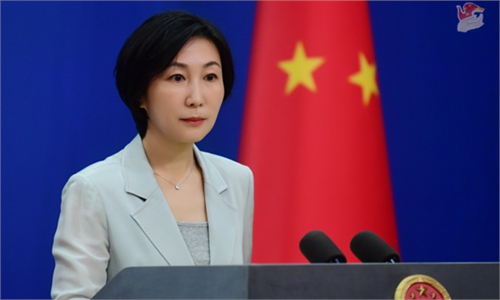
Foreign Ministry spokesperson Guo Jiakun made the remarks at a regular news briefing when responding to a query about a recent so-called trade agreement between the US and China's Taiwan.
Guo urged the US to earnestly abide by the one-China principle and the three China-US joint communiqués.
As part of the agreement, Taiwan-based chip and technology companies will invest at least $250 billion in production capacity in the US, and Taiwan region will guarantee $250 billion in credit for these companies, Reuters reported.
In exchange, the US will limit "reciprocal" tariffs on Taiwan region to 15 percent, down from 20 percent, and commit to zero reciprocal tariffs on generic pharmaceuticals, their ingredients, aircraft components and some natural resources, according to the report.
"There is but one China in the world, the island of Taiwan is an inalienable part of China's territory and the government of the People's Republic of China is the sole legal government representing the whole of China. This is a consensus of the international community and a political commitment made by the US to China. However, the US side and the island have made frequent moves in the economic and trade field, reaching a so-called agreement on trade and investment. This has blatantly violated the one-China principle," said Bao Jianyun, dean and professor of the Department of International Politics at the School of International Studies at Renmin University of China.
The US' move sends a wrong signal to "Taiwan independence" separatists, and once again shows that the US side says one thing but does another, and has acted in bad faith on the Taiwan question, Bao told the Global Times on Friday.
He said that US' move violates its commitments in the three China-US joint communiques, undermines the cornerstone of stable bilateral economic and trade ties, and is not conducive to the development of bilateral relations.
The so-called trade deal is in fact industrial plunder through tariff intimidation, Zhang Xiaorong, director of the Beijing-based Cutting-Edge Technology Research Institute, told the Global Times on Friday, stressing that the unfair agreement is aimed at hollowing out the island of Taiwan's pillar industry of chipmaking.
"The island promises investment of $250 billion, with an equal amount in credit, in exchange for a slight cut in tariffs. What the Taiwan region is forced to give up is not only cash, but also the core chip production capacity represented by TSMC," Zhang said.
Selling out the island
While the Democratic Progressive Party (DPP) authorities claimed that the agreement with the US is "a good result", some opposition lawmakers on the island have expressed concerns about the potential impact on the island's advantage semiconductor industry.
Cheng Li-wun, leader of the Chinese Kuomintang Party (KMT), on Friday sharply criticized the DPP claims of such a dismal negotiation result being a major achievement, Taiwan-based China Times reported.
She accused the DPP of hollowing out Taiwan's semiconductor and high-tech industries, while questioning whether the semiconductor industry on the island would have been willing to invest and set up factories in the US if the Lai Ching-te authorities hadn't bowed down to Washington. Cheng further criticized the Lai authorities for celebrating and engaging in cognitive warfare during a time of crisis for the island, per the report.
In an interview with CNBC, US Commerce Secretary Howard Lutnick claimed the US government's objective was to bring 40 percent of Taiwan's semiconductor supply chain to the US. "We're going to bring it all over so we become self-sufficient in the capacity of building semiconductors," Lutnick said.
"The DPP should take responsibility for the island's loss," Wang Jianmin, a research fellow at the Institute of Taiwan Studies under the Chinese Academy of Social Sciences, told the Global Times on Friday.
For the political purpose of aligning itself with the US, the DPP authorities have agreed to transfer its highly competitive chip industry to the US, making huge concessions that all the people on the island have to bear, Wang said, warning that this will deal a great blow to the island's economy in the coming five to ten years.
"The DPP authorities may comfort itself and promote its image by claiming that TSMC's core R&D and other core technologies remain on the island, but the weakening of Taiwan's chip industry is an ongoing process," udn.com wrote in a commentary on Friday, expressing worries that TSMC may be the US government's next target for investment following Intel if TSMC invests in the US.
TSMC has pledged around $165 billion of investments in the US, according to the company's website. Moreover, the company said its expanded investment is expected to support 40,000 construction jobs over the next four years and create tens of thousands of high-paying, high-tech jobs in advanced chip manufacturing and R&D. It is also expected to drive more than $200 billion of indirect economic output in Arizona and across the US in the next decade.
Some Taiwan regional netizens on the local forum PTT also expressed dissatisfaction with the so-called "trade deal".
A netizen posted "It's pathetic that the island claims to be strengthening security while moving the chipmaking industry overseas." Another netizen posted "The US wants TSMC and of course gives a little treat in exchange", while another posted "Congratulations to the US, they've made a killing!"
A Chinese mainland spokesperson on Wednesday criticized the DPP authorities for showing no resistance when confronted with overt bullying and exploitation by external forces, but instead moving to accommodate those forces.
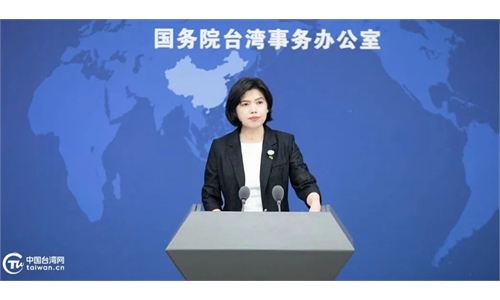
Zhu Fenglian, a spokesperson for the State Council Taiwan Affairs Office, commented in response to a question about a report that Taiwan island and the US are nearing a trade agreement to reduce Taiwan's tariff rate to 15 percent, while committing TSMC to building at least five more facilities in the US.
The so-called agreement amounts to economic exploitation of Taiwan by the US through high tariffs, aimed at siphoning off the island's industrial strength, Zhu said.
It reveals not only the self-interested nature of the United States, but also Washington's underlying intention of viewing Taiwan as a strategic pawn, she added.
RELATED ARTICLES