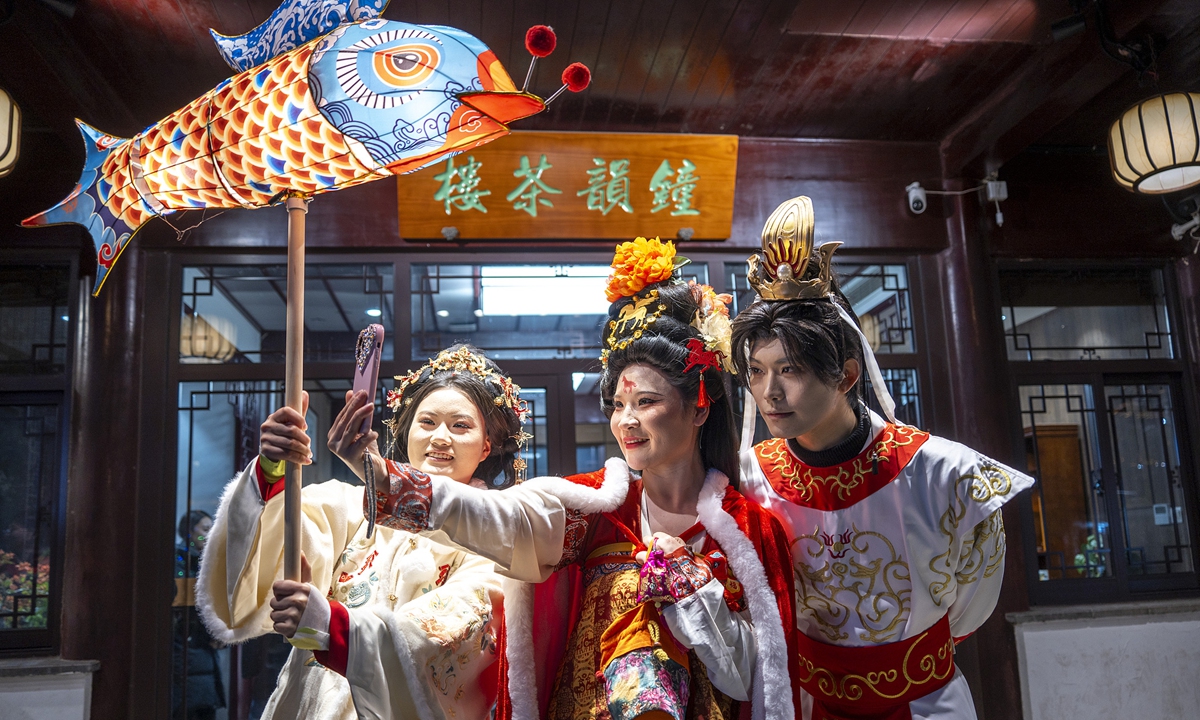
Young people dressed in traditional Chinese attire participate in the New Year's Eve bell-ringing ceremony at the Hanshan Temple in Suzhou, East China's Jiangsu Province, on December 31, 2025, to welcome 2026. Photo: VCG
Recently, the phrase "Love you, good old self, and see you tomorrow" has become a viral buzzword on Chinese social media platforms, drawing widespread attention.This expression affectionately and humorously refers to oneself as "old friend," conveying the warmth and self-care in a playful tone. In more formal wording, this is to say: "In my life, there has been a great love, and its object has always been me…"
It differs from the often-mentioned "being good to yourself;" in contrast, it is more like treating your busy, weary self as an old friend you've known for a long time. With this "mantra," we will instinctively find ourselves thinking: "It's chilly today-my dear old self needs to bundle up more." or "I've had a long, hectic day-my dear old self deserves a moment of quiet repose."
Around the same time as the buzzword gained popularity, another phrase, "Cheers to myself," started to trend in social media platforms. On short-video platforms, young people raise their glasses to the camera, sharing the ups and downs of life, poking fun at past experiences, and toasting the self who perseveres through difficulties and setbacks.
This expression was also included in the "Top 10 Internet Buzzwords of 2025" recently released by the National Language Resources Monitoring and Research Center, according to the Xinhua News Agency. It is interpreted as a gentle way for contemporary youth to relieve stress, achieve self-reconciliation and affirm their own value.
Cultivating inner tenderness
"One day, my stomach was hurting badly, and suddenly I wanted to be a little self-indulgent," Li Mingshan, an internet programmer who has been working in Beijing for a year, shared her story with the Global Times. "That day, I felt extremely exhausted. The high-intensity, fast-paced work left me unsettled. I didn't have time for dinner as I was stuck in the office working late. As I left the office, although I was tired and itching to crash into bed and fall asleep instantly, I still want to treat myself to a nice meal and practice self-kindness."
Li said she hailed a taxi and about half an hour later she was sitting in a steamed dumpling restaurant that was still open after midnight. "When the warm steam hit my face, it suddenly felt like I was taking care of another version of myself," Li said.
"When I took my kid to see the movie Nobody, there was a scene where the villain asks the protagonist, the pig demon: 'What do you really want?' The little pig demon, lying on the ground nearly defeated, replies, 'To live as the person I like.' I felt instantly shocked," Yang Funing, a 22-year-old single mother, told the Global Times.
The Nobody she montioned was a Shanghai Animation Flim Studio production that had become a hit last summer.
Since becoming a mother, her life has revolved around her kid, and she had almost forgotten that she, too, needs to be taken care of. "When this topic started trending, it felt like I could hear another part of myself calling for help," Yang said.
'Love you, good old self' becoming an internet buzzword stems from young people redefining and practicing self-love in a lighthearted and humorous way. The core of this trend lies in treating oneself as an old friend in need of good care, showing kindness by fulfilling small but immediate needs, like treating oneself to something one craves, Liu Haihua, a researcher at the research center on personality and social psychology in Peking University, told the Global Times on Wednesday.
"I said I didn't want to order takeout for lunch and felt like going out for hotpot. As soon as I heard myself say it, I immediately took myself out," Tangshoutianxin, a blogger with 290,000 followers on Douyin, the Chinese version of TikTok, said in one of her videos. Her videos on this topic garnered 420,000 likes. The blogger explained that this approach resonates widely because it cleverly addresses the common psychological state of today's youth.
Faced with pressures from meritocracy and an intensely competitive environment, directly talking about self-love can feel heavy or awkward. The new buzzword adopts a warm, third-person tone, bypassing such psychological barriers and making unconditional self-acceptance feel natural and unforced. It detaches self-worth from the external achievements, advocating for the low-cost, high-frequency self-care, providing young people with an inner strength to combat anxiety and loneliness, Liu noted.
Compared to earlier narratives in popular culture that emphasized resistance or venting, "love you, good old self" marks a more positive inward shift: Young people are moving from passively enduring pressure to actively building inner stability and tenderness, learning to become their own longest-lasting friend in a fast-changing era, Liu told the Global Times.
A sign of social progress
Before this topic sparked widespread discussion, Zhan Shuo, a 16-year-old high school student at Experimental School of Beihang University, had always believed that focusing on one's own feelings was a selfish act, and so he worked tirelessly to please his parents, his teachers and his classmates. It wasn't until he saw everyone on social media platforms sharing stories about self-love that he realized caring for oneself was actually the fastest path to self-improvement.
One weekend, while studying in the school library for an exam, he felt stressed out. Then, about 10 minutes later, he found himself sitting on the rooftop of the teaching building, quietly watching the sunset with a can of cola.
"Books say rational people make the best decisions given their limited resources," he crumpled the empty can. "But in those 10 minutes, as an 'irrational person,' I found everything was perfect," Zhan told the Global Times.
This psychological shift from outward focus to inward focus can be seen as a progressive sign of societal development at a specific stage. Widespread improvements in material conditions have satisfied the basic survival needs of the younger generation, allowing them more psychological space to focus on spiritual self-fulfillment, Liu noted.
As a netizen summarized: From the earlier "Sang culture", which was a trending word to reflect a lack of self-motivation felt by urban, middle-class Chinese young people, to "Buddha-like youth," then to "lying flat," and now to "love you, good old self," the world is witnessing a grand emotional reconciliation among Chinese youth.
Chinese young people not only engage in self-healing by creating and spreading memes like "love you, good old self," but they also find resonance in digital spaces and form new emotional support networks. This form of connection, rooted in shared psychological needs rather than geographic or blood ties, represents a new type of social support made possible by technological progress, Liu said.
The mind-set of "loving your good old self" weaves through countless tiny yet precious moments of everyday bliss, entailing the recognition and embrace of our own emotional state. From this moment onward, let us play an old favorite tune for ourselves on the commute to work, sit quietly in the car for 10 minutes after arriving home late at night... and truly embrace your good old self!
RELATED ARTICLES