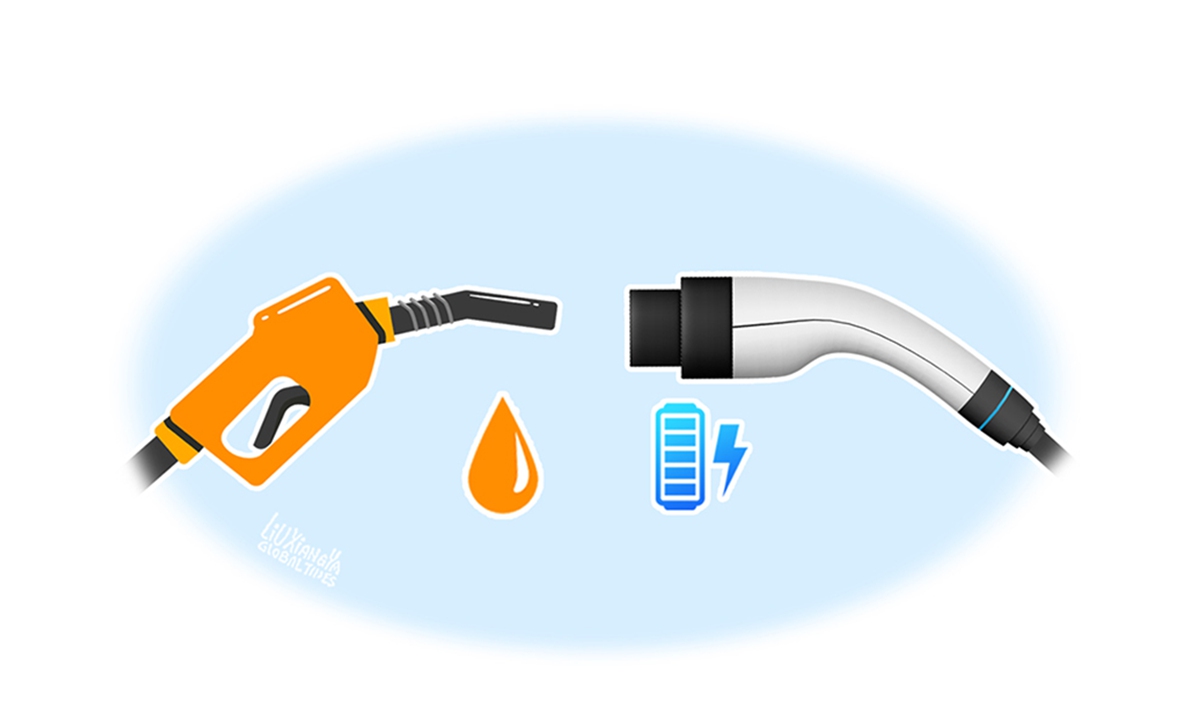
Illustration: Liu Xiangya/GT
In the industrial age, no reconfiguring of the global system has ever begun with a manifesto. They could start with the replacement of infrastructure, the migration of standards and the accumulation of daily choices. From this perspective, Canada's decision to import Chinese electric vehicles (EVs) aligns with the fundamental laws of trade and economic development.
According to the latest adjustment plan released by China's Ministry of Commerce on Friday, Canada will grant a quota of 49,000 units for Chinese EVs annually. Within this quota, vehicles will enjoy the Most Favored Nation (MFN) tariff rate of 6.1 percent. This means the door to the North American market may be quietly cracking open for Chinese EVs.
Washington seems to be anxious. US Transportation Secretary Sean Duffy said that Canada will "regret" allowing Chinese EVs into the market. But if we examine current trends in global EV development, it's far more likely that Americans will be the ones with regrets.
The automobile is the material embodiment of the American model: standardized production, mass consumption, a middle-class society and a suburban lifestyle.
A former General Motors executive once declared: "What's good for GM is good for America."
Today, as BYD's annual sales surpass Tesla's, the automotive manufacturing industry is undergoing a profound displacement.
The transformation in the global auto industry isn't merely a supply chain relocation - it represents a future wholesale replacement of production paradigms and standards, an upgrade of infrastructure, and an evolution of automotive consumer culture, underscoring the profound shift underway.
The data is cold and clear. According to the Associated Press, in 2025, BYD sold 2.26 million electric vehicles compared to Tesla's 1.64 million. Chinese EV sales grew 17 percent, Europe's 33 percent, citing data of Benchmark Mineral Intelligence, and the US grew by merely 1 percent.
When Japanese automakers challenged the US in the 1980s, it was competition within the same industrial system -a student surpassing the teacher. Essentially, they followed the same rules and pursued the same standards.
This time is different.
The rise of EVs isn't an improvement on combustion engines - it's a complete rewrite of industrial logic, establishing new standards and rules. What matters now is batteries, software, data, the capacity for rapid iteration, and a leap forward in production and consumption aligned with the green era.
China seized this window. Or rather, China created this window.
From the extraction and refining of battery materials to the complete manufacturing of vehicles, from charging infrastructure to automotive connectivity protocols, an entire industrial chain has been taking shape in the East, showcasing China's strategic foresight and resilience.
Chinese EVs can sell for as little as $10,000 to $20,000, while the average price of a new car in the US approaches $50,000, and EVs even more so. Many see only the price advantage - but more importantly, it reflects advances in technology and efficiency, as well as shifts in consumer attitudes.
It has placed the US, once the automotive industry's powerhouse, in a bind, and it has chosen to respond by erecting high trade barriers and slapping 100 percent tariffs on Chinese EVs, but these measures risk accelerating industrial decline and alienating consumers.
In essence, this is a dilemma with no good options. Open the market, and accept industrial decline. Close the market and betray the free-trade principles the US has long preached. Protect auto workers, and consumers pay the price.
When the US no longer considers how to combine competition and cooperation, but instead adopts protectionism to swim against the current, it may only be prolonging the pain.
Picture this: a BYD "Tang" cruising through the streets of Vancouver, its dynastic nameplate gleaming in North American sunlight. The scene feels surreal, yet utterly real. It symbolizes a tide.
In a report, the AP quoted Sam Fiorani, vice president at AutoForecast Solutions, as saying: "The advance of Chinese manufacturers is inevitable. It will happen eventually."
RELATED ARTICLES