IN-DEPTH / IN-DEPTH
Scholars’ Perspectives: Understanding CPC members’ people-centered ethos through the view on ‘small family’ and ‘big family’: former VP of Party School of CPC Central Committee
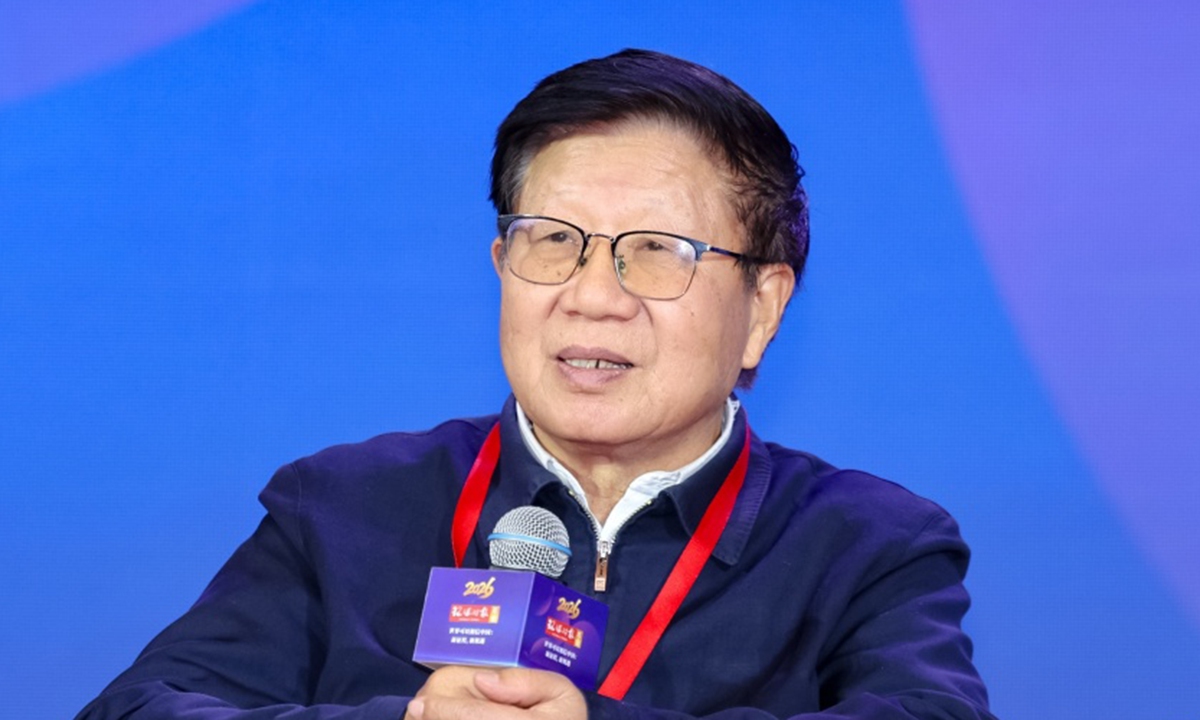
Li Junru, former vice president of the Party School of the Communist Party of China Central Committee Photo: Courtesy of Li
Editor's Note:
"When the happy hum of daily life fills every home, the big family of our nation will go from strength to strength." These words from President Xi Jinping's 2026 New Year message embody sincere and profound care for the people and convey touching and heartwarming strength.
"No issue of the people is too small; we care for every leaf and tend every branch in the garden of people's well-being." Since the 18th National Congress of the Communist Party of China (CPC), Xi, also general secretary of the CPC Central Committee and chairman of the Central Military Commission, has traveled extensively across the country, observing the conditions of the people, listening to their voices, and inquiring about their well-being. He cares deeply about the happiness and hardships of "every home," emphasizing that "of all the jobs in front of us, the most important is to ensure a happy life for our people."
Always placing the people above all else in hearts, upholding the original aspiration and mission of delivering benefits to the people, standing together with the people through thick and thin, and sharing a deep bond with them, and ensuring that the fruits of modernization benefit all people more extensively and equitably, China in the new era is steadily turning the people's yearning for a better life into reality, and is ensuring that the people's sense of gain, happiness, and security become more substantial, better safeguarded, and more sustainable.
The "people-centered" development concept and modernization approach has been the value that runs through the entire series of Xi Jinping: The Governance of China. In his speech made at the meeting with representatives to the first National Conference of Model Families, which was included in Volume II of the series, President Xi pointed out that "a prosperous and strong nation, the national rejuvenation and the happiness of the people are embodied by the happiness of the families and the better life of hundreds of millions of people." Volume V dedicated a section to "People-Centered Development" and compiled significant remarks by President Xi on this topic.
In the 20th installment of the special series "Decoding the Book of Xi Jinping: The Governance of China," the Global Times (GT), along with the People's Daily Overseas Edition, focuses on the "every home" and "big family of our nation" in President Xi's view and, as embodied in his heartfelt New Year message, the people-centered development concept of CPC members. We continue to invite Chinese and foreign scholars, translators of President Xi's works, practitioners with firsthand experience, and international readers to delve into the CPC Central Committee with Comrade Xi Jinping at its core's adherence to the people-centered development concept, and its epochal significance and value for us to strive in writing a new chapter of Chinese modernization.
In the 18th article of the "Scholars' Perspectives" column, Li Junru, former vice president of the Party School of the Communist Party of China Central Committee, elaborated his thoughts on the relationship between "small family" and "big family" in the view of the CPC members, and the Party's "people-centered ethos."
On the eve of the 2026 New Year, Chinese President Xi Jinping delivered a New Year message to the people across the country. This is a vivid, warmly moving speech in which every word strikes the heart. In particular, when President Xi noted that "when the happy hum of daily life fills every home, the big family of our nation will go from strength to strength," what we felt was not only a profound sense of family-nation sentiment, but also the "people-centered ethos" that reflects the deep bond between the Party and state leadership and the broad masses of the people.
"Jiaguo" sentiment—the sentiment of family and nation bounding together—is an outlook in which "family," or Jia in Chinese, and "nation," or Guo in Chinese, are closely intertwined. It reflects the Chinese people's profound humanistic understanding of, and broad identification with, the idea of "Jiaguo", and represents an essence of China's fine traditional culture.
In English, "Guo" is rendered as "country" in its geographical sense, "nation" in its ethnic sense, and "state" in its political or governmental sense; meanwhile, "Jia" is expressed as "home" when referring to a place of residence, and "family" when referring to a group bound by blood or legal ties. Within the English linguistic context, it is difficult to find a single term that, like the Chinese word "Guojia", so organically fuses "nation" and "family" into a relationship of shared flesh and blood and a common destiny. The very word "Guojia" inherently embodies the idea of Jiaguo sentiment.
The Communist Party of China (CPC) is a party that genuinely represents the fundamental interests of the broadest masses of the Chinese people and serves the people wholeheartedly. The Party's century-long struggle has been devoted to realizing one core principle: that the people "Dangjiazuozhu," meaning the people are masters of the country.
In the eyes of CPC members, "Jia" in "Dangjiazuozhu" refers to the sum of the people's "small families" and the "big family" of the nation; "zhu" means enabling the people to truly be the masters of both their "small families" and the "big family." After the founding of the People's Republic of China, the first law enacted—the Marriage Law—was enacted to ensure that the people became masters of their "small families." The Common Program of the Chinese People's Political Consultative Conference adopted in 1949, and the Constitution of the People's Republic of China promulgated in 1954, provided the fundamental guarantee for the people to truly become masters of the "big family."
In the hearts and minds of CPC members, "family" and "nation" ultimately converge in one word: the people.
The people-centered ethos of the CPC lies in its unwavering commitment to the principle that the people come first. General Secretary Xi Jinping has emphasized that "our people are the country's solid foundation and our main source of confidence to govern." The foundation of the state rests with the people, and the confidence of the CPC also comes from the people. In making any decision or undertaking any task, adherence to the principle of "putting the people first" is imperative—This is the value of the CPC as the ruling party.
In the speech included in volume I of Xi Jinping: The Governance of China—delivered when Xi met Chinese and foreign journalists for the first time after being elected General Secretary of the CPC Central Committee—he stressed that "the people's wish for a happy life is our mission." This represents the fundamental pursuit of the CPC Central Committee with Comrade Xi Jinping at its core in governing the Party and the country. It is also a defining feature of CPC's governance in the new era, which is to uphold the "putting the people first" commitment.
We remember that when General Secretary Xi led the Party and the people in striving to complete the building of a moderately prosperous society in all respects, he emphasized that "in building a moderately prosperous society in all respects, no one should be left behind." When proposing to comprehensively advance the great rejuvenation of the Chinese nation through Chinese modernization, the goal he set was for "the modernization of the entire population." And in leading the Party-wide fight against corruption, he issued a solemn pledge to "offend a few thousand instead of failing the 1.4 billion Chinese people."
What General Secretary Xi holds constantly in his heart is the people—because he has always practiced the lofty value that "I will fully commit to the people and never fail them."
Since socialism with Chinese characteristics entered the new era, the CPC Central Committee with Comrade Xi Jinping at its core has repeatedly emphasized the need to "ensure that the people's sense of gain, happiness, and security become more substantial, better safeguarded, and more sustainable."
The people-centered ethos upheld by CPC members—putting the people first—is a family-nation sentiment that delivers tangible benefits to countless households across the country.
Many friends at home and abroad have already noted that in China, efforts to promote high-quality development must be translated into improvements in people's livelihoods, and the development of whole-process people's democracy must likewise be grounded in people's livelihoods. Enriching cultural life must serve people's livelihoods; strengthening social governance, advancing ecological civilization, and safeguarding overall national security must all serve people's livelihoods. All of this, in the final analysis, is aimed at meeting the people's ever-growing aspirations for a better life.
Many foreign visitors to China often say they regret not having come earlier. They marvel not only at the warmth and friendliness of the Chinese people, the beauty of China's landscapes, and the richness of its cuisine, but also at how clean the living environment is and, in particular, how safe Chinese society is. Even walking alone on the streets late at night, one does not sense danger. The life enjoyed by the Chinese people is something that can be directly experienced not only by Chinese citizens themselves, but also by visitors from abroad.
What people in China and around the world most hope for is good health and a long life. In 2024, China's average life expectancy reached 79 years and is moving toward the goal of around 80 years by 2030. This figure has attracted widespread attention from both Chinese and international media, because it reflects the profound transformations that Chinese society has undergone.
In 1949, average life expectancy in China was only 35 years. It rose to around 68 years by 1981 at the beginning of the reform and opening-up period, climbed to 77.9 years by 2020, and during the 14th Five-Year Plan period has increased by more than 0.2 years on average each year—an achievement that is truly striking.
General Secretary Xi often says, "A nation can do well only when families do well." The people-centered ethos of the CPC is reflected in its commitment to serving the public and governance for the people, ensuring a social security system that enables all of China's over 1.4 billion people, young and old alike, to fully enjoy childcare, education, remuneration from work, medical care, old-age support, housing, and assistance for those in need.
In this list of "seven provisions," the main focus is the people—the "families" of countless households. The elements of childcare, education, remuneration from work, medical care, old-age support, housing, and assistance for those in need are not only the "needs" that the Party and state spare no effort to meet in response to the people's ever-growing aspiration for a better life, but also the very "well-being" that ensures "families do well."
The people-centered ethos of CPC members is further reflected in their mindset, exemplary conduct, and strict discipline in handling the relationship between their own "small family" and the "big family" of the nation.
The relationship of "small family" and "big family" is imbued with dialectics. On the 60th anniversary of the founding of the People's Republic of China, a hit song Guojia gained nationwide popularity, and its line "A family is the smallest unit of a nation; a nation is a collection of thousands of families" has since taken deep root in the hearts of the people. This simple yet powerful lyric concisely captures the inherent unity between "family" and "nation" — or between "small family" and "big family."
On the one hand, the "small family" is the foundation of the "big family" - only when individual families thrive can the nation prosper, and for the sake of national prosperity, individual families shall thrive even more. This aligns with the principle of "self-cultivation, family management, state governance, and bringing peace to all under heaven" put forward in the ancient Book of Rites. These principles emphasize that "Only when one's moral character is cultivated can the family be managed well; only when the family is managed well can the state be governed effectively; only when the state is governed effectively can peace be brought to all under heaven." In other words, it also aligns with Mencius' idea that "The foundation of the world lies in the state; the foundation of the state lies in the family; the foundation of the family lies in cultivating oneself."
On the other hand, the "big family" is the safeguard of the "small family" — without the nation, there would be no individual families to speak of. As Song Dynasty (960-1279) Chinese litterateur Fan Zhongyan put it, "I wish to be the first to worry about the nation's woes and the last to share in its prosperity." Similarly, Gu Yanwu, a famous Chinese scholar and philosopher of the 17th century, maintained that "Everyone has a duty toward his country."
In the fine traditional Chinese culture, emphasis is not only generally placed on the need to correctly understand and handle the dialectical relationship between the family and the nation; it also lays special stress on how government officials should approach the relationship between the two — namely, between the people and the nation.
To be specific, officials must bear three principles in mind: First, they need to recognize that "the people are to be cherished, not belittled. People are the foundation of a country and the country can only enjoy peace when its foundation is firm." Second, officials should understand that "Integrity is the cornerstone of governance" — meaning that as public servants, they must uphold integrity, refrain from abusing power for personal gain, and instead embody the spirit of the line "Though smashed to pieces, I fear it not, for I will leave my integrity in the world." Third, they have to internalize the maxim that "If it benefits the country, I will dedicate my life to it, regardless of fortune or misfortune." In other words, once taking office to serve the people, they must be ready to go through fire and water for the national interests.
CPC members are loyal practitioners of Marxism and outstanding inheritors of fine traditional Chinese culture. They not only understand the dialectical relationship between the "small family" and the "big family", between the people and the nation, but also have a deeper grasp of the dialectical relations between the self and the family, between the self and the people, and between the self and the nation.
On the one hand, as the vanguard of the working class in China, the Chinese people and the Chinese nation, the CPC has for its original aspiration and mission the pursuit of happiness for the Chinese people and the rejuvenation of the Chinese nation. It upholds the value of "putting the people first," adheres to the fundamental purpose of serving the people wholeheartedly, and follows the mass line as its work guideline. Therefore, every Party member must work diligently for the people and the nation, and this is also the best reward for themselves and their families.
On the other hand, the CPC, fully aware of the challenges and tests facing a governing party, has always adhered to the Marxist view of power that "power is bestowed by the people and should be exercised for the people." It has consistently upheld the principle of exercising strict self-governance over the Party and remained committed to Party's self-reform, and will never allow Party members to abuse the public power entrusted by the people for the benefit of their own "small families".
When formulating the eight-point decision on improving conduct, and conducting education on Party conduct and discipline, the CPC Central Committee with Comrade Xi Jinping at its core has repeatedly emphasized that officials at all levels must not only exercise strict self-discipline but also exercise strict oversight over their spouses, children, children's spouses, and staff members around them.
All CPC members understand that as Party members, especially officials, they must work diligently for the "small families" of the people and the "big family" of the nation. At the same time, they must never use public power to seek personal gains for themselves or their own families; any violation will result in punishment in accordance with Party discipline and national laws.
CPC members, who are strict with themselves, take the following oath upon joining the Party: "It is my will to be ready at all times to sacrifice my all for the Party and the people, and never betray the Party." When handling the relationships between the self and the Party, the self and the nation, the self and the people, and the self and the family, CPC members not only work diligently and strive arduously to ensure that each "small family" of the people thrive and the "big family" of the nation prospers, but the CPC also require its members and officials to "put the big family before their small families" for the sake of such goals.
To sum up in one sentence: Only by understanding the dialectical logic and value pursuit of CPC members regarding the relationship between the "small family" and the "big family" can one truly appreciate their people-centered ethos that is both sincere and fervent.
RELATED ARTICLES