'Pig-slaughter feasts' and other folk activities regulated to ensure public safety as Spring Festival approaches
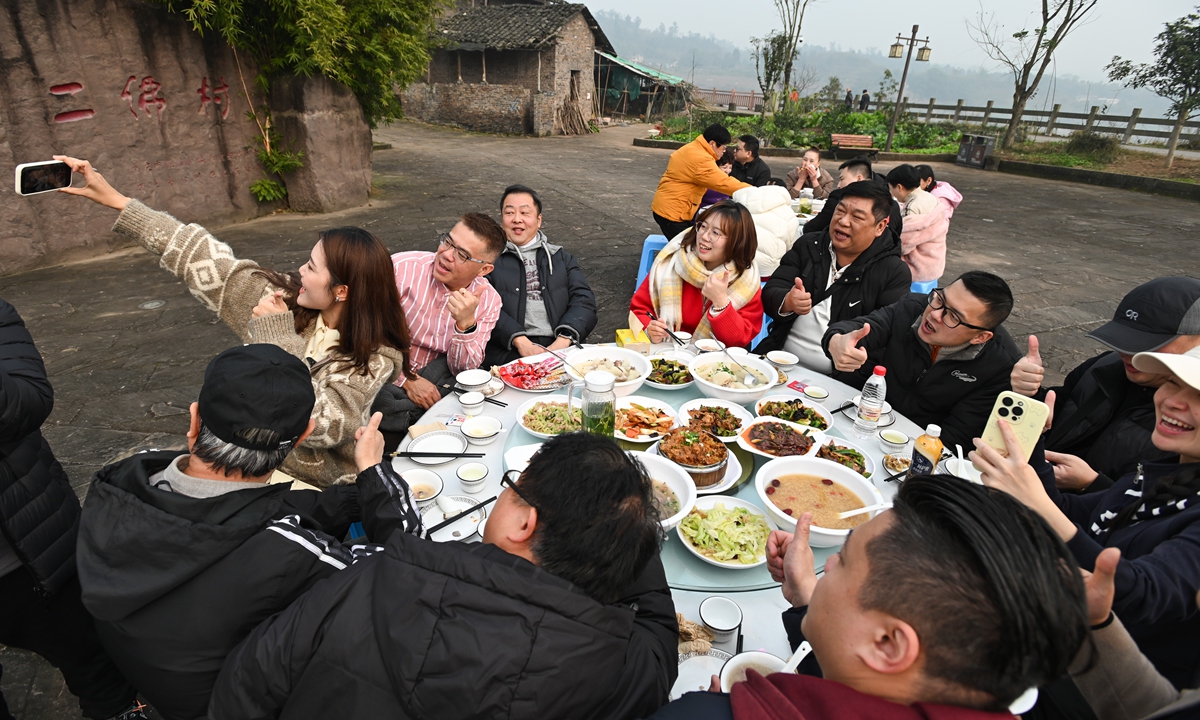
Tourists visit Hechuan, Southwest China's Chongqing Municipality, on January 16, 2026. Photo: VCG
As the Spring Festival approaches, folk activities have entered a peak season across different localities in China. Village "pig-slaughter banquets," boosted by influencer livestreams, have continued to gain popularity beyond local circles, yet the pursuit of online traffic has given rise to multiple hidden risks, such as traffic congestion, stampedes and food safety hazards, according to media reports.
In an article published by the Chinese Ministry of Emergency Management on Monday, local authorities in Loudi, Central China's Hunan Province have issued urgent reminder on strengthening safety and risk prevention of spontaneous mass gatherings including the "pig-slaughter banquets," setting out explicit requirements in five key areas including risk assessment, priority-based prevention and control, emergency support, publicity and guidance, and accountability enforcement.
Recently, a surge in "pig-slaughter banquets" unexpectedly sparked by social media has been urgently halted in multiple regions, according to media reports. Bloggers in Southwest China's Chongqing and Sichuan, Central China's Hunan and other regions have successively announced the cancellation of their events, citing reasons such as "participant numbers far exceeding expectations," "inadequate safety guarantees" and "lack of approval and filing procedures."
In response to such irregularities, Loudi authorities put forward targeted measures and clarified core prevention and control initiatives.
Public security, traffic control, market supervision and other departments shall conduct joint assessments, and resolutely implement traffic restriction, diversion or suspension measures for events that exceed capacity.
For key areas, the notice issued by Loudi explicitly stipulates strict requirements, such as ensuring gas safety and equipping sufficient fire-fighting equipment; in terms of road traffic, setting up temporary traffic control facilities and planning emergency access routes.
The "pig-slaughter banquets" enthusiasm started with a girl from Chongqing nicknamed Daidai, who triggered an "emotional tsunami" that swept across the internet as she invited netizens to help her father slaughter a pig for the Spring Festival, Hunan Daily reported.
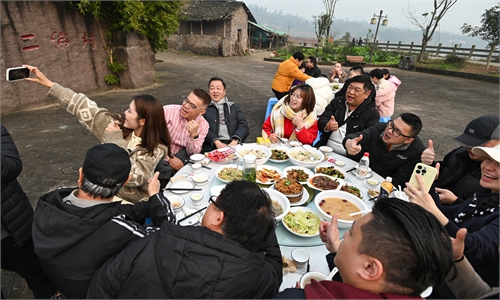
"My family is planning to slaughter two pigs at home, is anyone willing to help hold down the pigs? I'll treat you to feast soup," after Daidai posted on social media, over 3,000 people flocked to her home to lend a hand at the peak, and netizens were drawn to soak up the festive atmosphere.
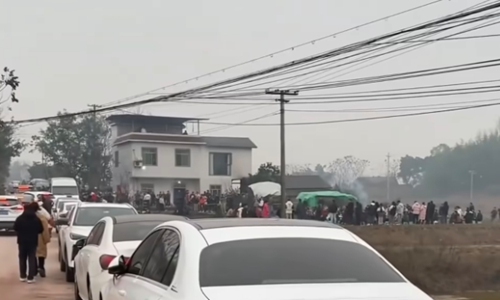
According to media reports, vehicles from all over the country stretched for kilometers along the narrow rural roads to Daidai's house. Local cultural and tourism, public security and other departments quickly deployed personnel to maintain order, while netizens voluntarily sent supplies and helped with cooking and serving dishes.
On January 13, the local culture and tourism development commission told media that a total of five pigs were slaughtered for the event, with more than 5,000 tourists arriving and the number of vehicles exceeding 1,000, reported The Beijing News.
Commenting on this viral phenomenon, a person in charge of the commission said that it was a simple invitation that aroused nationwide "homesick" across the internet. "What everyone is eating is not just the pig-slaughter meal, but the childhood memories they can never get back," the person in charge was quoted as saying in the report.
The traditional custom of the "pig-slaughter banquets" operates within the context of a close-knit community, relying on long-established social trust, informal normative constraints, and face-to-face accountability mechanisms. This operational model worked effectively in closed, stable rural communities, yet the sudden fame has revealed its vulnerabilities in modern public governance, such as whether the pigs have passed quarantine inspections, whether the venue is safe, and whether the number of participants is controllable, read a commentary published in Southern Metropolis Daily.
To break through this management dilemma between modern public governance and the spontaneous nature of traditional folk activities, it is imperative to move beyond the binary mindset of "regulation versus laissez-faire" and build a new governance model that is more flexible and intelligent, read the commentary.
Global Times
RELATED ARTICLES