Foreign businesses reaffirm commitment to Chinese market, citing expanding cooperation opportunities
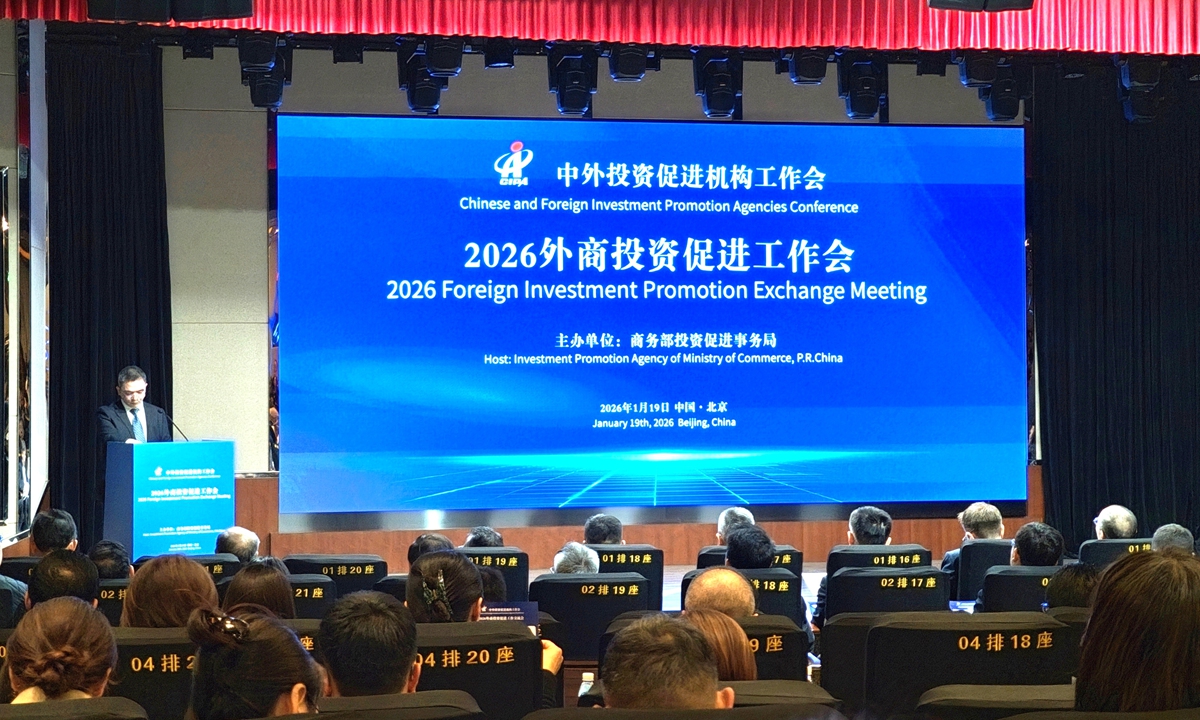
Chinese and Foreign Investment Promotion Agencies Conference held in Beijing on January 19, 2026. Photo: Yin Yeping/GT
Foreign business representatives on Monday expressed their strong commitment to the Chinese market, noting that they are seeing diversified and growing opportunities for cooperation as 2026 marks the beginning of the 15th Five-Year Plan (2026-30).
The remarks were made at Chinese and Foreign Investment Promotion Agencies Conference held in Beijing on Monday. The event, organized by Investment Promotion Agency of the Ministry of Commerce of China (CIPA), provided opportunities for foreign businesses and envoys to gain a better understanding of the Chinese market and policy measures, while interacting with government officials and other business partners for cooperation.
Representatives of embassies in China, investment promotion agencies, business associations, and multinational companies from more than 20 countries and regions attended the event, alongside representatives of commerce authorities, investment promotion agencies, industrial parks, and enterprises from more than 20 provinces and municipalities across China, according to CIPA.
Tom Simpson, managing director, China Operations and China chief representative of the China-Britain Business Council (CBBC), told the Global Times at Monday's event that "we greatly appreciate the close engagement that we enjoy with the Ministry of Commerce (MOFCOM)... We feel there are a lot of opportunities for us to exchange our thoughts, give our recommendations, and talk about ongoing issues and concerns that our members might have in terms of trade."
Talking about the potential of the Chinese market, Simpson said that "for us, where we're seeing a lot of positive activity is certainly in sectors like health care, international finance, and professional services, and the trade in services sector more broadly."
British business has been investing in China for a long time, and the commitment by British business to investing here remains strong, Simpson said, noting that "when you look at the long-term outlook, there is generally a greater level of optimism." "I think 2026 will be another step in that direction, and a big part of that would be the recovery of the growth rate of domestic consumption, which we have seen begin to rise," Simpson said.
Monday's event was a very good opportunity for foreign businesses to gain a better understanding of various policies and to interact with relevant partners, Osamu Onodera, chief representative for China and Northeast Asia of the Japan External Trade Organization (JETRO), told the Global Times on Monday.
Many Japanese companies have been quite successful in tapping into the Chinese market across diversified fields, ranging from electronics and new materials to consumer products, and are also deeply integrated into the Chinese supply chain, which is vital to their development, Onodera said.
"German companies have a long history in the Chinese market, with more than two-thirds of member companies having operated here for over 15 years. This reflects deep integration into China's economy and continued confidence in the market," Martin Hofmann, chairman of the German Chamber of Commerce in China, said at the event, noting that today more than 5,000 German companies operate in China, highlighting the importance of the Chinese market for German businesses.
Despite facing multiple challenges, 93 percent of German companies said that they would not leave the Chinese market and remain committed to it, Hofmann said, noting that the strongest investment intentions are in plastics and metal products, electronics, logistics, and transportation.
Talking about changes China has made that are positive for foreign businesses, Hofmann cited intellectual property protection as an example. China has achieved remarkable progress in intellectual property protection in recent years, and we recognized this, he said.
"German companies remain strong long-term partners in China, a very successful growth story over decades that needs to be continued," Hofmann said.
Some world-leading industry players also participated in Monday's event, underscoring their commitment to the Chinese market. Arkadiusz Budzinski, general manager of Ipsen China, told the Global Times at the foreign investment promotion event that there are several reasons why the company regards China as very important to its development.
"China is our strategic market, because it is the second-largest pharmaceutical market in the world… So every company wants to be present in China because of its huge potential," Budzinski said.
Another reason the global biopharmaceutical corporation believes that China will be increasingly important in the future is the country's aging population. In the pharmaceutical industry, there is a growing need to bring medicines to China to meet corresponding demand, he said.
In the past, the company mainly brought products into overseas markets, including China. However, this approach has changed. Last year, Ipsen signed a deal with a Chinese biotech company to jointly develop new molecules and products, which will be supplied not only to the Chinese market but also globally.
Ipsen entered China more than 30 years ago, and over the years, it has continued to increase its investment in the country. So far, this strategy has worked well.
"In the future, this market, especially the pharmaceutical segment, will be significantly larger," he said.
China has become an increasingly attractive destination for international capital. A recent KPMG report on the outlook for multinational companies (MNCs) in China revealed that nearly 70 percent of 137 surveyed executives are at least moderately confident in their three- to five-year growth prospects in China. Also, 94 percent are still investing in China.
The report also found that MNCs remain more optimistic about China than about the global economy.
Latest data from the MOFCOM shows that from January to November 2025, a total of 61,207 new foreign-invested enterprises were established nationwide, a year-on-year increase of 16.9 percent, indicating that China remains a favored investment destination for foreign businesses.
RELATED ARTICLES