IN-DEPTH / IN-DEPTH
Letters from China’s frontier guardians in mysterious Wakhan Corridor unveil perseverance, dedication spiritual legacy
Notes through time
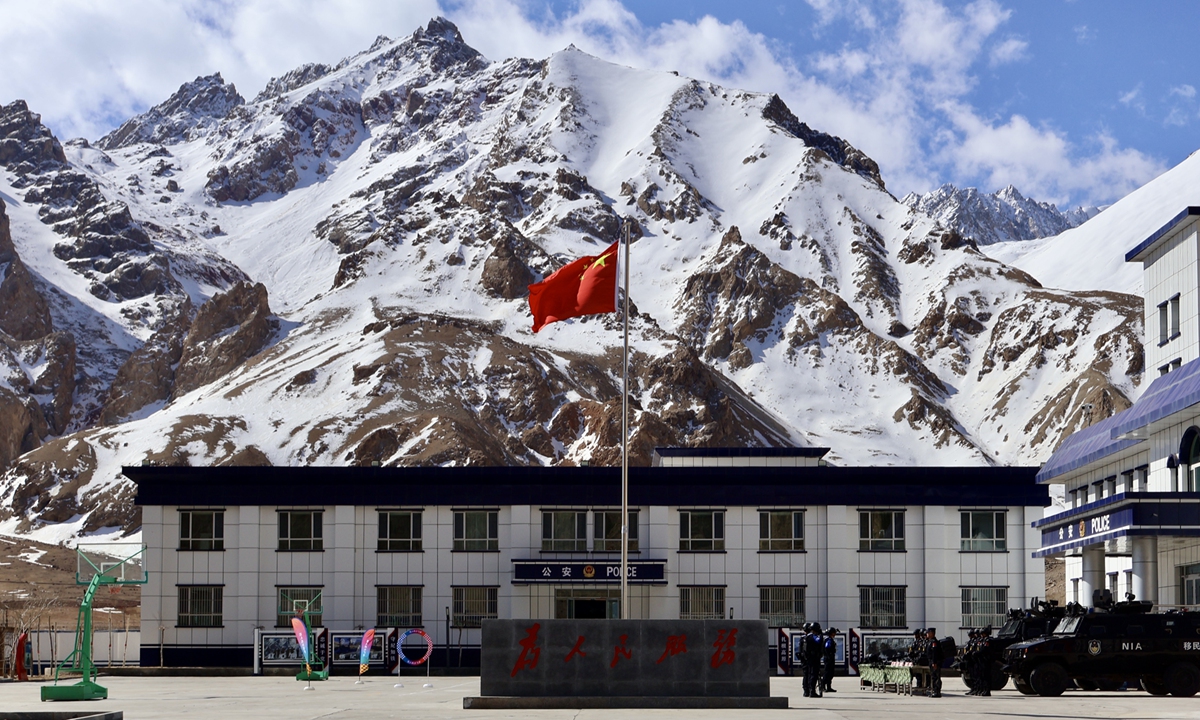
A view of the Paiyike Border Police Station in Taxkorgan Tajik Autonomous County, Northwest China's Xinjiang Uygur Autonomous Region Photo: Lin Xiaoyi/GT
Editor's Note:In the Pamir Plateau in Northwest China's Xinjiang Uygur Autonomous Region, at an average altitude of over 4,600 meters, stands the Paiyike Border Police Station. The officers stationed here guard the strategically vital Wakhan Corridor, overseeing a vast jurisdiction of 2,500 square kilometers and protecting a 197.4-kilometer border line in an area where China's borders converge with Tajikistan, Afghanistan, and Pakistan.
Within this station sits a special "Letters Through Time" mailbox. According to Kashi border management detachment officer Wang Bowen, this mailbox is part of a spontaneous yet solemn tradition within this close-knit group of officers. Whenever new recruits arrive here with great aspirations, or when fellow officers are transferred to new posts, they all leave a letter in the box.
"These letters are written to their future selves, to their comrades-in-arms who stand side by side with them, or to this land they defend with their youth," Wang explained.
This special feature, a joint presentation by the People's Daily Overseas Edition and the Global Times, shares excerpts from these extraordinary letters - more than just ordinary correspondence. It offers a glimpse into the perseverance and dedication of China's border guards.
These letters, written over nearly a decade, form a precious record of the spiritual legacy passed down through generations of border guards, revealing a profound sense of devotion to their homeland, Wang noted.
"Those simple vows take tangible form in the daily duties of these guards: Patrolling mountain valleys time and again, rushing to help herdsmen in need, and relying on the brothers who have their backs. Their quiet perseverance embodies a strong sense of mission and responsibility, serving as a vivid testament to the profound meaning of family and country," he said.
Song Dejiang: Standing guard in Wakhan Corridor is the honor of my life
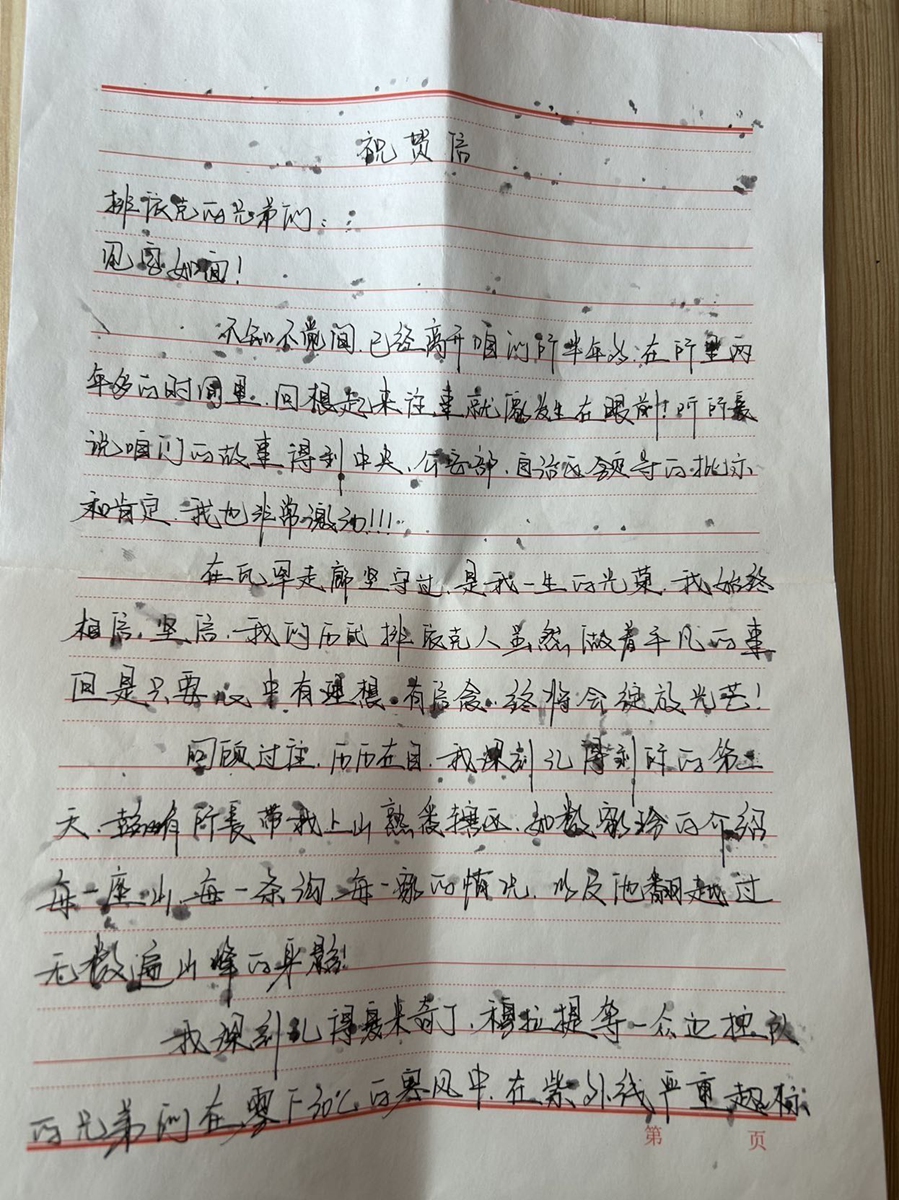
Part of Song Dejiang's letter Photo: Courtesy of Kashi border management detachment of the Xinjiang entry-exit border inspection station
"Standing guard in the Wakhan Corridor is the honor of my life. I firmly believe that all generations of Paiyike people, though doing ordinary work, will eventually shine brightly as long as they hold ideals and faith in their hearts," police officer Song Dejiang wrote in his letter.Song has served at the Paiyike Police Station for two years and left the position half a year ago. He is currently the deputy captain of the Yecheng border management brigade in Kashi.
For him, every memory at the Paiyike station still feels as vivid as if it happened yesterday.
"I remember the second day after arriving at the Paiyike station, when Station Chief Peng Mingyou took me up the mountain to familiarize myself with the jurisdiction, introducing me to every peak, valley, and household," he wrote in the letter.
For him, the memories remain vivid: the steadfast border control brothers standing firm through -30 C freezing winds and scorching summers under intense ultraviolet rays; the heroic efforts of those who battled for over seven hours — wading through icy rivers and trudging through thick mud — to rescue people stranded on the riverbank; and the determined patrols of comrades driving through fierce snowstorms to cover every mountain pass until nightfall.
"These countless experiences and memories are treasures I would not trade for mountains of gold," he noted.
Song said he could never forget the "four seasons in one day" weather of his jurisdiction, nor the images of his comrades patrolling through wind and snow. This is the quiet perseverance of taking root in the borderlands, and also a silent passing on of the torch.
Upon hearing that the Paiyike station had been awarded the national "Public Security Model" title by China's Ministry of Public Security, along with numerous other recognition, Song could hardly contain his excitement. He deeply understood that this honor was built on countless days and nights of steadfast duty.
Yang Tengfei: Determination to safeguard border security cannot be stopped
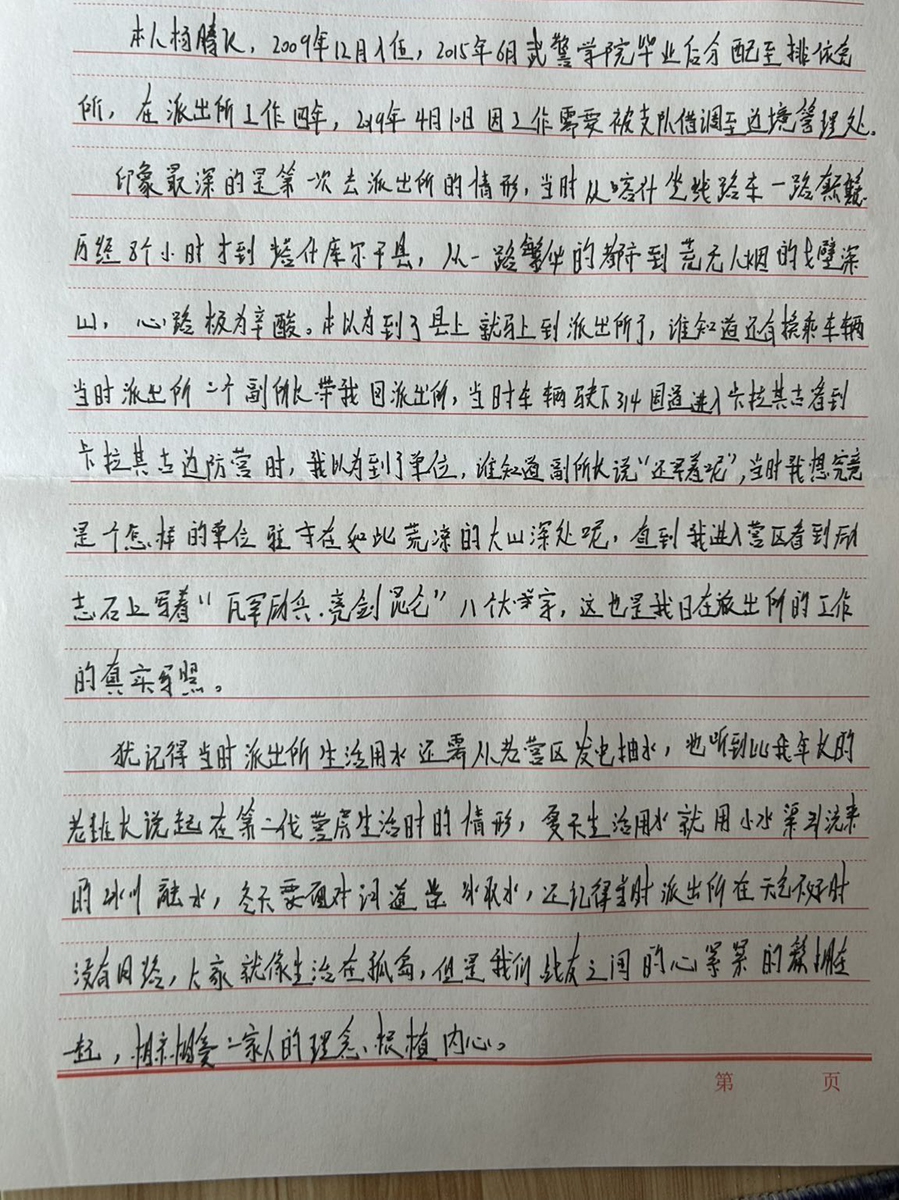
Part of Yang Tengfei's letter Photo: Courtesy of Kashi border management detachment of the Xinjiang entry-exit border inspection station
For police officer Yang Tengfei, what impressed him most was his first journey to Paiyike Border Police Station. After an 8-hour bumpy ride from Kashi to Tashkurgan Tajik Autonomous County, he thought he had arrived — only to find they still needed to transfer vehicles. When he saw the border defense camp, he assumed they were there, but they said, "Still far away."Yang recalled that in summer, their water came from glacial melt diverted through small channels; in winter, ice had to be chopped. "When bad weather hit, we felt like we were living on an isolated island, yet our comrades' hearts stayed united," he wrote in the letter.
Yang began working at Paiyike Border Police Station in June 2015. In April 2019, due to work needs, he was temporarily transferred by the detachment to the border management office.
During his tenure at the Paiyike station, Yang left his footprints at every ravine entrance. In scorching summers or freezing winters, they never dared to relax. Once, while patrolling the China-Pakistan border with several comrades, there was no road yet — they had to wade across rivers. The water was shallow in the morning, but by afternoon, snowmelt had swollen the river so much that their vehicle was nearly swept away.
"I also heard veteran officers recall riding donkeys for border patrols; once, they were swept into the freezing river and barely reached the bank, only to warm themselves at a villager's home. Despite all these hardships of border patrols, our determination to safeguard border security cannot be stopped," Yang emphasized.
In the letters Yang usually wrote to his family, he only chose to write about the warm sunshine of the Wakhan Corridor and the honor of guarding the border.
Every time he spoke with his family on the phone, Yang always shared only good news and never mentioned worries. On the other end of the line were his family's concerns; on this end were howling cold winds and the lonely watchtower. Yet Yang said that whenever he sees the sunrise, with golden light pouring over the boundary marker, a warm current surges in his heart. "What I am guarding is not just a marker — it is the territory of the motherland, and the countless homes behind it," he said.
Jing Xuhui: Duty to 'guard and protect' etched upon putting on the police uniform
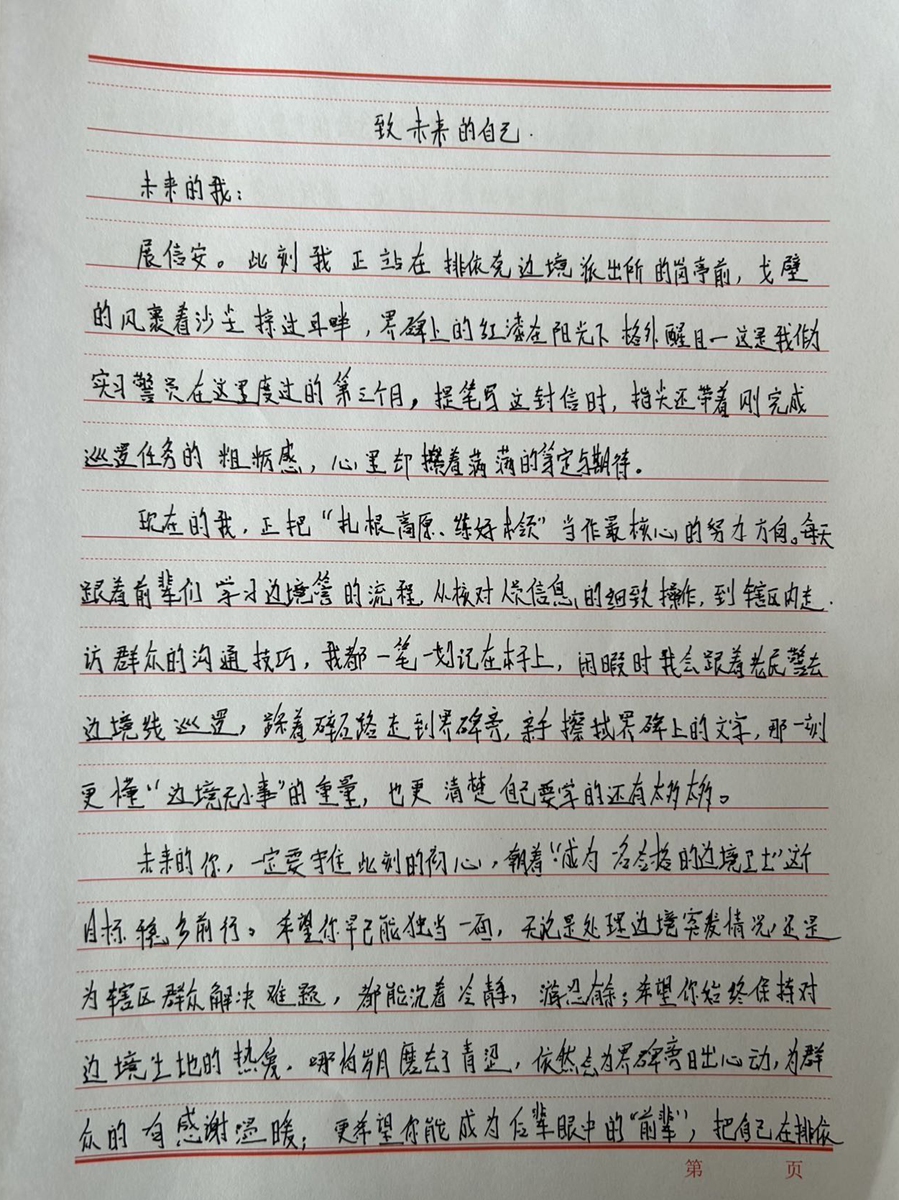
Part of Jing Xufei's letter Photo: Courtesy of Kashi border management detachment of the Xinjiang entry-exit border inspection station
"Right now, I'm standing in front of the sentry box at the Paiyike Border Police Station. The Gobi wind, carrying sand and dust, brushes past my ears, and the red paint on the border marker shines brightly under the sun. This is my third month here as a trainee police officer. As I write this letter, my fingertips still carry the roughness from just finishing a patrol, but my heart is filled with firm resolve and anticipation." These are the words from a letter Jing Xuhui, a police officer born after 2000 at Paiyike, wrote to his future self.Jing graduated from college and joined the Paiyike Border Police Station in 2024. In his letter, he wrote that his current focus was to "set down roots at the border and master his duties," when he spent his days learning border control procedures from senior officers, meticulously noting down everything from the precise steps of verifying identities to the communication skills needed when visiting local resident
During those three months, Jing was like a sponge, eagerly absorbing everything around him. What he remembered wasn't just work processes, but also the wrinkles etched by wind and sand into the corners of the former station master's eyes, and the warmth in the residents' eyes when they said, "Thank you for your hard work, kiddo." These moments felt so profound that he thought writing them down in a notebook or keeping them in his heart wasn't enough. Jing believes they deserved to be "preserved" more solemnly, in a place that wouldn't be faded by the routines of daily life.
That's why he decided to write a letter, to himself 10 or 20 years from now. He hopes this letter would be like a mirror; when he feels lost, he can take it out to remind himself of his original pure intentions.
He outlined his hopes for his future self in the letter: "You must hold fast to the initial resolve you feel at this moment, and steadily progress toward the goal of becoming a qualified guardian of the border." He hoped his future self would be a capable and composed professional, whether handling border incidents or helping residents, and that he would retain his love for this land. "May you still be moved by the sunrise beside the border marker. And more than anything, I hope you become a mentor in the eyes of the younger generation, passing on the experience, beliefs, and the spirit of Paiyike to the next generation," he said.
Liu Zuoyu: Never forget why you came here
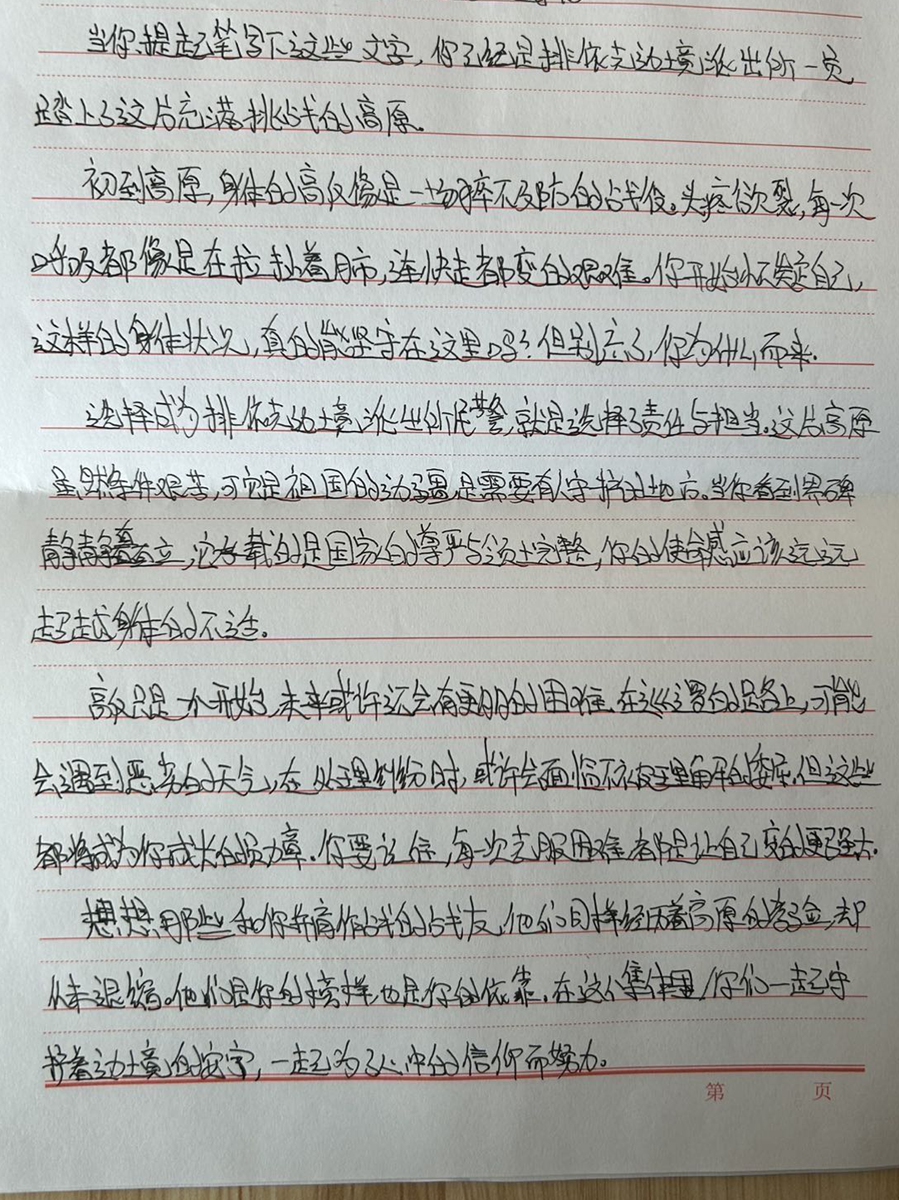
Part of Liu Zuoyu's letter Photo: Courtesy of Kashi border management detachment of the Xinjiang entry-exit border inspection station
"Stepping onto the plateau for the first time, altitude sickness hit like a sudden, unforeseen ordeal. A splitting headache throbbed in my skull; every breath felt like a sharp tug on my lungs; even a brisk walk became a struggle. I couldn't' help but doubt myself, could my body really hold up here? But then, I told myself: Never forget why you came here." These were the words of encouragement Liu Zuoyu wrote to himself when he first arrived at the plateau to serve as a police officer at Paiyike Border Police Station.In his writings, Liu made it clear that choosing to work at Paiyike Border Police Station meant choosing duty and commitment. "Life here is harsh, but this plateau is part of our motherland's borderland, a place that demands guardianship. When I think of the boundary markers standing silently, bearing witness to our nation's dignity, my sense of mission instantly outweighs the physical discomfort."
He acknowledged that altitude sickness was only the beginning. Harsh weather during patrols, misunderstandings while mediating disputes, all these, he believed, would eventually become "medals of growth."
When a sense of mission prevails over physical agony, and the conviction to guard the border takes root deep in one's heart, altitude sickness ceases to be an insurmountable barrier. The harsh patrol weather and the frustration of being misunderstood, mentioned in Liu's note, are the daily realities for border police officers. These trials are not burdens - they are honors etched into the fabric of their youthful years.
Liu ended his letter with a simple yet powerful note to his future self: "In the days ahead, take care of yourself. Adapt to this environment. With steadfast belief and persistent effort, protect this land and its people."
RELATED ARTICLES