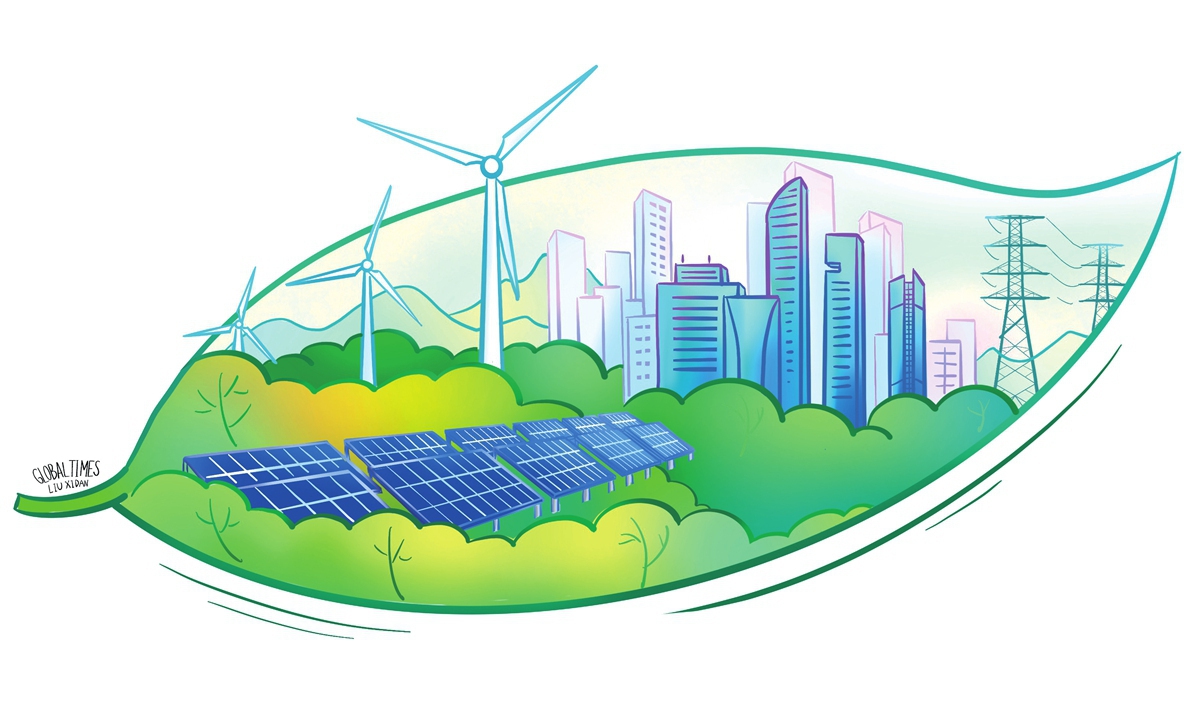
Illustration: Liu Xidan/GT
The proportion of clean energy supply in China continued to rise in 2025, Hu Hanzhou, director of the Energy Statistics Department of the National Bureau of Statistics, said in a statement on Monday.According to the statement, electricity generated from clean energy sources - including hydropower, nuclear, wind, and solar power - by China's major industrial enterprises reached 3.42 trillion kilowatt-hours in 2025, up 8.8 percent year-on-year. This accounted for 35.2 percent of their total power output, up 2.1 percentage points from a year earlier.
Separately, data from the National Energy Administration showed on Saturday that China's total electricity consumption exceeded 10 trillion kilowatt-hours for the first time in history, according to the Xinhua News Agency.
These figures not only highlight the ongoing optimization of China's energy structure but also underscore the vital role of the green transition in supporting economic and social development. The growing share of clean energy in total supply is a manifestation of China's energy system moving toward diversification and low-carbon development. As the world's largest energy consumer, China has a particularly pressing need to build a self-sufficient and resilient energy supply mix. The consistent expansion of clean energy generation has helped reduce excessive reliance on coal and oil, while strengthening the overall security and stability of the country's energy supply.
Moreover, the rapid development of clean energy has provided strong support for the sustained and healthy operation of the economy and society. The milestone of total electricity consumption exceeding 10 trillion kilowatt-hours serves as powerful evidence of China's economic vitality and scale. Even amid rising power demand, clean energy has been used in tandem with conventional sources to ensure the safe and stable operation of the grid.
More importantly, the fast-growing production of green energy equipment and materials has spurred the emergence of a large-scale, integrated industrial ecosystem. From photovoltaic modules and wind turbines to energy storage systems and smart grid solutions, a complete industrial chain spanning research and development (R&D), manufacturing, operation, and services has taken shape in China. This has created jobs, attracted significant R&D investment, and accelerated technological innovation.
The fact that energy intensity continues to decline while total electricity consumption keeps growing demonstrates that China's economic development is becoming more environmentally sustainable. This development path, led by technological innovation and driven by green industries, is opening new horizons for high-quality economic growth in China.
Furthermore, China's industrial advantages not only solidify the foundation for its own green transition but also contribute significantly to global efforts to tackle climate change by providing cost-effective and reliable products and technologies.
The global energy transition still faces severe challenges. On the one hand, many countries and regions still grapple with electricity shortages or vulnerable grid infrastructure. Even in some developed economies, power systems are under strain from new high-load sources of demand, such as those associated with the rapid growth of artificial intelligence. On the other hand, green production capacity - particularly high-quality output from China, which should be part of the solution - is being smeared as "overcapacity" in some markets and subjected to various forms of trade barriers and policy restrictions.
Such practices violate market principles and undermine global efforts to combat climate change. The real crisis confronting the world is climate change itself - not an oversupply of the very solutions needed to address it. Impeding the global flow of clean energy technologies and products will only slow the transition, raise costs, and ultimately harm humanity's shared climate interests.
China's experience demonstrates that the coordinated advancement of economic growth and environmental protection is not only feasible but also an essential choice for sustainable and high-quality development. With its vast market, complete industrial chain, and committed actions, China is becoming an indispensable stabilizer and accelerator in the global shift toward green energy. Its journey sends a clear message to the world: the green transition is not a burden on development, but an opportunity.
RELATED ARTICLES