Takaichi to dissolve lower house for snap election; Japan PM tries to shift focus, alleviate stress from diplomatic difficulties with Beijing: experts
By and Ma Tong Published: Jan 19, 2026 11:00 PM

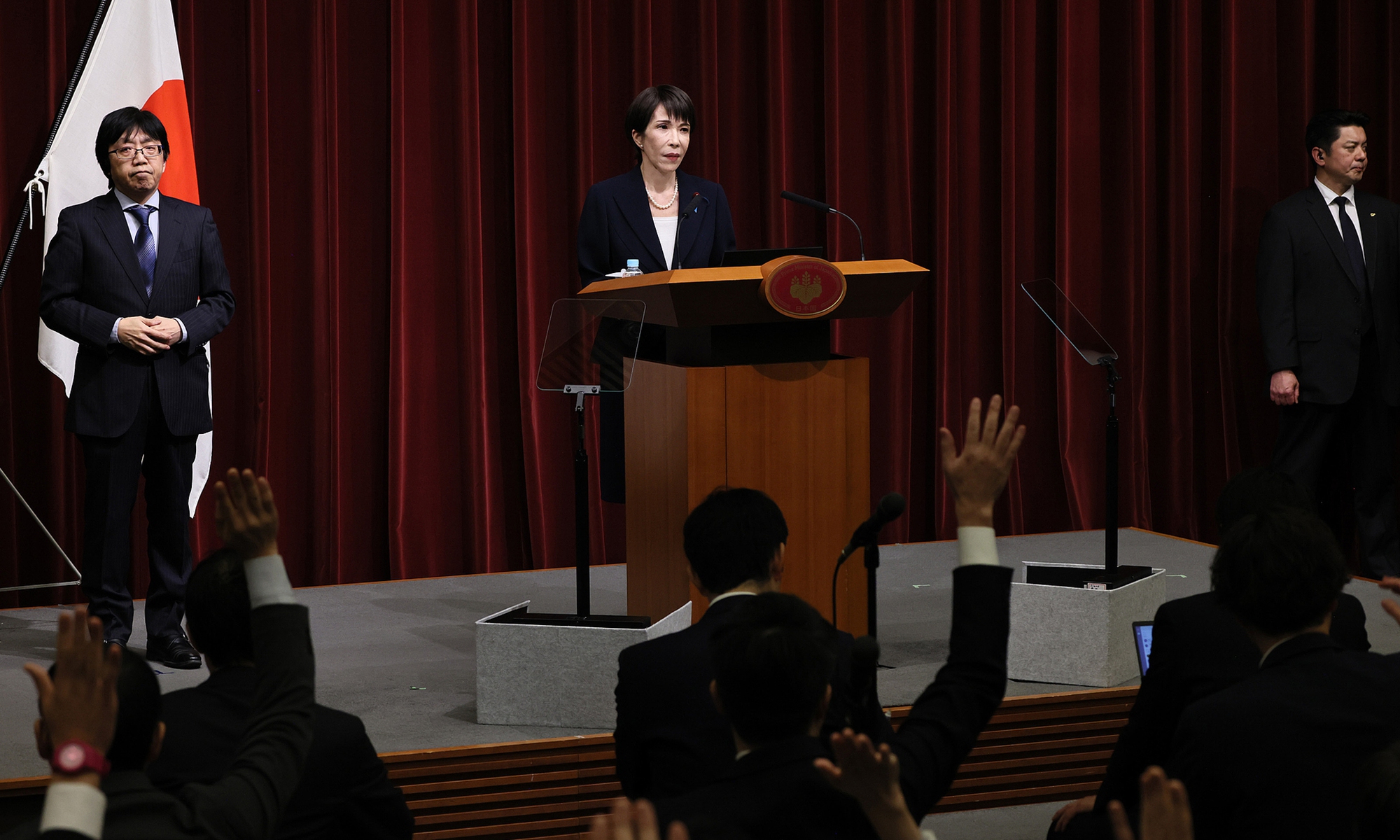
Japanese Prime Minister Sanae Takaichi attends a press conference to announce the dissolution of the House of Representatives at the prime minister's office in Tokyo on January 19, 2026. Photo: VCG
Japanese Prime Minister Sanae Takaichi announced on Monday that she will dissolve the House of Representatives on January 23, the day the ordinary Diet session convenes, for a snap general election, according to media reports. Japanese media described the move as "an unusually early election at an unusual time." Besides the weak position of the ruling party, Japanese media noted that factors behind the decision also included strained China-Japan relations following her Taiwan-related remarks.
This marks only the second time in 60 years that dissolution would occur at the outset of an ordinary Diet session, and the first since sessions began convening in January in 1992, Asahi Shimbun reported.
As the schedule for the lower house election has been officially announced for January 27 with counting on February 8, the period from dissolution to voting would be the shortest in post-war history at 16 days, prompting both ruling and opposition parties to accelerate election preparations, Jiji Press reported.
Regarding the reason for dissolving the House of Representatives, Takaichi claimed Monday that "What the Takaichi administration has begun to undertake is a major transformation of critical policies related to the nation's foundation, starting with entirely new economic and fiscal policies."
According to Jiji Press and Kyodo News, Takaichi's decision to dissolve the lower house just over a year after the previous election in October 2024 has sparked criticism from opposition parties, saying she is putting political considerations ahead of parliamentary enactment of the initial budget for fiscal 2026 starting in April, despite her pledge to prioritize policy implementation.
Social Democratic Party leader Mizuho Fukushima criticized Takaichi's lower house dissolution, noting that "This is a dissolution that abandons people's livelihoods," NHK News reported.
Regarding timing of Takaichi's move, Asahi Shimbun reported Monday that a factor is deteriorated relations with China following Takaichi's Taiwan-related claims.
China has decided to strengthen export controls on dual-use items to Japan, effective as of January 6, heightening a sense of crisis within the Takaichi administration with some worrying about the potential inclusion of rare earth controls, the Japanese media report claimed.
The report noted that "depending on China's future actions, the economy—a flagship policy of the Takaichi administration—could be affected."
According to Asahi Shimbun, it is believed that Takaichi aims to dissolve the house when cabinet approval ratings are high, thereby increasing LDP seats and stabilizing the administration's foundation. Once budget committee deliberations begin in the Diet, the administration could face scrutiny from opposition parties, potentially leading to a decline in support, Asahi Shimbun added.
Her erroneous Taiwan-related remarks and radical military expansionist agenda have undermined the foundation of China-Japan ties. China's targeted countermeasures have put economic pressure on Japan, and Takaichi administration's handling has been attacked by the opposition parties. The core purpose of dissolving the Diet at this moment is to evade pressure from upcoming parliamentary questioning, shift the focus of public attention through elections, and alleviate the stress caused by diplomatic difficulties with China, Xiang Haoyu, a research fellow at the China Institute of International Studies, told the Global Times on Monday.
Also on Monday, during her meeting with leaders of Keidanren (Japan Business Federation), Takaichi, citing China's moves to strengthen export controls toward Japan, called for diversifying procurement sources to avoid "excessive dependence" on specific countries for critical materials. She also claimed that she intends to "coordinate with like-minded countries in making representations to China," NHK News reported.
Takaichi's latest claims regarding China's export controls are an attempt to manage the fallout from her previous provocative words toward China, while avoiding any direct acknowledgment of her own responsibility, Chen Zilei, Director of the Research Center for Japanese Economics at Shanghai University of International Business and Economics, told the Global Times on Monday.
"Takaichi ought to explain the origins and evolution of the issue to Japan's business community and assume the corresponding political responsibility. Instead, she has chosen to obscure the causal relationship, framing the problem as a supply chain risk in an attempt to downplay Tokyo's policy errors," Chen said.
Xiang pointed out, elections cannot resolve supply chain dependency in the short term, and alternative solutions are costly and time-consuming. "The economic repercussions will inevitably emerge over time, ultimately subjecting Takaichi's administration to increasing governance pressure," the expert added.
Kyodo News cited another reason for the upcoming dissolution of Japan's lower house: the Takaichi administration has faced challenges in managing the Diet, as the LDP-led coalition holds only a razor-thin majority in the lower chamber and remains a minority in the House of Councillors, requiring it to cooperate with opposition parties to pass bills.
To battle the conservative ruling camp, the Constitutional Democratic Party (CDP) of Japan and the Komeito party, a former longtime LDP ally, agreed Thursday to form the Centrist Reform Alliance, which would be the largest opposition force, for the upcoming contest, according to Kyodo News.
The new party is taking aim at core contentious points of Takaichi's right-wing security policies, highlighting domestic anxieties about excessive political right-leaning and military adventurism, Xiang commented. "However, in the short term, this force is unlikely to fundamentally reverse the severe rightward shift in Japanese politics, though it may serve as a counterbalance," Xiang said.
In response to a question on January 13 that Japan's Prime Minister has signaled her intention to call a snap election possibly in February, the Chinese Foreign Ministry spokesperson Mao Ning said that this is Japan's internal affair. "I have no comment on this," Mao said.
RELATED ARTICLES