The world witnesses the resilience of China’s economy ‘advancing under pressure’: Global Times editorial
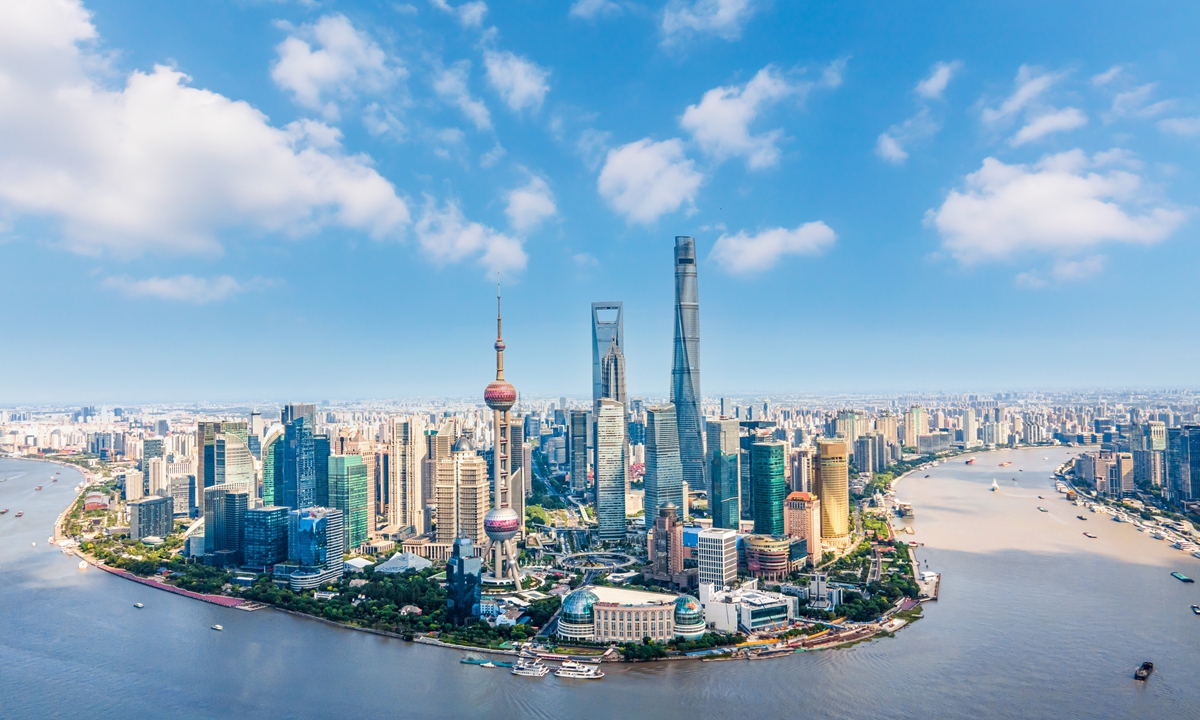
A view of the Lujiazui area in Shanghai Photo: VCG
On January 19, the National Bureau of Statistics (NBS) released China's economic data for 2025. China's gross domestic product (GDP) exceeded 140 trillion yuan, an increase of 5 percent over the previous year at constant prices, confirming the steady foundation of the Chinese economy amid a complex environment. The achievement of China's economic growth targets reflects both the high level of policy formulation and strong execution capabilities. With this, the "14th Five-Year Plan" concluded with remarkable "four consecutive leaps" in economic scale - rising from 110 trillion yuan to 120 trillion, then to 130 trillion, and finally surpassing 140 trillion. The steady and progressive signals continuously sent by the world's second-largest economy are both a contribution and an encouragement to the world.
The past year has been remarkable. The Chinese economy moved forward under pressure toward new and improved directions. From an external perspective, intensified global trade frictions, ongoing geopolitical conflicts, and divergent policies among major economies - particularly the renewed threats of tariffs by certain countries - have caused severe shocks to global industrial and supply chains. Domestically, challenges such as economic transformation pains and uneven consumption recovery have tested the precision of macroeconomic regulation. Over the past year, the global trade and economic order suffered severe shocks, and there were pains in the transition from old to new growth drivers. Yet China's economy still achieved both a "quantitative leap" and a "qualitative improvement," fully demonstrating its capacity to adapt, overcome challenges, and maintain resilience under pressure.
The 5 percent GDP growth in 2025 is hard-earned, and even many Western media outlets have praised China's economic resilience. The Wall Street Journal, often badmouthing China's economy, described China's economic growth as "robust," noting that China's exports rose rather than fell in 2025, defying expectations that the trade war would hobble the country. The BBC reported that the latest data shows China's economy exhibiting a "two-speed economy" in manufacturing and exports, accompanied by a photo of a Chinese female worker producing red electric guitars for export on a factory line. Over the past year, the world has witnessed both China's achievements in export diversification and its resilience to "advance under pressure."
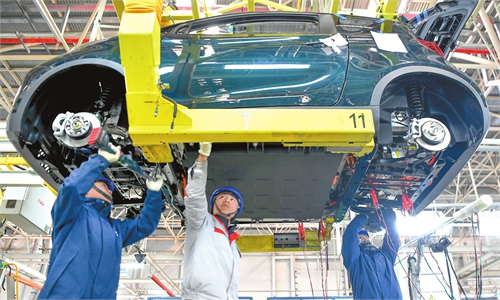
China's economic resilience is rooted in a solid industrial foundation and well-calibrated management of macroeconomic policies. From the perspective of industrial structure, the coordinated development of the three sectors has been further consolidated, providing diversified momentum for growth. The primary industry, with a growth rate of 3.9 percent, has reinforced the baseline for people's livelihoods, with grain output remaining high for many consecutive years, supporting stable prices and social stability. In the secondary industry, the 4.5 percent growth reflects profound structural upgrades: The value added of above-scale equipment manufacturing and high-tech manufacturing increased to 36.8 percent and 17.1 percent, respectively, while production of civil drones and industrial robots rose 37.3 percent and 28 percent year-on-year. New quality productive forces are accelerating the reshaping of industrial structures. The tertiary industry led with a growth rate of 5.4 percent, accounting for 57.7 percent of GDP and contributing 61.4 percent to overall economic growth. The upgrading and efficiency improvements in the service sector have provided strong support for employment expansion and consumption upgrades.
In a global economic situation filled with uncertainty, the innovative dynamism and down-to-earth sense of responsibility of the Chinese economy are becoming some of the scarcest forms of certainty valued by the international community. This certainty stems from a constant surge in momentum for innovation. From the Tianwen-2 probe entering orbit and the maiden flight of the "Jiutian" UAV, to the CR450 high-speed train setting new "China speed" records and the commissioning of China's first aircraft carrier equipped with electromagnetic catapults, a series of major breakthroughs highlights China's solid progress toward high-level technological self-reliance and self-strengthening, while providing new support for the upgrading of global industrial chains.
This certainty is also reflected in China's commitment to opening-up backed by action. We advance institutional opening-up at depth, and have granted zero-tariff treatment on 100 percent of tariff lines to all the least developed countries having diplomatic relations with China. We maintain an average contribution rate of around 30 percent to global economic growth, demonstrating our commitment to upholding economic globalization and the multilateral trade system through concrete actions.
Among the data released on Monday, one striking detail stands out: In 2025, China's household car ownership reached 52.9 vehicles per 100 households. At the same time, real per capita disposable income grew by 5 percent, matching GDP growth, while consumer spending on daily necessities and services, transportation and communications, and education, culture and entertainment rose rapidly. China's economy combines self-transcending innovation with a genuine commitment to people's well-being. The growing confidence of the Chinese people in living better lives is precisely what enables China's economy to continue delivering confidence to the world.
Looking back from the first year of the 15th Five-Year Plan, what China's economy demonstrates is a kind of reliability the world expects, as well as a sustainable development logic.
From the solid foundation of a GDP totaling 140 trillion yuan to the vigorous vitality of new quality productive forces, China's economy is sending a clear signal through its unique resilience and dynamism: using its own certainty to offset global uncertainty, and providing a steady course for the world economy as it navigates through the fog.
RELATED ARTICLES