German study finds 96% of US tariff burden borne by itself; levies also weaken industrial competitiveness: expert
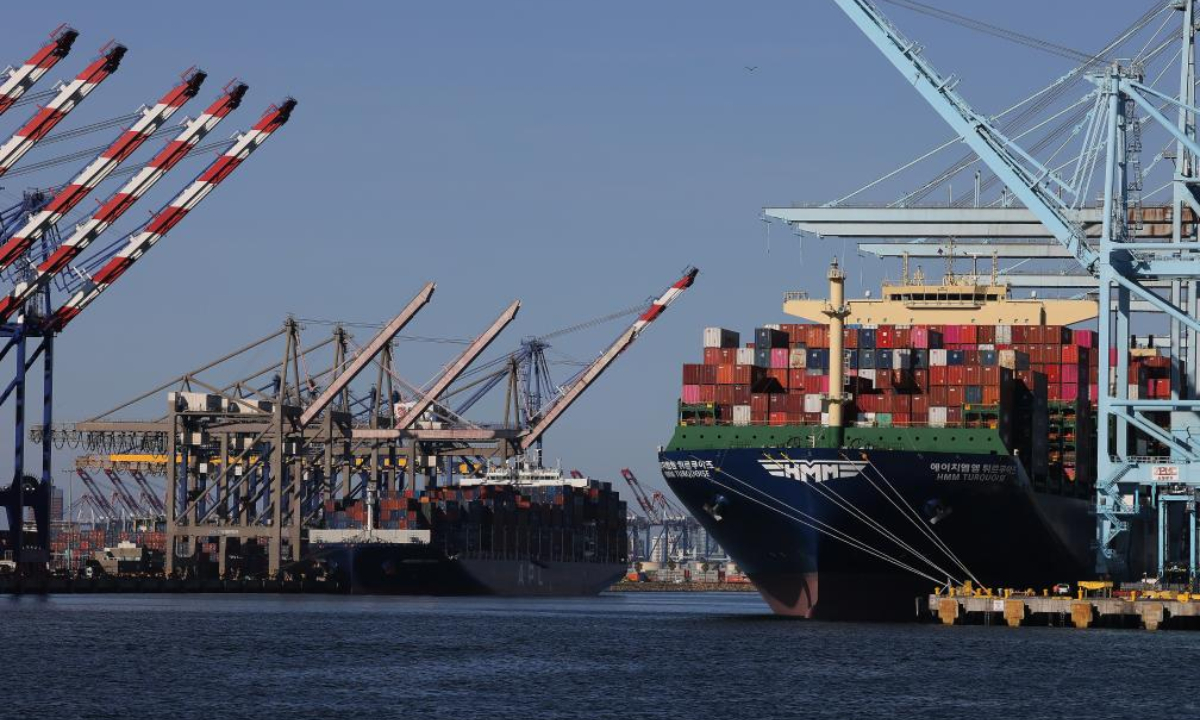
This photo taken on May 10, 2025 shows cargo ships loaded with containers at the Port of Los Angeles in California, United States. Photo:Xinhua
A new study released on Monday (local time) by a German economic research institute shows that the vast majority of tariffs imposed by the US government are ultimately borne within the US economy itself, rather than by foreign exporters, contradicting repeated claims by US officials that tariffs shift costs onto other countries.
The study adds new empirical evidence to ongoing debates over the economic impact of tariffs, which not only raise costs for consumers and firms in the country that imposes tariffs, but also weaken its industrial competitiveness, a Chinese expert said on Tuesday.
According to the study conducted by the Kiel Institute for the World Economy, about 96 percent of the tariff burden falls on US importers and consumers, while only around 4 percent is absorbed by exporters abroad.
The findings are based on an analysis of more than 25 million US-bound maritime shipment records, covering nearly $4 trillion in trade between January 2024 and November 2025, the report said.
Julian Hinz, research director at the Kiel Institute and one of the authors of the study, said that the tariffs amounted to an "own goal," noting that the widely held claim that foreign countries pay the tariffs is "a myth," according to a statement released by the institute.
The data show that higher tariffs have only a limited effect on exporters' pricing decisions. For every 10-percentage-point increase in tariffs, average import prices declined by just 0.39 percent, suggesting that exporters absorbed only a small share of the additional cost.
In practical terms, the study finds, even when a 25 percent tariff is imposed on a product, foreign suppliers cut prices by less than 1 percent on average, with most of the cost remaining on the US side and eventually passed on to consumers through higher prices.
Rather than forcing exporters to lower prices, the report also finds that higher tariffs mainly reduced trade volumes. Following tariff hikes on imports from Brazil and India in August 2025 (raising duties on Brazilian goods to 50 percent and on Indian products from 25 percent to 50 percent) exports to the US fell sharply, by as much as 24 percent, while export prices remained unchanged, according to the study.
As tariffs expand to cover more trading partners, the main risk lies in their spillover effects, which accelerate trade diversion and raise compliance and adjustment costs for firms, adding friction to already fragile global supply chains, Bian Yongzu, an economic analyst and executive deputy editor-in-chief of Modernization of Management magazine, told the Global Times on Tuesday.
The expert further noted that trade frictions are more likely to redirect trade flows than change pricing behavior, as companies adjust supply chains or seek new markets rather than cut prices, adding "while higher tariffs may bring short-term revenue, their costs tend to accumulate domestically over time, weakening industrial competitiveness, especially in sectors reliant on imported components or materials."
Over the long term, higher tariffs are likely to squeeze profit margins for US companies and push up prices for consumers, while exporting countries may face reduced sales to the US and increased pressure to seek alternative markets, according to the report. Hinz said that, in this sense, "tariffs ultimately disadvantage everyone."
RELATED ARTICLES