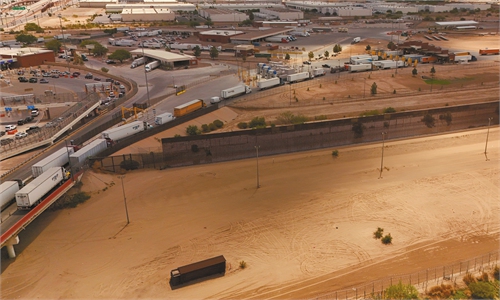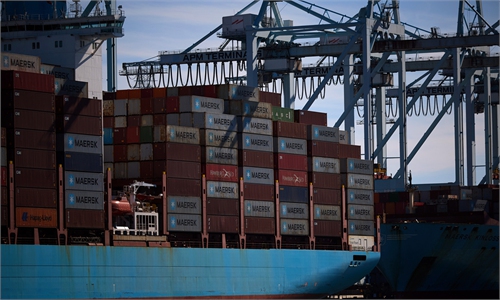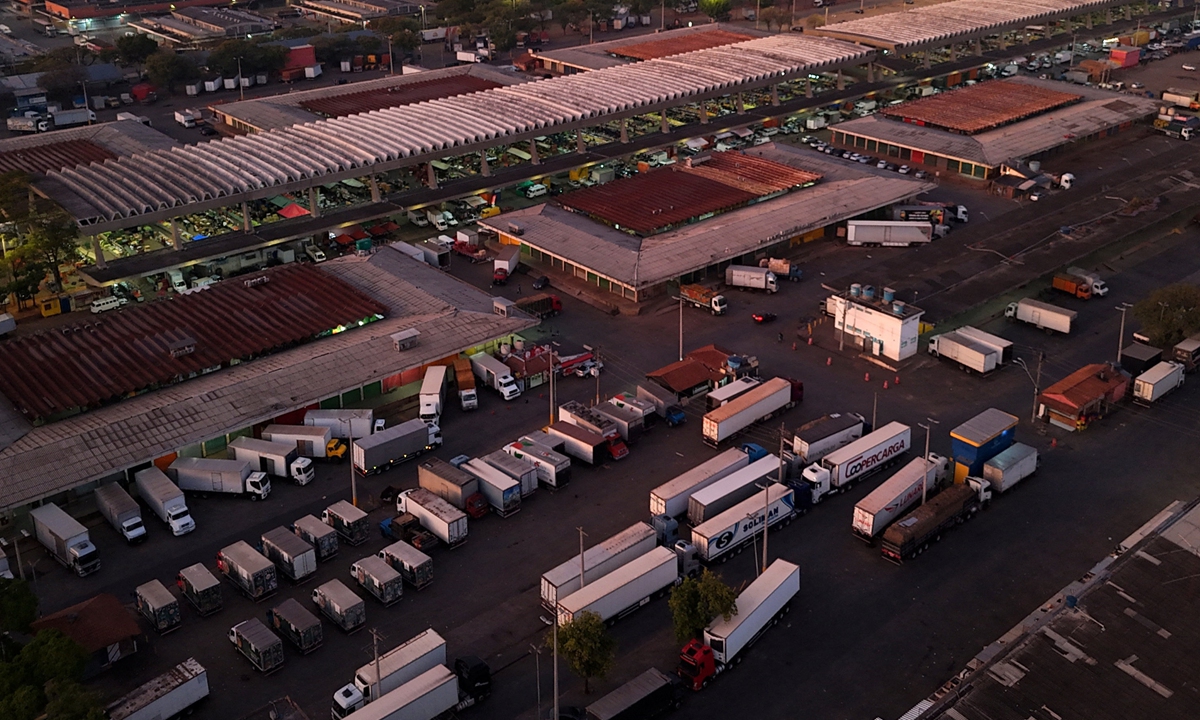
A logistics center in Sao Paulo, Brazil on August 3, 2025 Photo: IC
The latest wave of tariffs imposed by Washington on dozens of countries is likely to remain in place, according to a US official on Sunday, a signal that experts say risks creating tremendous uncertainty for global investment and trade, with repercussions that could boomerang back on the US economy and weigh on global growth in the months ahead.
Jamieson Greer, the US trade representative, said in an interview that aired Sunday (local time) that tariff rates are "pretty much set" on more than 60 trading partners after US President Donald Trump's executive order last week, according to a CBS report.
When asked if US President will be negotiating the tariff rate down in coming days, Greer told CBS's Face the Nation "I don't think they will be," but added that these tariff rates are "set rates pursuant to deals," per the report.
Trump signed an executive order Thursday local time further modifying tariff rates with 69 trading partners, including a 35 percent duty on many goods from Canada, 50 percent for Brazil, 25 percent for India, and 39 percent for Switzerland, according to a presidential executive order, Reuters reported.
The latest US moves may serve both as "a disguised form of pressure" on trading partners and a "political showcase" for domestic audiences, but if these tariffs officially take effect, the negative impacts could quickly spill over into the US' own real economy while further undermining the stable expectations of global trade and exacerbating uncertainty for global investment and economic growth, Chinese and foreign experts warned.
Uncertain talks ahead
The new tariffs won't take effect until August 7, which was seen as a short window for negotiations by other nations to bring rates down, per Politico. But according to Reuters, Greer suggested "latest tariffs unlikely to budge."
According to Reuters, the Swiss government is open to revising its offer to the US in response to planned heavy tariffs, Business Minister Guy Parmelin said, as experts warned the 39 percent import duties announced by US President could trigger a recession in Switzerland.
The Swiss cabinet is set to hold a special meeting on Monday to discuss its next steps, with Parmelin saying that the government would move quickly before the tariffs are imposed on August 7, per the report.
In a latest development reported by Reuters, Trump and Canadian Prime Minister Mark Carney will likely talk "over the next number of days," said Dominic LeBlanc, the federal cabinet minister in charge of US-Canada trade, who believed "a deal to bring down tariffs remained an option."
Both nations have previously voiced opposition to the tariff hikes. The levy — up from an originally proposed 31 percent tariff that Swiss officials had described as "incomprehensible" — is a body blow for the small European nation. Reuters reported on August 1 that an industry association criticized the tariffs, saying they "are based on no rational basis and are arbitrary."
Carney previously said that his government is disappointed by Trump's decision, and vowed to act to "protect Canadian jobs, invest in industrial competitiveness, buy Canadian and diversify export markets," according to Xinhua News Agency.
Zhang Monan, deputy director of the Institute of American and European Studies at the China Center for International Economic Exchanges in Beijing, said Greer's latest remarks may reflect Washington's tactic of exerting disguised pressure on trading partners. By setting a tight deadline for tariff implementation, the US is likely attempting to force countries that have not yet reached deals back to the negotiating table, Zhang said.
The widespread high-tariff regime has already become a fixed strategy of the US, serving only its own interests, but this series of actions is essentially tearing apart the multilateral, coordinated tariff framework once led by the WTO, according to Zhang.
Park Seung-chan, chairman of The Federation of Korea-China, told the Global Times on Monday that the urgency of the US moves also highlights their performative political nature, which are aimed at showcasing "trade victories" before key deadlines to maintain domestic political support.
Park said what the US is demanding is far more than mere tariff talks — in many cases, it is pushing for large-scale investment commitments into the US.
Long-term global ripples
Experts predict that the tariffs' impact will be severe not only for the US economy but also for the global trade landscape — a trend already reflected in recent domestic data and echoed by growing opposition from at home and abroad.
According to data released by the Bureau of Labor Statistics (BLS) Friday, July saw US job growth slow sharply, with only 73,000 non-farm jobs added, far below forecasts of 104,000 new roles, Xinhua reported on Sunday. The weaker-than-expected hiring pushed the unemployment rate up to 4.2 percent, from 4.1 percent in June, it said.
US President announced the firing of the BLS chief on Friday, accusing Erika McEntarfer of falsifying the jobs numbers without providing any evidence of data manipulation.
The firing has drawn criticism from relevant parties and economists in the US that the action could undermine confidence in official US data, Reuters reported.
"With slowing job growth and wage growth, consumption is almost certain to be weak. Investment is not picking up the gap, so we will likely see further weakness…" said the report, citing Dean Baker, co-founder of the Center for Economic and Policy Research.
Zhang stressed that the ripple effects of the tariffs could quickly spread through the US economic system. "The US and global economy may feel a substantial shock in the third and fourth quarters of this year," Zhang said. She further warned of a pronounced drop in global trade liquidity, and accelerated fragmentation of industrial coordination.
RELATED ARTICLES