ARTS / CULTURE & LEISURE
‘Horse drawing’ hikes: Creative exploration needs a foundation of safety
By Published: Jan 20, 2026 08:45 PM

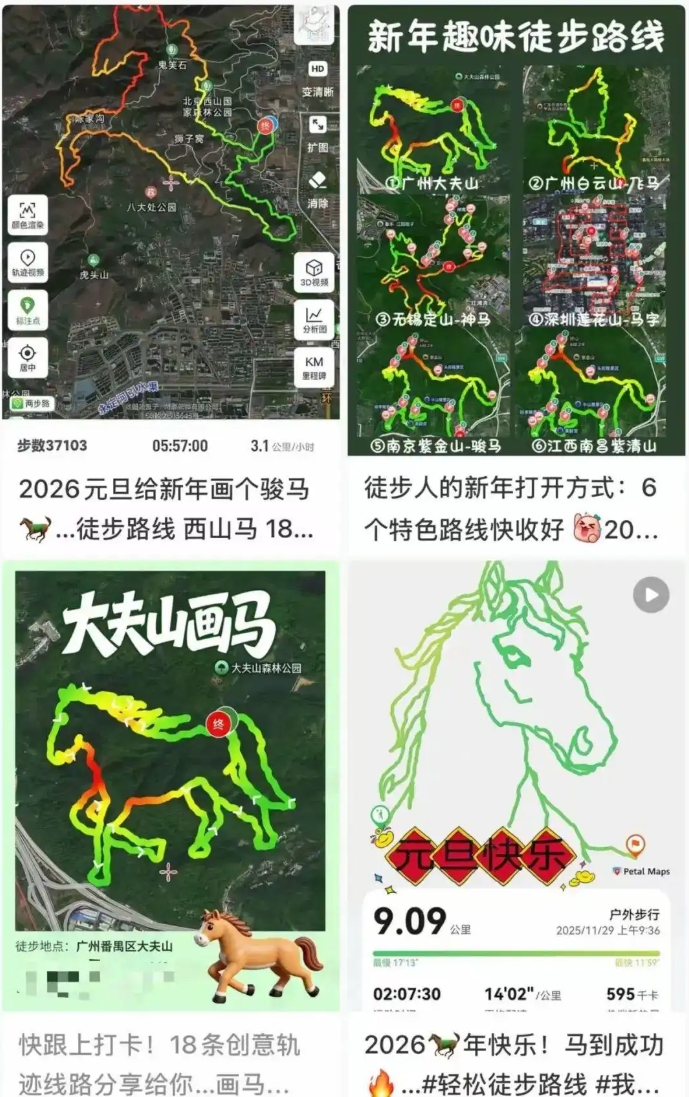
'Horse drawing' hikes
As the Year of the Horse approaches, a new hiking trend is galloping across China: using one's feet as a brush, the landscape as a canvas and a GPS device to "draw" a horse on a digital map. From group treks on Longquan Mountain in Southwest China's Sichuan Province to viral "galloping horse" routes in Beijing's Western Hills, this creative blend of traditional zodiac culture and outdoor adventure has quickly taken off on social media. Participants, often covering 10 to 20 kilometers on foot, infuse their journeys with New Year wishes, turning a symbol of tradition into a lively, interactive ritual.Yet, a recent controversy surrounding a "99 percent wild trail" in Dafushan Forest Park in Guangzhou, South China's Guangdong Province, has sounded an alarm for this creative hiking trend.
Dabbling in the undeveloped wilderness is no simple game. The controversial route in Guangzhou covers 14.08 kilometers, with a cumulative elevation gain of over 1,300 meters, while 99 percent of it is unmarked wild trails. Some sections have slopes as steep as 80 degrees, requiring hikers to scramble up inclines, navigate dense forests, and even slide down slopes.
More dangerously, this area lacks mobile phone signals, supply points, and safety signage, while snakes and insects are an occasional threat. In the event of an emergency, rescue teams would struggle to locate and reach those in need. This "fatal attraction" of internet-fueled adventure is not rare: on the banned Aotai Trail in the Qinling Mountains, three hikers lost their lives earlier in January, according to the People's Daily.
To balance exploration and safety, a "combination of restriction and guidance" offers a sustainable path for popular outdoor activities. Instead of simply banning the trend, Dafushan Forest Park responded by closing dangerous sections, erecting barriers and warning signs, and - most notably - collaborating with local cultural and tourism authorities and professional surveyors to launch an official 16.95-kilometer "horse drawing" route. This new path preserves the creative essence of the original design while avoiding hazardous terrain, with clear guidance and facilities suitable for families and beginner hikers, the People's Daily reported.
Luo Le, a sports scholar at the Beijing University of Chemical Technology, told the Global Times on Tuesday that this "combination of restriction and guidance" not only respects public creativity but also protects safety and the environment.
On January 9, China's General Administration of Sport issued a notice calling for stricter regulation of internet-famous hiking and climbing routes. The guidelines require authorities to identify key routes, install safety warnings, strengthen joint enforcement, and penalize illegal cross-country attempts.
Luo also pointed out that the General Administration of Sport has clearly promoted the values of "scientific, civilized, safe, and eco-friendly" outdoor sports. For spontaneous activities like "horse drawing" hikes, officials should not only provide safe, recommended routes but also guide participants to seek information from authoritative sources, such as official platforms, to ensure that passion for the outdoors is always backed by knowledge and safety.
The author is a reporter with the Global Times. life@globaltimes.com.cn
RELATED ARTICLES