Illustration: Liu Rui/GT
Editor's Note:2026 marks the commencement of China's 15th Five-Year Plan (2026-30), a pivotal phase in the nation's medium- to long-term development. A successful venture starts with a good plan and with clear goals set. At this critical juncture, where a profound restructuring of the global order converges with a tipping point in the technological revolution, China's Five-Year Plan is poised to inject momentum and certainty into global development, charting a steady course for the new journey ahead.
In its newly launched "New Blueprint, New Opportunities" series, the Global Times (GT) invites Nobel laureates in economics, former central bank governors, core decision-makers of international organizations and renowned economists from countries with diverse civilizations, different economic systems and stages of development, to deeply analyze how the 15th Five-Year Plan will reshape the underlying logic of China's interaction with the world and to explore the "anchor of certainty" and "new paradigm of development" that this plan is to offer for a turbulent world.
In the first installment of the series, GT reporter Wang Wenwen talked to James Heckman (Heckman), an American economist and Nobel laureate. Heckman shared his opinions on China's new engines for economic development and its commitment to further opening-up.
GT: Many countries have plans for their future development directions, while China formulates development plans with a five-year cycle. What is your view on China's five-year development plans?
Heckman: Generally, the Chinese government and the companies are very pragmatic. They try ideas, they experiment and they will pull out of something that's not working. I've been visiting various provinces in China. What impressed me is the number of social experiments that have been conducted by those governments to try out different policies. These are done strictly from the point of view of trying to understand how to improve the well-being of people in those provinces. It's not like some public displays, but rather a sense of trying to look at the data and seeing whether or not a particular policy, for example, a pension policy or welfare policy, works or doesn't work. The same would be true for subsidization and promotion of certain industries. I do believe that pragmatism works well for China. I think the leaders are listening to people who are giving them sound and sincere advice about what will help the Chinese people and the Chinese economy best.
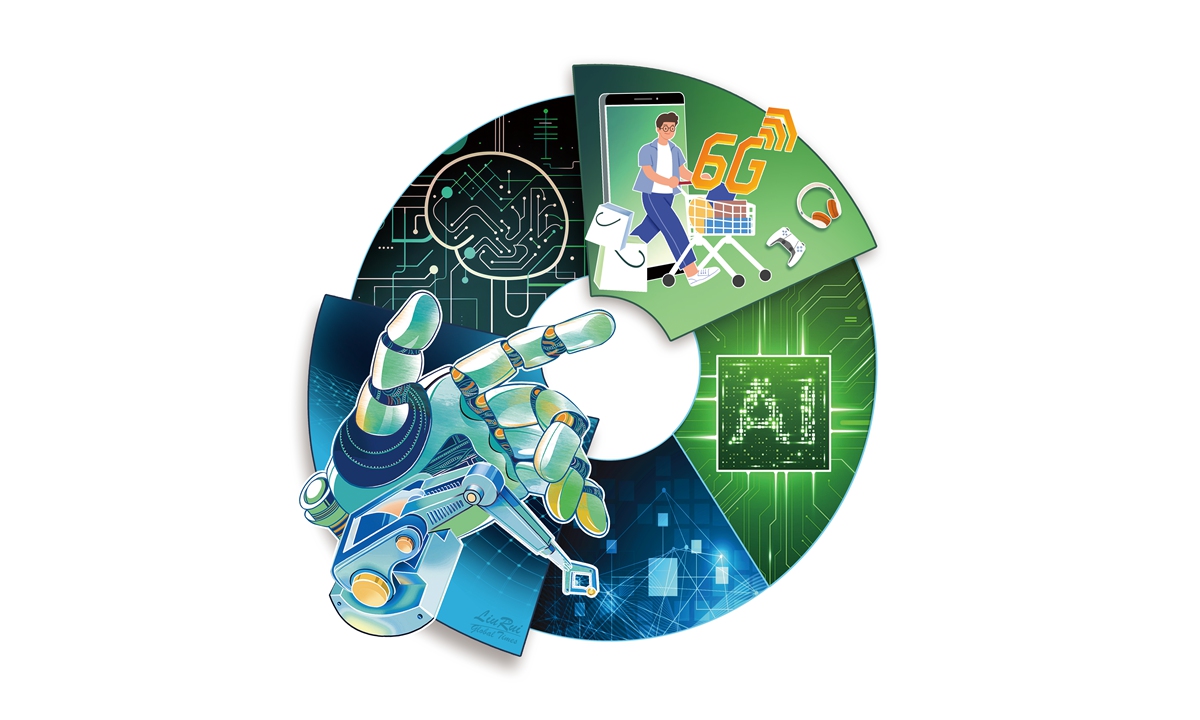
GT: China plans to turn next-generation industries, including quantum technology, bio-manufacturing, hydrogen energy and fusion energy, brain-computer interfaces, embodied intelligence and sixth-generation mobile communications, into new engines for economic growth. How do you see these "new engines" for economic development in the coming period?
Heckman: It's reasonable and it'll work out. China has a very strong set of universities and research units. It's right at the edge of breaking through on its own and getting recognized for what it is. China has major scientists and there are a lot of good ideas and a lot of good work being done at Chinese research institutions.
One thing I found very useful and very valuable for the world of science and technology is that China is so "aggressive" in producing new ideas and supporting research on new things. It's wise not only from the perspective of strategic defense, but also it's wise to invest in science and give China the initiative and the ability to essentially create new technologies, like quantum computing - that's a very important idea.
In the early dynasties there was discouragement of scholarly learning and humanistic learning. Here I think China has a great advantage in technology and science and proven ability. Chinese scientists, mathematicians, engineers and economists are really making quite a splash in the world.
GT: China prioritizes the building of a robust domestic market to navigate rising external uncertainties. Against the backdrop of global economic weakness, do you think China's strong domestic market can be regarded as the "capital" for China's economic development?
Heckman: Historically, the reason why the US developed so much in the 20th century was it had the largest domestic market. The sheer size of it allowed there to be specialization and development at a scale that was not possible in a smaller country, for example, France or Germany or England.
Now China has a wonderful capacity. And the savings rate in China is very high. That's a stimulus for entrepreneurs to meet the consumer demand, so I think it's an engine for growth. I do believe it's an untapped resource.
More affordable consumption goods and higher quality goods will open up a big demand and open up the advantage for Chinese consumers. The living standard is not just a matter of how much the GDP is. It's what the per capita consumption is. Also, China is facing another issue that many countries in Asia and the US and many countries in Europe are facing - declining growth in the population. That creates a demand for a different kind of service and provision.
GT: You are highly concerned about the development of AI technology and its integration with industries. The Chinese government has proposed promoting the in-depth integration of technological innovation and industrial innovation in the coming years. What suggestions do you have for this?
Heckman: To make AI effective, we have to implement learning systems. AI has a lot of possibilities. Think of something like DeepSeek, a highly effective generative technology. It shocked the world. It was cheap, highly effective, much less demanding than ChatGPT and many of the other cloud programs that were around at the time. You have to have a workforce and a way that the workforce implements AI to make it effective. For instance, generative AI can scan the literature and find out the best way to do this and provide a way to essentially avoid the reliance on memory, which is a huge limitation for humans. The potential of AI is endless. What you have to do is get a reasonably skilled workforce willing to take an adventure. And I'd say the best way for China to implement AI is to allow people the freedom to fail.
GT: Despite the rise of unilateralism and protectionism, China holds the view that economic globalization is an irreversible historical trend and has stated that it will unswervingly expand opening-up. What is your take on this firm stance of China?
Heckman: I'm glad China is opening up. I think the American policy ignores the basic principles of economics, which is the gains from trade, the gains from specialization. We're already seeing it now in the US when Trump implements his tariffs. It's a very bad economic policy. We've had, for 20 or 30 years, a growing link - trade. If you look at the net effect, the whole idea that China is threatening and closing down the American economy is a misperception. America gains from trading with China. We know that. It's been studied by competent economists. The trouble is this [US] administration is not open to ideas from people who are doing serious research. They are very much political and not pragmatic. This is a case where democracy in the US is working in a very negative way, because all these politicians promise to do things, without showing why they work.
China is trying to keep the country's trading and trying to gain. China is more commonsensical about what the costs and benefits are. There's wiser planning about public expenditure, but in the US accountability is very low. At this stage, China is wiser and smarter in how its public policy is being informed and crafted.
RELATED ARTICLES