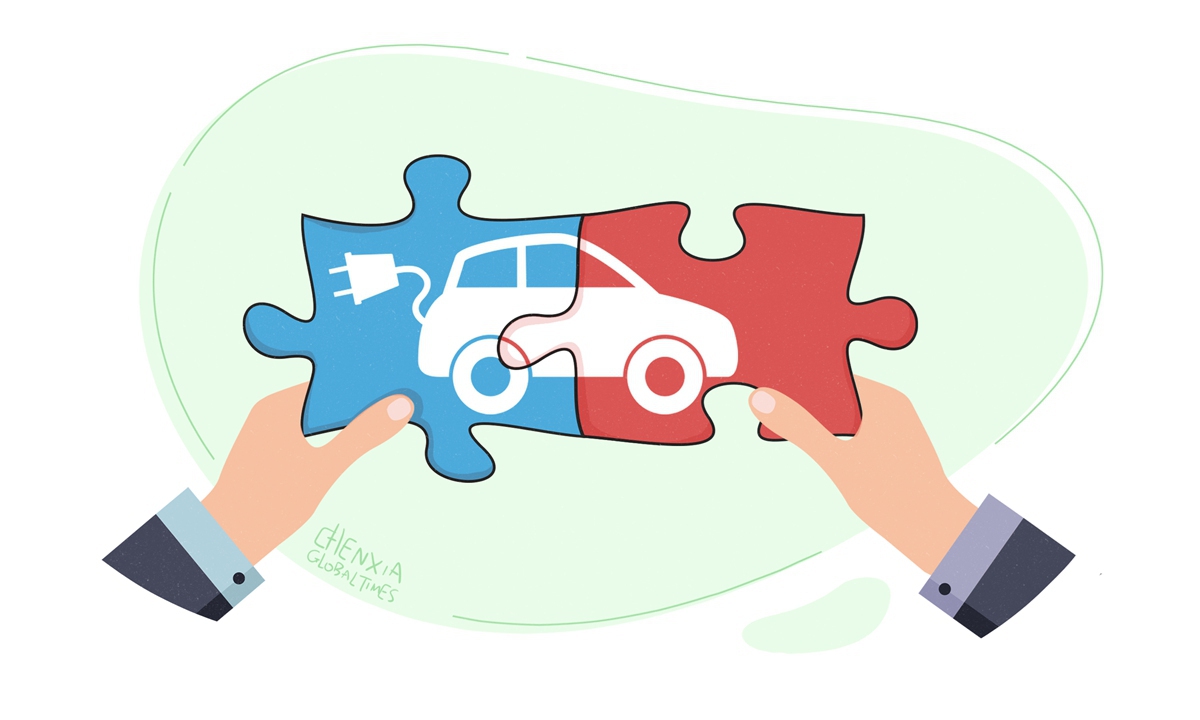
Illustration: Chen Xia/GT
Germany will reintroduce subsidies ranging from 1,500 euros ($1,745) to 6,000 euros for private consumers purchasing electric vehicles (EVs), the environment ministry announced on Monday, reviving incentives that were halted at the end of 2023, the Xinhua News Agency reported. Notably, the subsidy program will be open to all manufacturers, including Chinese brands, and the German government will not impose origin-based restrictions, Bloomberg reported on Monday.The global vehicle industry is at a pivotal moment in its electrification, as mounting environmental concerns and tighter climate regulations make a transition to cleaner, sustainable energy imperative. Nowhere is this tension more concentrated than in Germany, the bloc's largest car producer. Against this backdrop, Germany's latest subsidy program goes beyond merely bolstering its domestic auto industry - it sends a signal that carries meaningful implications for the broader trajectory of industrial development and the EU's climate objectives, warranting close attention.
First, the policy underscores Germany's determination and sense of urgency in advancing the electrification of its auto industry. As a traditional powerhouse with a solid industrial foundation and deep technological expertise, Germany faces pressure from both global carbon neutrality goals and industrial transformation. The subsidy program is designed to lower the consumer cost barrier, stimulate market demand, and thereby create vital market space and economies of scale for domestic automakers' electric offerings, fostering the upgrading and restructuring of the entire industrial chain.
Second, Germany's move reflects a pragmatic and rational consideration. At a press conference on Monday, German Environment Minister Carsten Schneider expressed confidence in European and German brands, noting that "I cannot see any evidence of this postulated major influx of Chinese car manufacturers in Germany, either in the figures or on the roads - and that is why we are facing up to the competition and not imposing any restrictions."
Beyond its domestic implications, this subsidy policy aligns with the EU's broader climate ambitions. In December 2025, EU negotiators agreed to a binding 2040 climate target to cut net greenhouse gas emissions by 90 percent compared with 1990 levels, a European Parliament press release said.
Yet, growing evidence suggests that it remains a formidable challenge for the EU to rely solely on local brands to supply a sufficiently diverse and affordable range of EVs in the short term. Thus, introducing competitive, cost-effective products, including those from China, presents a realistic pathway to rapidly boost adoption rates for EVs and keep the bloc's climate agenda on track.
It is also noteworthy that Germany's latest move comes just days after China and the EU agreed on price undertaking guidance for Chinese EV makers. According to the statement released by China's Ministry of Commerce last week, China and the EU conducted multiple rounds of consultations in the spirit of mutual respect, and both sides believe it is necessary to provide general guidance on price undertakings for Chinese exporters exporting EVs for passengers to the EU, thereby enabling them to address relevant concerns in a way that is more practical, targeted, and consistent with WTO rules.
This important consensus lays a constructive foundation for two of the world's major economies to resolve trade disputes through consultation and dialogue, setting a positive and much-needed example at a time when the global economy is facing a rising trend of unilateralism and protectionism, marked by high tariffs.
These developments open more predictable avenues for cooperation between China and Germany, and between China and the EU at large, in the EV sector. China has accumulated notable advantages in battery technology, intelligent driving, and industrial chain integration, while Germany retains deep strengths in vehicle engineering, brand management, and global market channels. The strong complementarity between the two sides offers considerable potential for collaboration.
Germany's subsidy policy sets a noteworthy example. Amid rising protectionism, its embrace of competition to "grow the pie" charts a forward-looking path for the domestic industry's sustainable development and points to a collaborative direction for the electrification of the automotive sector.
RELATED ARTICLES