Canadian military’s reported modeling of response to hypothetical US invasion highlights rift between allies, reflects sense of crisis: expert
By and Liang Rui Published: Jan 20, 2026 11:51 PM

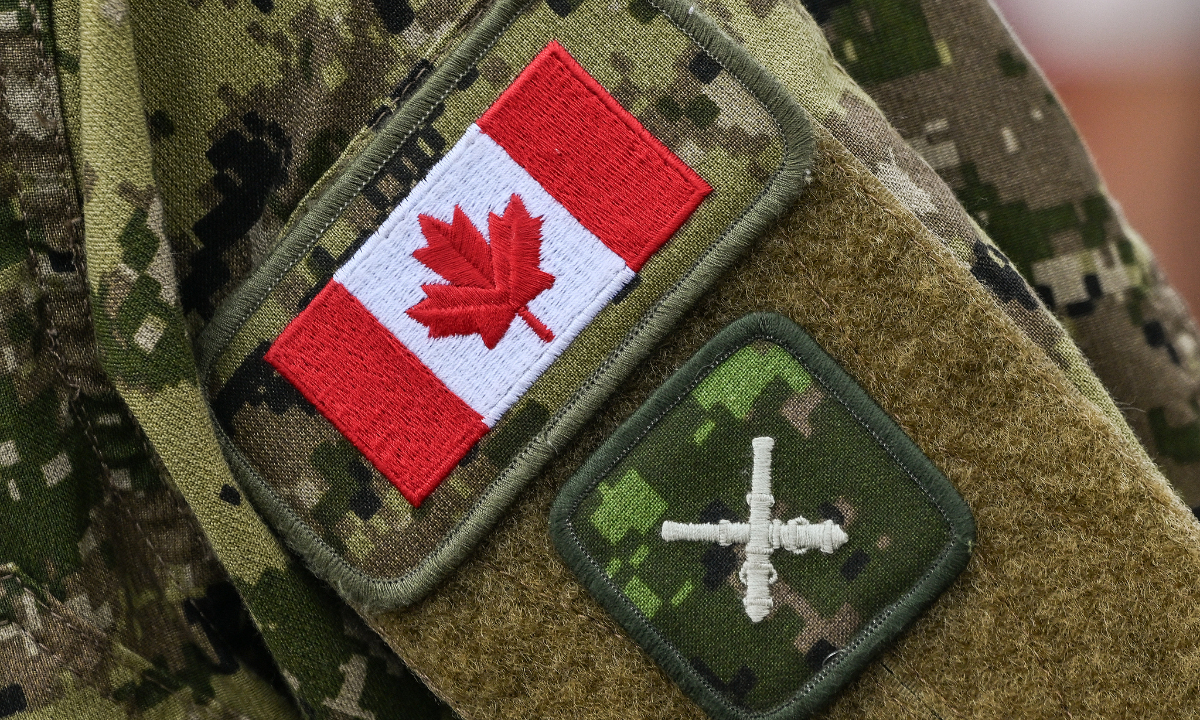
The Canadian flag and Royal Regiment of Canadian Artillery (RCA) Gunner L1 badges are visible on a soldier's sleeve as members of the Canadian Armed Forces engage with visitors at a promotional stand during a summer festival in Edmonton, Alberta, Canada, on July 18, 2025. Photo: VCG
The Canadian Armed Forces have modeled a hypothetical US military invasion of Canada and the country’s potential response for the first time in a century, according to a Canadian media report on Tuesday. A Chinese expert said that Canada’s reported move highlights the growing rift between the two allies amid the US’ territorial claims, and reflects Canada’s sense of crisis as well as a certain level of preparedness to not succumb to US bullying.
Citing two senior government officials, Canadian media outlet The Globe and Mail reported on Tuesday that Canada’s potential response to the hypothetical US military invasion includes tactics similar to those employed against Russia and later US-led forces in Afghanistan.
The two senior government officials said military planners are modeling a US invasion from the south, expecting American forces to overcome Canada’s strategic positions on land and at sea within a week and possibly as quickly as two days, The Globe and Mail reported.
Canada does not have the number of military personnel or the sophisticated equipment needed to fend off a conventional American attack, they said. So, the military envisions unconventional warfare in which small groups of irregular military or armed civilians would resort to ambushes, sabotage, drone warfare or hit-and-run tactics, according to the Canadian report.
One of the officials said the model includes tactics used by the Afghan mujahedeen in their hit-and-run attacks on Russian soldiers during the 1979-1989 Soviet-Afghan War. These were the same tactics employed by the Taliban in their 20-year war against the US and allied forces that included Canada. The aim of such tactics would be to impose mass casualties on US occupying forces, the official said.
Retired major-general David Fraser, who commanded Canadian troops in Afghanistan alongside the US, said Canada could also use drones and tank-killing weapons like the ones used in the ongoing Russia-Ukraine conflict, according to The Globe and Mail.
A senior Defense Department official said Canada would have a maximum of three months to prepare for a land and sea invasion. The first indications that invasion orders had been sent would be expected to come from US military warnings that Canada no longer has a shared skies policy with the US, The Globe and Mail quoted a source as saying.
This rupture in the joint defense agreement would likely see France or Britain, nuclear-weapon states, being called on to provide support and defense for Canada against the US, according to the report.
The Canadian report noted that the US President Donald Trump has been challenging NATO allies with repeated calls for the US to acquire Greenland and threats to impose tariffs on European countries who oppose the takeover, and that Trump has also repeatedly talked about Canada becoming the 51st state of the US.
The Globe and Mail also noted that despite Canada having created a model of an American assault on the country, the officials, along with a number of experts, say it is unlikely the Trump administration would order an invasion of Canada.
Zhang Junshe, a Chinese military affairs expert, told the Global Times on Tuesday that as the report suggests, the Canadian military is no match for the US military in a frontal conflict, as the two countries’ ground, naval and air forces are not at a comparable level at all – not to mention that Canada has long depended on the US for its national defense.
The potential Canadian response mentioned in the report is a form of asymmetric warfare, Zhang noted. He said that Canada is a country with vast territories, and its forces are supposed to be stronger than those of Afghanistan, so it should pose a high level of threat to the US.
Against the backdrop of the US’ territorial claims on Greenland and even Canada itself, the Canadian military’s modeling of a hypothetical US military invasion of Canada and the country’s potential response seems to be a strong signal, reflecting Canada’s sense of crisis, and demonstrating to the US that Canada won’t easily succumb to US bullying, Zhang said, noting that it is also possible that Canadian officials are attempting to create a deterrence.
At least, the situation indicates that a rift is looming large between the two old allies, Zhang said.
RELATED ARTICLES