‘Board of Peace’ resembles a club that turns the world into the ‘law of the jungle’
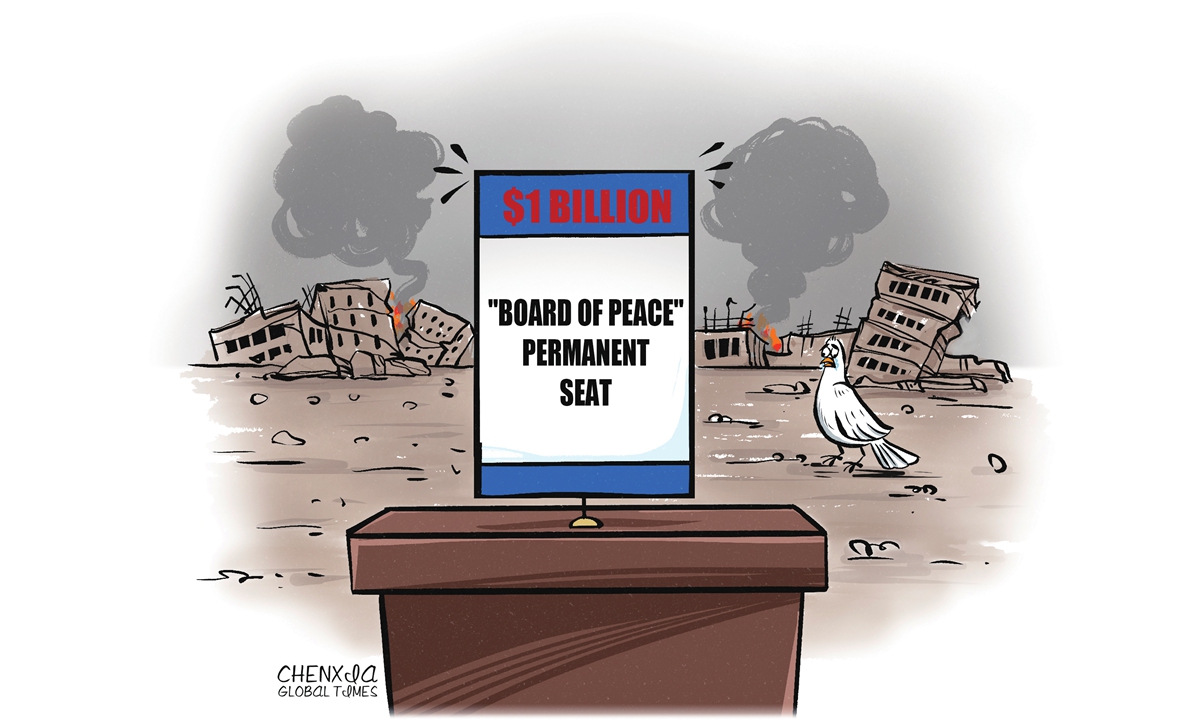
Illustration: Chen Xia/GT
US President Donald Trump on Tuesday threatened to impose 200 percent tariffs on French wines and champagne after French President Emmanuel Macron was reported to be unwilling to join his "Board of Peace" on Gaza, according to media reports.
The so-called Board of Peace is part of a "20-point peace plan" proposed by the US to end the Israel-Hamas conflict in the Gaza Strip. According to the draft charter of this board, it will be chaired by Trump. Membership would be by invitation from the chairman, who would hold key authority over terms, renewals and removals. What shocked the international community even more was that the US plan openly priced the board's "permanent seats" at $1 billion each. This act of "privatizing" international affairs and "commodifying" regional peace not only disregards the will of the Palestinian people but also poses a huge challenge to the existing international governance system and norms of conduct.
The current Israel-Palestine conflict has lasted nearly 30 months, and the humanitarian crisis in Gaza continues to worsen. The White House's push to form a "Board of Peace" is primarily aimed at demonstrating US influence over the situation in Gaza. However, this institution, which should be responsible for peace in Gaza, is a typical product of "transactional diplomacy." The nomination list is filled with US politicians and their cronies, but conspicuously absent is the most critical stakeholder - the Palestinians. This "absence" has drawn widespread criticism from the international community, with some even suggesting it reveals the institution's "colonial" nature - attempting to privately outline Gaza's future without the consent of the Palestinian people.
Even more shocking is the White House's explicit offer of a "permanent seat" for $1 billion. This move reduces the solemn cause of international peace to a game of money. Gaza's future should not be a commodity to be bought; under the influence of capital and hegemonic will, it will find it difficult to achieve true peace.
Judging from the proposed charter of the "Board of Peace," this mechanism is unlikely to resolve the current crisis and may even poison the political landscape of the Middle East. First, it has not prioritized the imminent humanitarian crisis in Gaza, instead focusing more on the capital operations of postwar reconstruction.
Second, this board seriously hinders a comprehensive and just solution to the Palestine-Israel issue. The US-led Gaza peace plan not only eliminates the political role of the Palestinian National Authority in Gaza but also establishes a so-called Board of Peace controlled by external forces above the Palestinian technocratic committee. In essence, this replaces sovereign governance with external intervention, undermining the political foundation of the "two-state solution." The US thereby deprives Palestinians of their fundamental right as a state to handle their own affairs, effectively further dividing the Gaza Strip from the West Bank and making a just and lasting peace even more unattainable.
Third, this move has severely impacted the global governance system. The current Gaza crisis is a brutal illustration of the disorderly state where "might makes right." If peace seats can be bought and major powers can arbitrarily establish their own systems outside the existing international order, the fairness of the postwar international order will be undermined. This "club governance" model reduces international law to a private contract among major powers, forcing the world back into the law of the jungle.
To truly resolve the Israel-Palestine issue, we must return to the international order of fairness and justice. Any arrangements regarding the postwar governance of Gaza must be discussed within the framework of the UN and must fully respect the fundamental principle of "Palestinians governing Palestine." Genuine peace should be built on the basis of the "two-state solution" and the restoration of the legitimate rights of the Palestinian people, not on a "small group" privately established by a hegemonic power. The international community should be wary of the dangerous tendency to place geopolitical games above international law and ensure that the reconstruction of Gaza is the reconstruction of justice, not an expansion of hegemony.
The author is a research fellow with the China Institute of International Studies. opinion@globaltimes.com.cn
RELATED ARTICLES