Beijing becomes China's second city with GDP exceeding 5 trillion yuan, after Shanghai
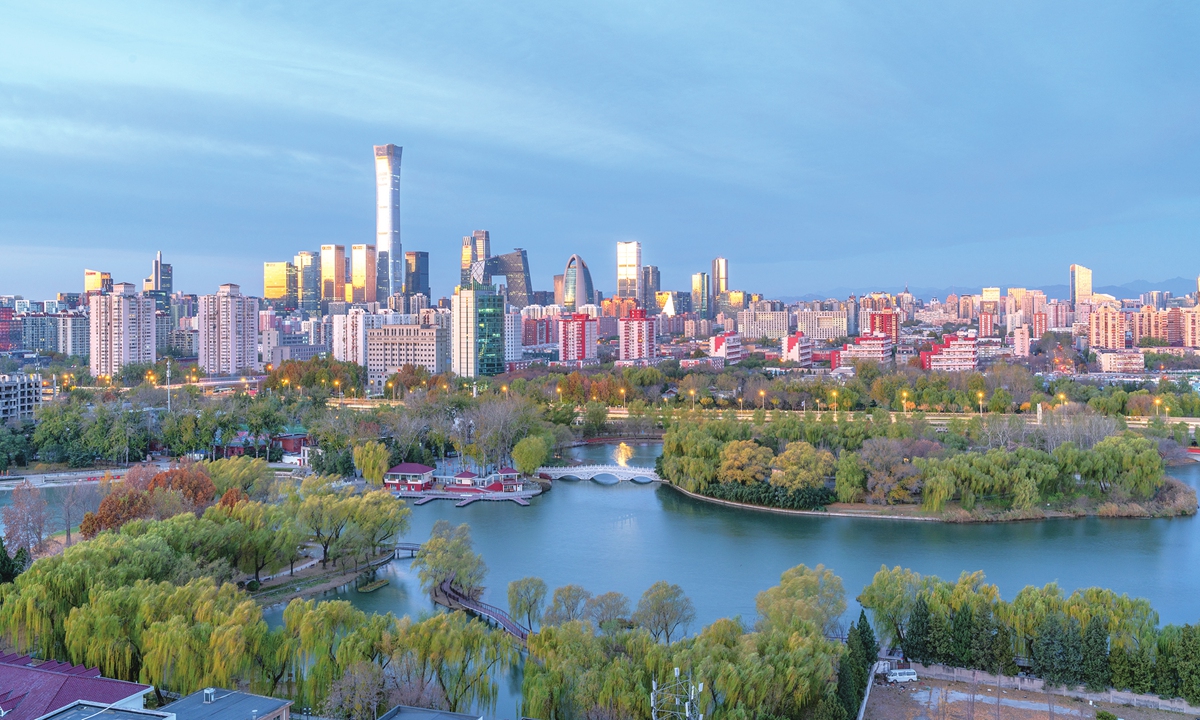
A sunrise view over Honglingjin Park and the CBD area in Beijing on November 20, 2025 Photo: VCG
Following Shanghai, Beijing has officially become the second Chinese city to surpass 5 trillion yuan ($718 billion) in GDP, the latest data on Wednesday showed. This progress stems from an optimization of Beijing's economic structure, with high-end, sophisticated, and cutting-edge industries empowering the growth, observers said.
According to data released by the Beijing Municipal Bureau of Statistics on Wednesday, Beijing's regional GDP reached 5.21 trillion yuan in 2025, up 5.4 percent year-on-year.
Shanghai's GDP totaled 5.67 trillion yuan in 2025, up 5.4 percent year-on-year, the municipal statistics bureau released on Wednesday. This followed the city's GDP topping 5 trillion yuan to reach 5.39 trillion yuan in 2024, making it the first city in China to reach such milestone.
Beijing's GDP in 2024 reached 4.98 trillion yuan, approaching the 5 trillion yuan milestone.
In 2025, the sectors of information transmission, software and information technology services, finance and industry contributed more than 80 percent to the city's overall economic growth, providing solid foundation for bolstering the capital city's economic resilience, according to Beijing Municipal Bureau of Statistics.
The information transmission, software and information technology services sector increased by 11.0 percent year-on-year, recording value-added of 1.22 trillion yuan, and the value-added of finance sector surged by 8.7 percent, reaching 866.82 billion yuan, official data showed.
Both the 2025 annual economic performance and the achievements during the 14th Five-Year Plan period (2021-25) demonstrated the continued optimization of Beijing's economic structure. This progress stems from a full embrace of "high-end, sophisticated, and cutting-edge" industries, with new quality productive forces serving as a key engine for high-quality development, according to the Xinhua News Agency.
The digital economy value-added now accounts for over 40 percent of the city's GDP. The top three industries, namely information services industry, finance industry and manufacturing, provide strong support to Beijing's economic growth. Beijing's information services industry maintains the largest scale nationwide. High-end sectors, such as integrated circuits and new-energy vehicles (NEVs), have achieved rapid growth.
In 2025, the value-added of industrial enterprises above designated size grew 6.5 percent year-on-year on a comparable basis. Among them, strategic emerging industries and high-tech manufacturing increased by 15.5 percent and 7.5 percent respectively. Output of NEVs surged 1.4 times, lithium-ion batteries grew 1.2 times, service robots up 47.6 percent, and wind power generating units up 21.6 percent, highlighting the increasingly prominent advantages of innovation-driven industries.
Innovation remains the major driving force behind socioeconomic development. In recent years, Beijing's whole-society R&D expenditure intensity has consistently hovered around 6 percent.
On average, more than 300 new tech companies are established every day, and Beijing leads the nation in the number of registered and launched large-scale artificial intelligence models.
According to the leading 200 science cities list released by Nature Index in November, Chinese cities occupied six spots in the top 10, with Beijing holding the No. 1 position.
Global Times
RELATED ARTICLES