China expresses grave concern, vows measures to protect Chinese firms after reports of EU draft plan to phase out ‘high-risk’ tech suppliers
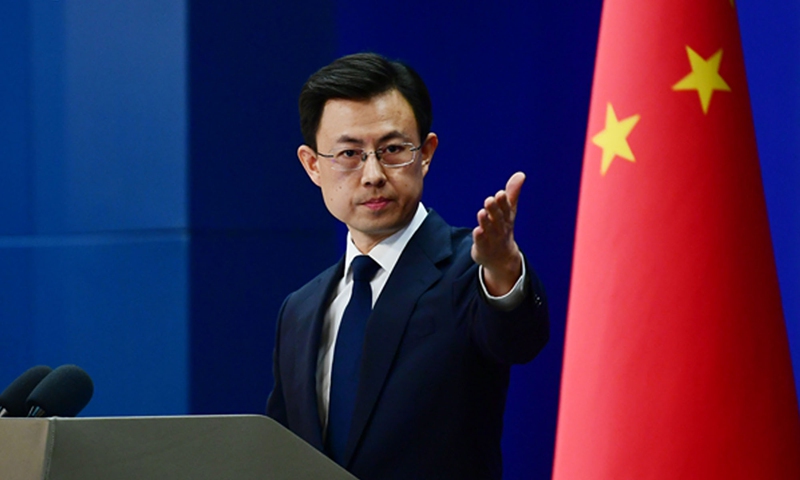
Photo: Chinese Foreign Ministry spokesperson Guo Jiakun
China on Wednesday expressed grave concern over reports that the EU plans to phase out components and equipment from so-called high-risk suppliers in critical sectors, and slammed the EU for using security as a pretext for political manipulation, urging the bloc to avoid going further down the wrong path of protectionism and vowing to protect Chinese companies' lawful rights and interests.
The European Commission (EC) dismissed the sheer fact that Chinese companies have provided secure and high-quality products, and that China and the EU have sound foundation and potential for cooperation in digital network industry, but used security as a pretext for political manipulation, Chinese Foreign Ministry spokesperson Guo Jiakun said on Wednesday.
Guo made the comments in response to reports that the EC rolled out a new cybersecurity package on January 20 and on the basis of a 5G security "toolbox," the EU plans to forcibly de-risk Europe's telecommunication networks by weeding high-risk third-country suppliers, and some commentators believe the so-called "high-risk suppliers" have a political undertone, which aims to remove Chinese companies from Europe's telecom networks citing security risks.
The EU plans to phase out components and equipment from high-risk suppliers in critical sectors, according to a draft proposal released by Brussels on Tuesday -- a move criticized by China's Huawei, which is set to be among the companies affected, Reuters reported.
The measures were set out by the EC in revisions to the EU's Cybersecurity Act, Reuters reported. It claimed that the move was driven by what it described as a rise in "cyber and ransomware attacks," alongside growing concerns over "foreign interference, espionage," and "Europe's reliance on non-EU technology suppliers."
Commenting on the EU move, Guo said that this not only gravely hinders the EU's technological progress and economic growth, but also tarnishes its reputation for an open market and saps foreign companies' confidence in investing in the EU.
"We urge the EU to stop pursuing the wrong path of protectionism. China will do what is necessary to defend Chinese companies' lawful rights and interests," Guo said.
Chinese companies have long been conducting lawful operation in Europe and are law-abiding and high-quality providers for the EU's telecom and digital sector. They are never a security threat to European countries, the spokesperson noted.
He said that to forcefully limit or ban companies from the market without any evidence and based on non-technical standards seriously violates market principles and fair competition. This act of protectionism is yet another example of turning normal cooperation to political and security issues.
Attempts to arbitrarily intervene in the market and violate economic rules don't make one country safer but pay huge price. Facts prove that in a handful of countries, phasing out quality, safe and secure Chinese telecom equipment not only stifles digital and cyberspace advancement, but also causes huge economic loss, he said.
Chinese analysts also noted that pushing the proposal through would face significant practical challenges in implementation, while forcibly advancing so-called "de-risking" measures against China could bring a range of adverse consequences for European industries.
According to Reuters, the new measures will apply to 18 key sectors identified by the EC, including detection equipment, connected and automated vehicles, electricity supply and storage systems, water supply systems, and drones and counter drone systems, said the report. Cloud services, medical devices, surveillance equipment, space services and semiconductors are also classified as critical.
Driven by geopolitical rivalry and ideological considerations, some EU politicians have continued to push a so-called "de-risking" agenda targeting China, Zhang Jian, a vice president at the China Institutes of Contemporary International Relations, told the Global Times on Wednesday. However, industrial cooperation between China and the EU is mutually beneficial and delivers tangible gains for EU member states, making it hard for Brussels to build broad internal consensus around exclusionary measures based on speculative or unsubstantiated risk assumptions, Zhang said.
"The EU's latest proposal reflects a shift toward a more mandatory and coercive stance on restricting Chinese technology. However, attitudes toward — and demand for — cooperation with China in technology and critical infrastructure vary widely across the bloc," said Zhao Yongsheng, a research fellow at the Institute of Regional and International Studies at the University of International Business and Economics in Beijing. Even if Brussels attempts to push the proposal through, it is likely to face substantial practical obstacles at the implementation stage, Zhao said.
Both Chinese analysts said that restricting or banning companies' market access through administrative measures is a serious violation of market principles and fair competition rules.
"A legislative proposal to limit or exclude non-EU suppliers based on country of origin, rather than factual evidence and technical standards, violates the EU's basic legal principles of fairness, non-discrimination, and proportionality, as well as its WTO (World Trade Organization) obligations," a Huawei spokesperson said, according to Reuters.
"We will closely monitor the subsequent development of the legislative process and reserve all rights to safeguard our legitimate interests," the spokesperson said.
RELATED ARTICLES