Aurora staged in many places across China as the planet experiences 6 hours of severe and moderate geomagnetic storming
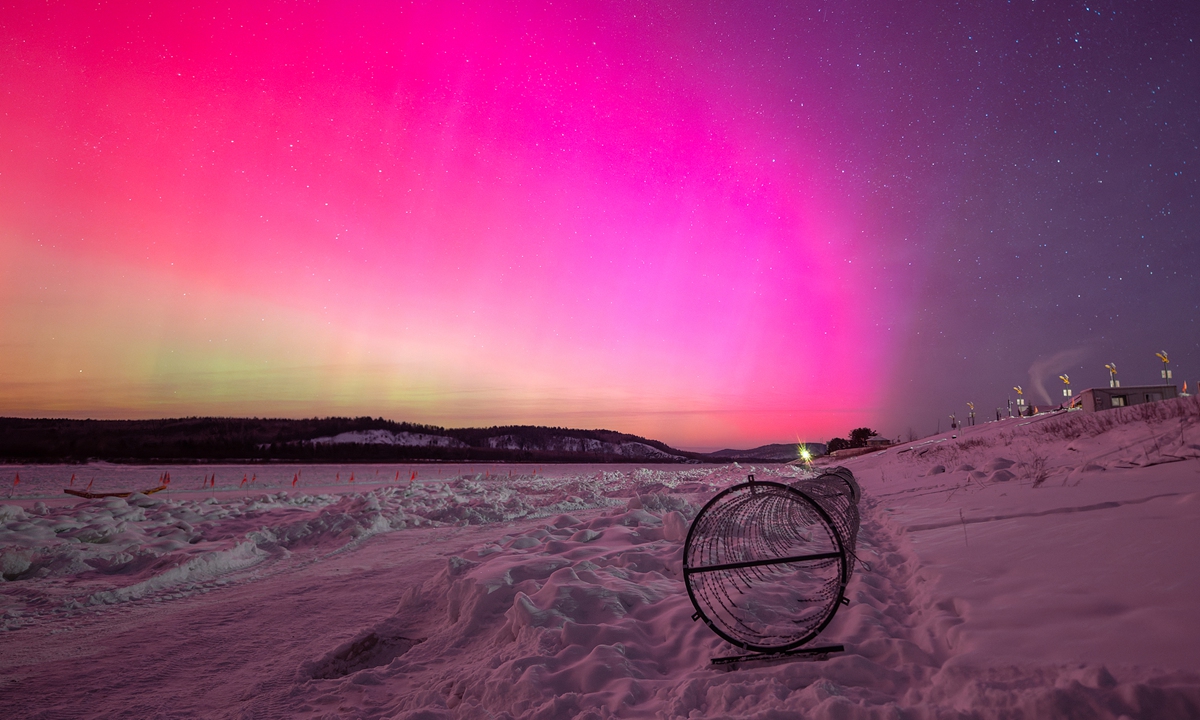
A rare and magnificent aurora appears in the sky over Northeast China's Heilongjiang Province due to the influence of a geomagnetic storm on the early morning of January 20, 2026, in Luoguhe village of Mohe city. Photo: VCG
Aurora shows have been staged in many places across China on Tuesday night, media reports showed. A geomagnetic storm began affecting Earth from 02:00 on January 20. By 20:00 that day, the planet had experienced 6 hours of severe geomagnetic storming and 6 hours of moderate geomagnetic storming.China's Fengyun-3H meteorological satellite has also captured images of the aurora from space, providing a clear visual indication of which regions are experiencing the phenomenon, China's Central Television reported.
On Chinese social media, netizens have been sharing photos and videos of the aurora. One particularly spectacular display appeared in the sky over Luoguhe village in Northeast China's Heilongjiang Province, painting the entire night sky with brilliant pink. Many users posted posts wishing themselves good luck.
Based on current solar activity, China Meteorological Administration has forecast that over the next three days, solar activity is expected to remain at moderate levels, with a possibility of M-class or higher solar flares.
Under the combined influence of coronal holes and coronal mass ejections (CMEs), a minor geomagnetic storm is possible on Wednesday. Geomagnetic activity is predicted to range from quiet to active on Thursday. Due to the potential occurrence of these geomagnetic storms, ionospheric conditions may experience disturbances, according to the administration.
As one of the most typical forms of solar eruptive activity, a single coronal mass ejection can hurl billions of tons of solar material away from the sun's surface at speeds of hundreds of kilometers per second, an article by People's Daily wrote.
This material not only carries the kinetic energy of its enormous mass and speed, but also transports the sun's powerful magnetic energy. When such an ejection reaches Earth, it can trigger changes in the direction and strength of Earth's magnetic field—a phenomenon known as a geomagnetic storm, per People's Daily.
The report said that geomagnetic storms have no direct impact on the human body. The variation in the magnetic field caused by a geomagnetic storm is actually very small—weaker than the magnetism of common household items such as refrigerator magnets or magnetic hooks.
However, geomagnetic storms can pose certain risks to spacecraft and satellite operations. During a storm, satellites and space stations may experience increased atmospheric drag, leading to orbital decay. Operators must therefore enhance orbital monitoring and perform necessary orbital adjustments. Satellite navigation signals may also incur larger positioning errors, though the impact on everyday public use of navigation services is generally minimal.
In addition, intense geomagnetic activity can interfere with the migration and navigational abilities of certain animals. For instance, homing pigeons, which rely on solar and geomagnetic cues for navigation, can be significantly affected during strong geomagnetic storms, People's Daily reported.
Global Times
RELATED ARTICLES